


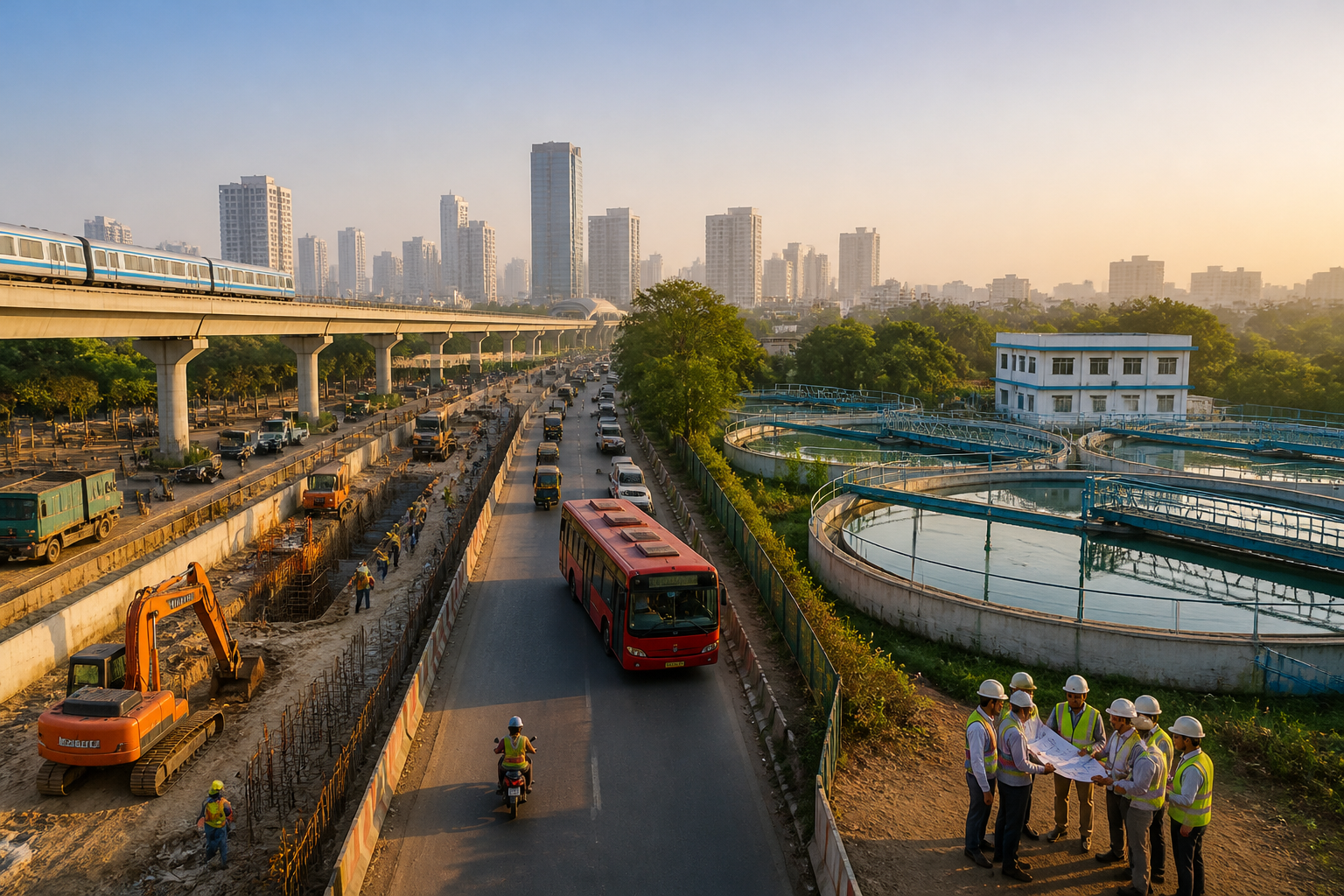
India’s urban financing debate is moving beyond the question of how much money cities receive to whether they can prepare, finance and maintain projects that investors consider bankable. Finance Minister Nirmala Sitharaman’s call for a combination of public investment, stronger municipal finances, development finance and private capital places that institutional challenge at the centre of the country’s urban development agenda.
Speaking at the World Bank-IMF Annual Meetings in Bangkok on the theme of mobilising private capital for urban and water infrastructure, Sitharaman said India needs cities that are both financially sustainable and capable of attracting investment. Her remarks connect several existing government programmes with a broader attempt to build a pipeline of urban projects that can move from public policy announcements to credible implementation.
The most significant instrument in this framework is the Urban Challenge Fund. The government has allocated Rs 1 lakh crore in central assistance with the stated aim of catalysing Rs 4 lakh crore in total urban investment. Cities compete for assistance through challenge mode, with support linked to project appraisals and commitments to reforms in governance, planning and municipal finance.
That design changes the role of central assistance. Instead of treating public funding only as a direct source of project expenditure, the framework envisages it as a means of supporting project preparation, closing viability gaps, improving local capacity and attracting additional capital. Sitharaman said public funds would help mobilise investment rather than replace government funding.
This distinction is important because many urban projects do not fail only because construction finance is unavailable. They also struggle with weak preparation, uncertain demand, unclear procurement arrangements and inadequate systems for recovering costs and maintaining assets. The finance minister said cities must develop a pipeline of bankable projects supported by technically sound designs, realistic demand assessments, life-cycle cost estimates and credible procurement and implementation arrangements.
The emphasis on project preparation places municipal institutions at the centre of the financing model. A city may have a clear need for water infrastructure, transport improvements or other urban services, but the need alone does not make a project investable. A project must also demonstrate how it will be designed, procured, financed, operated and maintained over its life.
This is where the Urban Challenge Fund’s project-preparation and capacity-building components become significant. The fund provides support at national, state and city levels, according to the account of Sitharaman’s remarks. That structure recognises that urban infrastructure is delivered through multiple layers of government and that municipal bodies may not always have the technical or financial capacity to prepare projects on terms acceptable to lenders and private investors.
The approach builds on an existing public investment framework. Sitharaman cited the Atal Mission for Rejuvenation and Urban Transformation, the Smart Cities Mission and the Swachh Bharat Mission as programmes that have supported the expansion and modernisation of essential urban services over the past eight to nine years. These programmes have created a base of public investment, but the new financing emphasis is on linking such expenditure with reforms and the mobilisation of private capital.
The proposed financing architecture therefore has three connected parts. Public investment remains necessary to provide basic services and support inclusion. Development finance and central assistance can help prepare projects and bridge gaps where revenues are insufficient. Private capital can then be brought into projects that have credible designs, demand assessments, procurement systems and payment arrangements.
The model does not remove the importance of government spending. Urban services often have wider social benefits that cannot be recovered fully through user charges or commercial returns. A public role is therefore required both to fund essential services and to ensure that investment is not limited to projects with the strongest revenue potential.
At the same time, Sitharaman’s formulation places pressure on cities to improve their own financial and administrative systems. The Urban Challenge Fund links assistance with reforms in governance, planning and municipal finance. This means that access to central support is intended to be associated with measurable institutional commitments rather than treated as an unconditional transfer.
The framework also includes a specific financing mechanism for smaller urban local bodies. The fund’s Rs 5,000 crore credit repayment guarantee sub-scheme is aimed at eligible urban local bodies with populations below one lakh. Its stated purpose is to help these bodies access finance for urban development projects. The guarantee component acknowledges a difficulty faced by smaller municipalities: even when a project is necessary, local institutions may struggle to obtain credit because their repayment capacity and financial systems are not strong enough for conventional lending.
A repayment guarantee can address part of that barrier, but it does not by itself create a viable project. The wider framework still depends on project preparation, realistic demand assessments, credible procurement and arrangements for operation and maintenance. The central financing design therefore treats credit access and institutional capacity as related problems rather than separate ones.
The government’s City Economic Region approach adds a regional layer to this agenda. The approach was taken up from February 1, when the Budget for 2026-27 was presented, according to Sitharaman. Budget 2026-27 proposed Rs 5,000 crore per City Economic Region over five years through challenge mode and reform-cum-results-based financing.
Regional planning matters because urban infrastructure rarely stops at municipal boundaries. Land use, transport, water systems and other services can operate across adjoining jurisdictions, while planning and financial responsibility may remain divided between separate local bodies. Sitharaman said regional planning can improve land-use efficiency, reduce duplication of infrastructure and services, and establish clearer accountability for ownership, payments and maintenance.
This regional focus also expands the meaning of an investable city. It is not only a city with a project that can attract finance. It is a wider urban economy with coordinated land use, infrastructure planning and institutional responsibility. If neighbouring jurisdictions build overlapping systems or cannot agree on who owns and maintains an asset, even a technically sound project can face operational and financial problems.
The policy language around investability also reveals a shift in how urban development is being framed. Cities are being treated as economic systems that require long-term financial planning, not only as locations where individual infrastructure projects are constructed. The emphasis on life-cycle costs suggests that the government is seeking to account for the expenditure required after construction, including operation, maintenance and eventual renewal.
However, the supplied account does not establish how each reform will be measured, which projects will qualify or how private capital will be allocated across different types of urban infrastructure. It also does not specify the implementation timetable for individual projects under the Urban Challenge Fund or the City Economic Region approach. Those details will determine how the financing framework works in practice.
What is clear is the direction of policy. Public investment will remain the foundation for essential urban services, while central support is increasingly being designed to improve project preparation, strengthen municipal finances and draw in other sources of capital. Challenge-based funding is intended to reward reform commitments and results, while guarantees are intended to widen access for smaller urban local bodies.
The larger urban question is whether Indian cities can build the institutional systems needed to convert capital into reliable services. Money can support a project, but bankability also depends on technical design, demand assessment, procurement, payment systems and maintenance responsibilities. The government’s current approach recognises this by placing municipal finance and project preparation alongside construction funding.
Sitharaman’s remarks therefore signal an effort to connect India’s urban programmes into a more structured financing pipeline. The evidence available so far confirms the scale of the proposed public support and the intended role of private capital, but not yet the results of implementation. The key developments to monitor will be the projects selected through challenge mode, the reforms adopted by participating cities, the use of the repayment guarantee for smaller municipalities and the extent to which regional planning produces clearer financial and operational accountability.

