


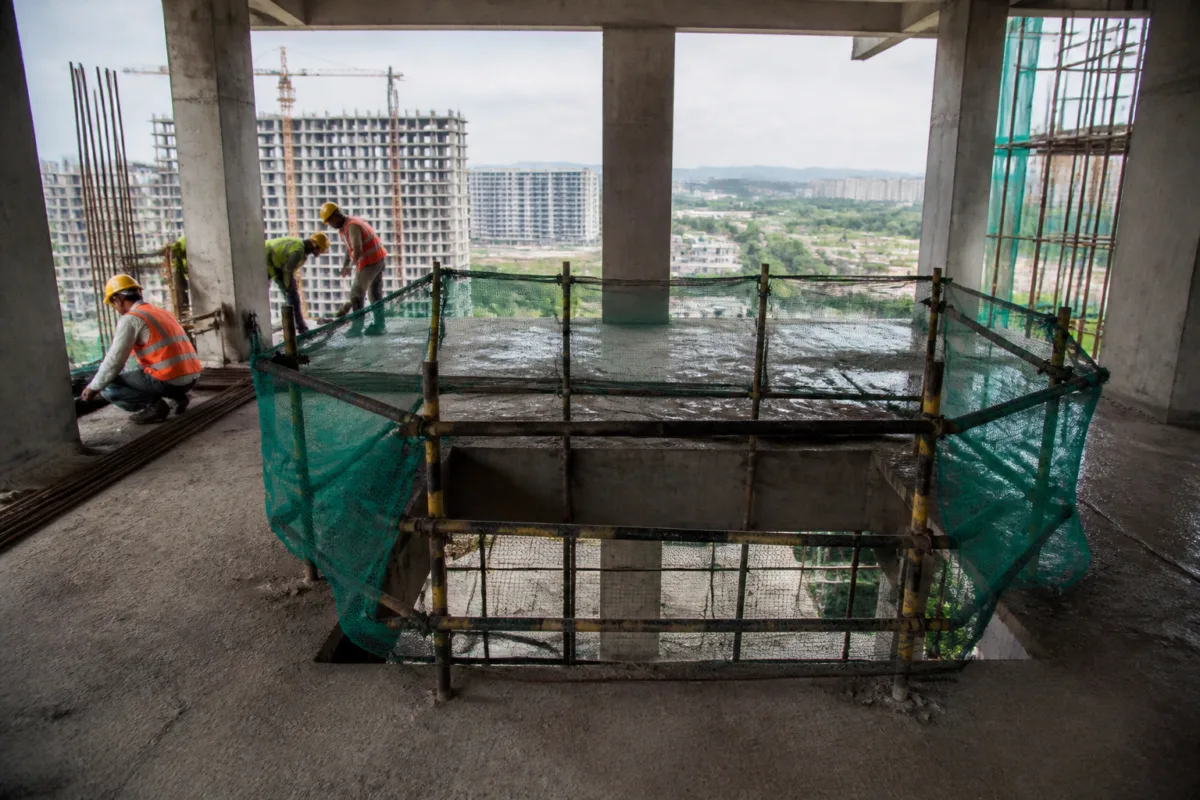
The death of 40-year-old construction worker Vinod Nisad after he fell into a lift pit at an under-construction high-rise in Dronagiri has exposed a basic but consequential question in Navi Mumbai’s expanding construction belt: who is responsible for ensuring that unfinished buildings do not become lethal workplaces? Uran police have registered a case against developer Nimishbhai Vora after the incident at a building in Sector 47, where Nisad allegedly fell from the second floor while carrying out tile-cutting work.
According to the report by Times of India – Mumbai, the incident occurred on Monday. Nisad sustained head and other grievous injuries after falling into the lift pit and was taken to a hospital, where he died. His body was handed over to relatives after a post-mortem examination. Police have booked the developer for causing death by negligence and under other relevant sections of the Bharatiya Nyaya Sanhita. The investigation is continuing.
The immediate case is about one fall at one construction site. Its wider importance comes from the setting: Dronagiri is one of the urbanised areas of Uran taluka where multiple high-rise buildings are under construction. The node is being developed by the City and Industrial Development Corporation, or Cidco. As construction expands across such areas, the safety of workers depends not only on the conduct of individual contractors and developers but also on whether inspections, site controls and enforcement operate consistently.
The report alleges that there was no safety belt or other safety equipment at the site. That allegation is central to the police case, but it remains subject to investigation. The available account does not establish whether the site had a documented safety plan, whether safety equipment had been issued and used, who supervised the work, or whether any inspection had taken place before the fall. Those unanswered questions matter because a lift shaft in an incomplete building is a visible and foreseeable hazard, particularly when floors are being used by workers before the structure is occupied.
Nisad was engaged in tile-cutting work and reportedly lost his balance on the second floor before falling into the lift pit. The sequence illustrates how construction risks are often created by the interaction of ordinary tasks and incomplete building conditions. Tile work requires workers to move around unfinished floors, openings and edges. When a shaft is not securely covered or protected, a momentary loss of balance can turn into a fatal fall. The report does not provide details about the physical barriers at the opening, the condition of the floor, or the presence of supervisors. These will be important parts of the continuing investigation.
The case also shows why construction-site safety cannot be treated as a private matter between a worker and a builder. A worker’s death affects a family that may depend on wages earned at a site far from the worker’s home. Nisad was originally from Maharajganj district in Uttar Pradesh. The report says that such incidents can leave families without a means of survival, underlining the economic vulnerability that can follow a workplace fatality. The available material does not state the number of dependants or the compensation, if any, offered to the family. Those details remain important to understanding the full impact of the death.
Dronagiri’s development context adds an institutional layer to the incident. Cidco is developing the node, while private builders are constructing individual high-rise projects. The report alleges that builders have benefited from minimum checks not being carried out by authorities. That is an allegation rather than an established finding, but it raises a clear governance question: how are responsibilities divided between the development authority, local enforcement agencies, project promoters and contractors when a construction site remains unsafe?
The report does not identify the specific authority responsible for the alleged missed checks, nor does it say whether the site had received any notice, approval or inspection before the accident. It also does not indicate whether the police investigation will examine the contractor, site engineer, safety officer or other people involved in the work. Without those facts, responsibility cannot be assigned beyond the police action already reported against the developer. The distinction is important: registering a case begins an investigation; it does not by itself establish criminal liability.
Still, the incident points to a gap between the pace of urban construction and the visibility of construction governance. High-rise projects create multiple stages of risk before a building becomes a finished asset. Lift shafts, staircases, balconies, slab edges and service openings can remain exposed while different categories of workers move through the site. The report’s reference to an incomplete high-rise and an unprotected lift pit shows how the unfinished building itself formed part of the hazard environment.
The available evidence also reveals the limits of routine incident reporting. It records the worker’s fall, the injuries, the police case and the alleged absence of safety equipment. It does not provide a site inspection report, a statement from the developer, a response from Cidco, details of the construction contractor or information about earlier safety complaints. It does not establish whether similar incidents have occurred in Dronagiri or whether the site was operating in breach of a specific requirement. Those omissions should be addressed as the investigation progresses rather than filled through assumption.
For urban authorities, the institutional challenge is to ensure that safety checks are not reduced to paperwork. A construction project passes through multiple administrative and physical stages, but a worker encounters the site in real time. The protection required at an exposed shaft must exist when the worker reaches the floor, not only when a plan is approved or an inspection is recorded. The report does not establish how Dronagiri’s inspection system functions, how frequently sites are checked or what enforcement follows a violation. Those are the administrative facts needed to assess whether the case reflects an isolated failure or a wider weakness.
The numbers in this case are limited but significant: one 40-year-old worker, a fall from the second floor, a lift pit, a site in Sector 47 and a police case under the BNS. They describe the immediate event but not the full scale of the risk across the node. The report says many high-rise buildings are under construction in urbanised parts of the taluka, but it gives no total number of projects, workers, inspections or accidents. That missing baseline makes it impossible to quantify the safety problem, even though the urban expansion that creates the risk is clearly documented.
The central question is therefore not only what happened to Nisad, but what the investigation will establish about the chain of responsibility around the site. It should clarify the condition of the lift pit, the safety equipment available, the supervision of tile-cutting work, the identity of the contractor and the inspection history of the building. A response from the developer and Cidco would also establish whether the reported allegations are contested and what corrective action, if any, has been taken.
The police investigation is the next formal step. Until it produces further findings, the confirmed facts are that Nisad died after falling into a lift pit at an under-construction high-rise in Dronagiri, Uran police registered a case against the developer, and the report alleges that safety equipment was absent. The case will show whether accountability stops with an individual prosecution or prompts closer scrutiny of construction-site safety across a rapidly developing node.

