


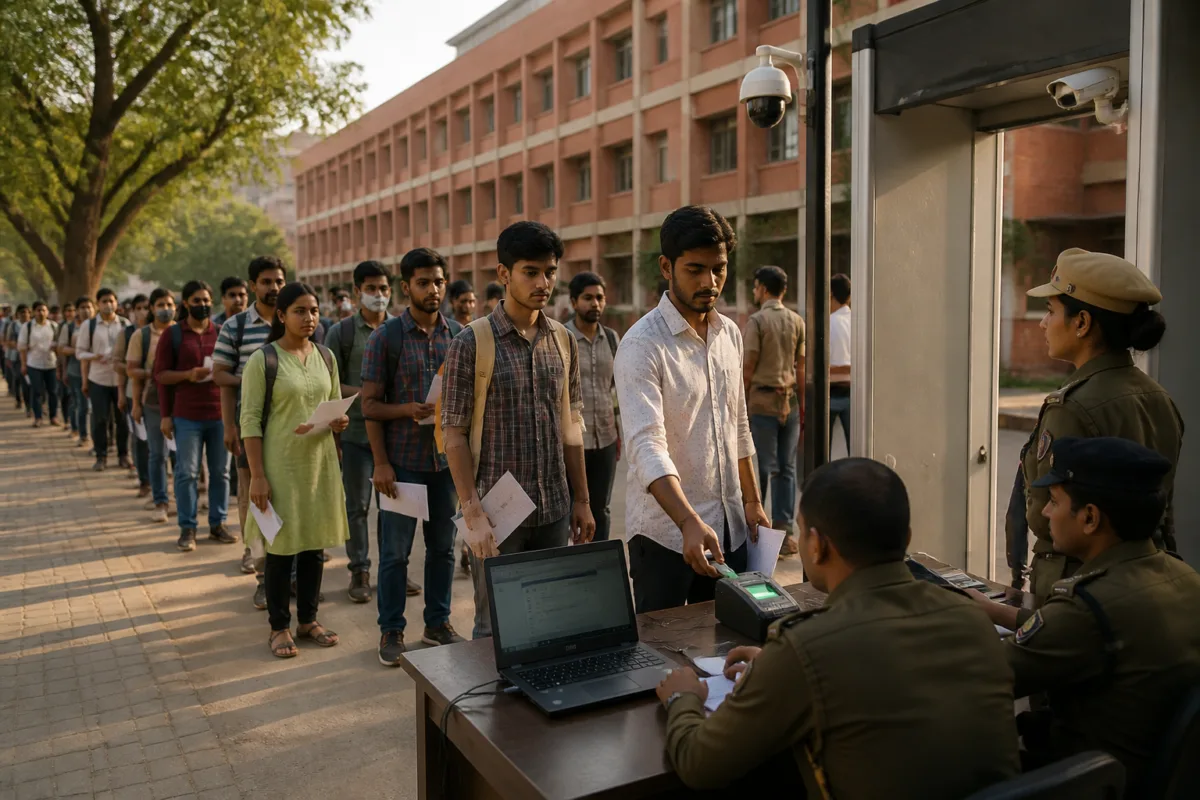
The Uttar Pradesh Subordinate Services Selection Commission’s PET-2026 examination ended with 68.79% attendance and 67 candidates flagged for further scrutiny through AI-based facial matching, as authorities used Aadhaar authentication, biometrics and an extensive surveillance network across the state.
The examination was held over three days—October 25, October 30 and November 1—in six shifts at 1,372 centres spread across 60 districts. Of the 35.41 lakh candidates who registered for the state’s largest recruitment screening examination, 24.36 lakh appeared, according to information reported by The Times of India.
The state government said the examination concluded peacefully under a multi-layered security and surveillance system intended to prevent impersonation, cheating and other irregularities. For the first time on such a scale, authorities combined AI-based facial recognition with Aadhaar authentication and biometric verification to establish candidate identities.
Photographs and iris scans were also captured during the verification process. Surveillance at examination centres was supported by 31,602 CCTV cameras connected to a central command centre at the commission headquarters and monitoring hubs at the district level. The arrangement placed the examination within a larger administrative system involving centralised monitoring, identity authentication and district-level enforcement.
Nearly 94,000 personnel were deployed for the examination, along with 2,744 sector and static magistrates. Candidates underwent mandatory frisking before entering the centres, while mobile phones, Bluetooth devices, smartwatches and other electronic gadgets were prohibited inside examination halls. Signal jammers were installed at centres in 20 districts as part of the measures against unfair means.
The commission said its AI-based facial matching system flagged 67 candidates as suspicious for further scrutiny. Two first information reports were registered during the examination period. In the latest reported case, an FIR was lodged in Mainpuri on November 1 after a Bluetooth device was recovered from a candidate.
The scale of the examination also required transport and traffic coordination across the participating districts. Authorities operated special transport services, prepared traffic management plans and established district-level helplines to support candidate movement and address operational issues.
The examination’s conclusion leaves the commission with the task of examining the flagged cases and processing the results under its recruitment framework. The reported use of facial recognition, iris scans, Aadhaar authentication and biometric verification marks a significant expansion of technology-led identity and security controls in a high-volume public examination.

