


Udaan’s plan to pursue an initial public offering by the end of 2027 or the first quarter of 2028 is more than a familiar startup recovery story. It is a test of whether a business-to-business commerce company can build durable value by concentrating on a smaller number of urban markets instead of chasing national scale at any cost.
The company, which once supplied shopkeepers in about 80 Indian cities, has pulled back to roughly 16 clusters and narrowed its focus to groceries and staples. According to CEO Vaibhav Gupta, the reset is beginning to show in the numbers: Udaan expects FY26 revenue to grow 10 to 12 per cent, while losses are expected to narrow by about 20 per cent. Gupta has also said the company is targeting full profitability by the end of 2027.
The urban significance lies in what changed between the earlier expansion strategy and the current one. Udaan is no longer presenting growth primarily as a question of entering more markets. It is concentrating on how much procurement activity it can capture within existing markets, how frequently retailers place orders, how large those orders are and how efficiently goods move through warehouses and delivery networks.
That shift places the city, rather than the national map, at the centre of the business model.
### From geographic reach to city-level density
Udaan’s earlier strategy was built around reach. It offered a broad range of goods, including food staples, groceries and fast-moving consumer goods, to retailers across a large number of cities. The company subsequently reduced its footprint and exited select non-essential categories. Revenue declined by more than half from its peak, and FY25 revenue fell 20 per cent to ₹4,561 crore.
The contraction came with a financial cost, but it also changed the basis on which the company evaluates growth. Udaan’s net loss narrowed to ₹1,055 crore in FY25, down 37 per cent from the previous year. Losses had already fallen from ₹2,075 crore in FY23 to ₹1,674.1 crore in FY24, making FY25 the third consecutive year of narrowing losses.
The company says revenue grew at an approximate 25 per cent compound annual growth rate between the fourth quarter of calendar year 2023 and the first quarter of calendar year 2026. Over the same period, contribution margin increased by nearly 500 basis points and EBITDA burn declined by about 70 per cent.
These figures do not establish that the turnaround is complete. They do show the operating logic behind the reset: fewer, denser markets can make it easier to use warehouses, consolidate procurement and reduce the cost of serving each order. Udaan has said Bengaluru and several other major clusters are already EBITDA-profitable, while its management has described the company’s supply-chain cost structure as among the lowest in the country.
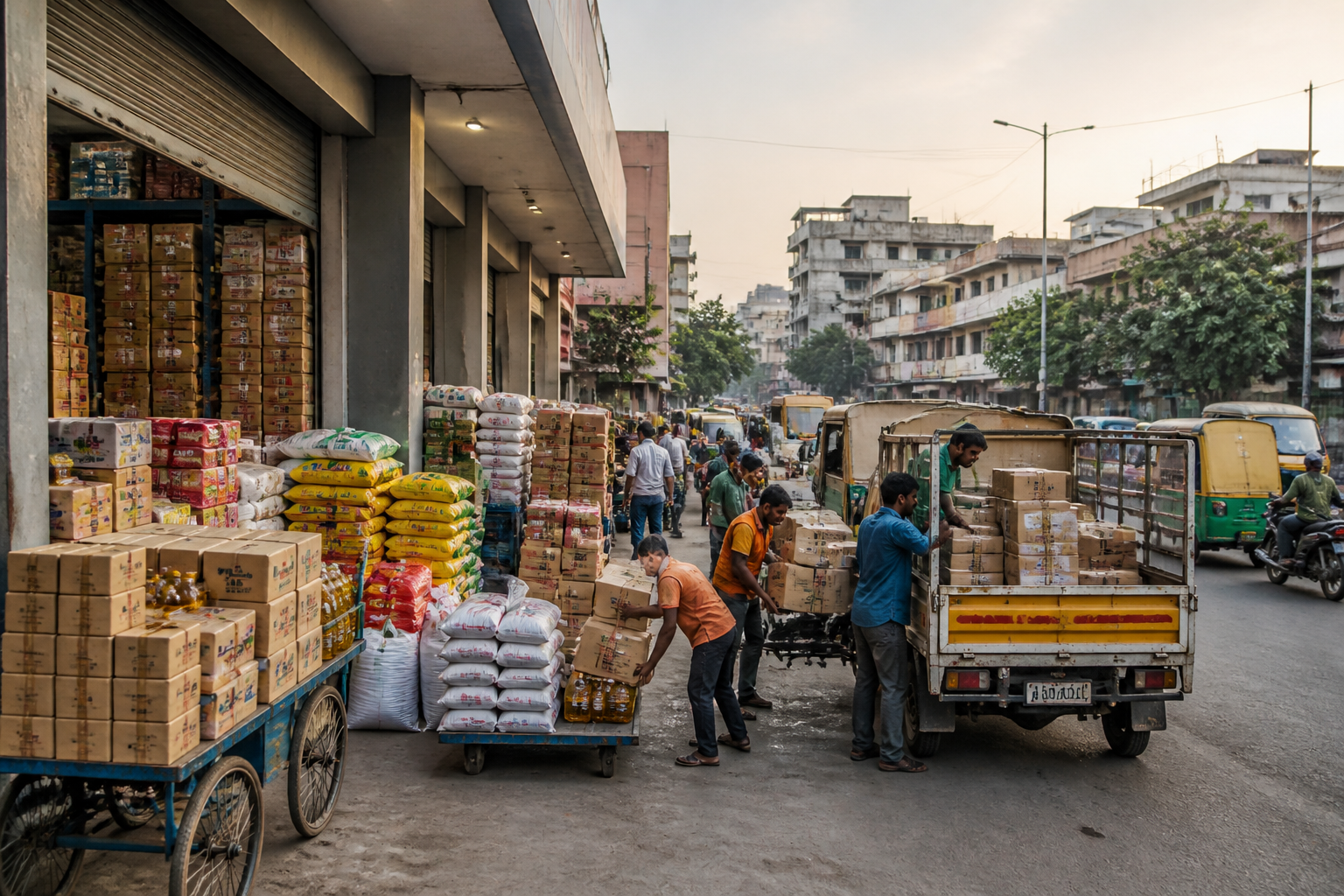
For urban markets, density matters because distribution is not simply a digital transaction. It depends on physical storage, replenishment, transport routes, delivery frequency and the concentration of customers who can be served within a workable network. A platform with more orders in an established cluster can potentially improve utilisation without making the same level of infrastructure investment required to enter an entirely new market.
### The infrastructure behind a B2B order
The public image of e-commerce often centres on apps, payments and customer acquisition. Udaan’s current strategy highlights the less visible infrastructure underneath the transaction: sourcing systems, warehouses, fulfilment operations, distribution capacity and the retailer relationships that determine repeat demand.
Gupta told Business Standard that the company has moved beyond scale to focus on “market economics and revenue quality”, including wallet share, purchase frequency and contribution per order. In practical terms, this means that a retailer’s repeated use of the platform may be more valuable than simply adding another retailer to the network.
This is particularly relevant to the way neighbourhood commerce operates. Udaan’s customers are retailers, while its wider distribution system serves the movement of everyday goods into local markets. The company expects much of its growth to come from existing retailers ordering more frequently, purchasing larger baskets and using Udaan for more categories. Its stated opportunity is to win a larger share of existing retailers’ procurement spending rather than rely mainly on customer acquisition or geographic expansion.
That model makes operational performance a shared responsibility across the organisation. Udaan says category and city leaders are now assessed not only on revenue or gross merchandise value, but also on contribution margin, retention, order frequency, basket size, procurement efficiency and fulfilment costs. Procurement teams are responsible for sourcing economics, category teams for range and availability, city teams for retention and frequency, and operations teams for fulfilment costs.
The arrangement reflects a broader principle of urban logistics: the financial outcome of a delivery network is shaped by multiple decisions that are made at different points in the system. Product availability affects order frequency. Order density affects delivery economics. Warehouse utilisation affects the cost of each shipment. Retailer retention affects whether that infrastructure is used repeatedly.
### Revenue quality is now tied to the network
Udaan is also attempting to improve the mix of business flowing through its existing network. Private labels account for 15 to 25 per cent of staples sales across its operating cities, according to the report. Its horeca360 business is expanding procurement and distribution services for hotels, restaurants, caterers and other institutional buyers.
In Bengaluru, private labels and HoReCa together contribute about half of Udaan’s revenue. This is important because the company is trying to increase wallet share without rebuilding the entire business around new cities. A denser base of demand can give the same sourcing and distribution network more uses, provided the additional business does not add disproportionate fulfilment costs.
The acquisition of Swiggy-owned LYNK Logistics for ₹500 crore in an all-share deal is another part of that strategy. Swiggy received about 2.8 per cent of Udaan and invested a further ₹75 crore. Udaan said the combination would add distribution capacity and retail reach in markets that align with its cluster-led approach.
The transaction also shows that the company is choosing a combination of owned and acquired capabilities rather than attempting to build every component internally. Gupta described the deal as a way for the two businesses to become stronger on the B2B side. The available information does not establish how the acquisition will affect Udaan’s consolidated profitability, but it does indicate that distribution reach remains central to the company’s next phase.
### The IPO question is really a profitability question
Udaan’s proposed IPO timeline has been revised over several years, making profitability the more important test than the listing date itself. The company has promised a public listing for five years, while the current plan is for the end of 2027 or the first quarter of 2028.
A $160 million recapitalisation announced in July 2026, combining fresh equity, new debt and debt-to-equity conversion, strengthened the balance sheet and simplified the capital structure. It followed a $114 million Series G financing in 2025. These transactions provide financial support for the turnaround, but the company will still need to demonstrate that operating improvements can persist across the business.
Gupta has said Udaan is now profitable in all the cities where it operates and has a high single-digit market share in those cities. He also said the company could continue growing at 25 to 30 per cent annually in those markets for the next four or five years, before addressing what he described as another 1,000 potential cities.
Those comments reveal the tension in the company’s strategy. The first phase of the turnaround has depended on restraint: fewer clusters, tighter categories and greater attention to unit economics. The next phase may require deciding when additional geographic expansion strengthens the network and when it begins to dilute the density that made the existing markets more efficient.
The distinction matters for cities because expansion is not costless. New markets require procurement links, storage capacity, delivery systems, retailer acquisition and management attention. The company’s own reset suggests that a larger footprint does not automatically produce a stronger urban distribution network.
Udaan’s planned IPO will therefore be judged on more than whether revenue resumes growth. The central question will be whether its cluster-led model can convert local density into sustained profitability while expanding access to a much larger set of cities. The evidence supplied so far shows improving margins, falling losses, stronger performance in selected clusters and additional distribution capacity through LYNK. It does not yet establish whether those gains can be maintained at national scale. The company’s profitability target by the end of 2027 and its proposed listing in late 2027 or early 2028 will provide the next formal milestones.

