


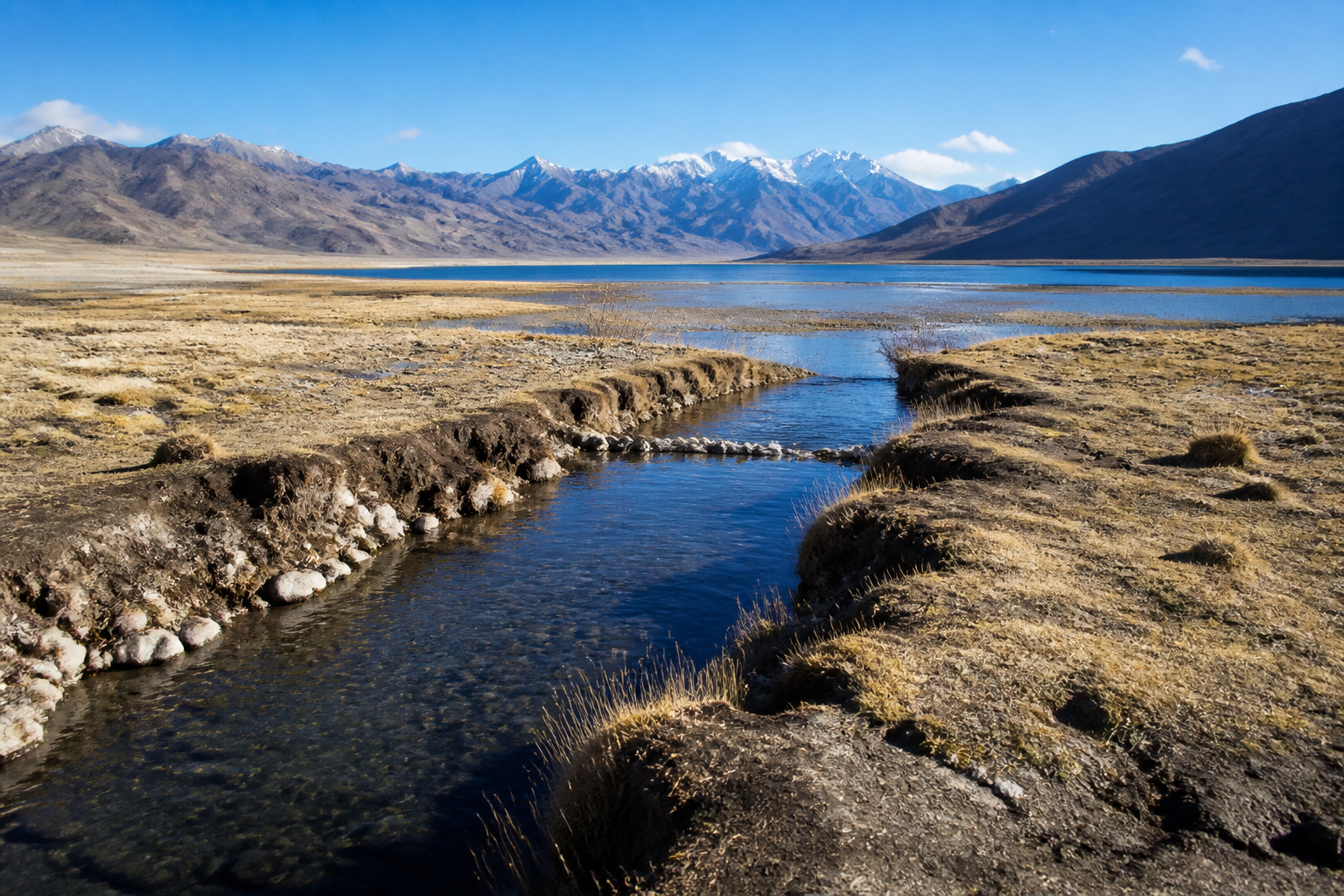
Ladakh has begun a major Tso Kar Lake revival project by redirecting glacier meltwater from a remote stream in Changthang to the shrinking high-altitude lake, with officials aiming to restore its original spread within a year.
The project will channel an average of 132 cusecs, or about 320 million litres a day, from the Rupshu Kharnak stream, located 11 kilometres from Tso Kar at an altitude of 18,000 feet. The water currently flows unused into the Sindhu River. Tso Kar lies at nearly 15,000 feet above sea level.
According to an official statement issued in Leh, the lake has shrunk by nearly 70 per cent over the past decade. Its area has fallen from nearly 11,000 acres to about 3,200 acres, affecting the local ecosystem and reducing the arrival of migratory birds. The black-necked crane, once commonly associated with the region’s biodiversity, has also become rare.
The decline has affected local livelihoods. Villagers told Lieutenant Governor Vinai Kumar Saxena during his visit on August 10 that the loss of grasslands and grazing areas had forced Pashmina herders to travel between 50 and 75 kilometres from their homes. The project is intended to restore both the lake and surrounding grazing grounds.
Instead of constructing a new concrete channel, authorities are using gravity flow and low-cost earthworks. Three natural depressions along the stream’s descent, covering 270 acres, 24 acres and 10 acres, are being developed into cascading freshwater wetlands. Check dams fitted with reinforced cement concrete pipes will allow sediments to settle before water reaches Tso Kar.
The three water bodies are expected to store nearly 1.23 billion litres of freshwater. Officials said the system could provide cleaner water to the lake while creating additional wetland habitats for migratory birds and supporting tourism in the region.
Work began on September 2 ahead of the harsh winter, when temperatures in the area can fall to between minus 20 and minus 30 degrees Celsius. By September 9, engineers had diverted 20 cusecs of glacier water into the first depression through earthen channels and a disused concrete canal built in 1995. The official statement said nearly 20 per cent of that depression had filled within four days.
The initiative followed a rapid survey ordered after villagers raised concerns during Saxena’s visit. The Public Health Engineering department had initially proposed an 11-kilometre reinforced cement concrete channel, but Saxena rejected the plan on ecological grounds and favoured natural channels designed to blend into the landscape.
Saxena said an earlier project that diverted 90 million litres of Stok Glacier water to parched farmland near Leh had shown that large-scale water management was feasible in Ladakh’s cold desert using simple engineering. He described the Tso Kar initiative as a potential blueprint for high-altitude ecological restoration and said it would strengthen the region’s long-term climate resilience.
The next stage of the project is the continued diversion of water through the cascading wetlands before it reaches Tso Kar. Officials estimate that successful channelisation could restore the lake to its original expanse within a year.
