


Thiruvananthapuram Corporation’s proposed urban development plan with Ahmedabad is significant not because it announces one completed project, but because it brings several of the city’s most persistent civic challenges into a single institutional programme. Waste management, polluted waterbodies, infrastructure funding and technology-enabled administration are being presented together, with the corporation seeking council approval before moving to implementation.
The proposal is built around a twin-city partnership between Thiruvananthapuram and Ahmedabad. The two municipal corporations signed a memorandum of understanding on November 3 in Ahmedabad, after which an eight-member delegation led by Thiruvananthapuram mayor V V Rajesh held discussions with Ahmedabad mayor Hitesh Barot and municipal commissioner Banchha Nidhi Pani. The delegation also visited waste segregation facilities to study Ahmedabad’s approach to collection, segregation, transportation, processing and scientific disposal.
That sequence matters administratively. The corporation has not presented the programme as an already funded or operational scheme. The proposed projects are to be placed before a special council meeting for approval, and Mayor Rajesh said the detailed aspects would be made public after the council clears them. The immediate event, therefore, is a shift from inter-city cooperation to an internal approval process. The next test will be whether the partnership can produce defined projects, costs, responsibilities and timelines rather than remain a framework for exchanging municipal practices.
Waste management is the most direct area of operational cooperation. According to the report, Thiruvananthapuram intends to draw on Ahmedabad’s experience across the full waste chain, from collection to final disposal. This is broader than adding a new processing facility. It suggests that the corporation is examining the relationship between household-level segregation, transport systems, processing capacity and disposal practices. The delegation’s visit to segregation facilities indicates that the proposed knowledge transfer is intended to examine how the system works on the ground.
However, the supplied plan does not yet establish which elements Thiruvananthapuram will adopt, how they will be adapted to local conditions or what performance standards will be used. The corporation’s waste challenge is described in the report as a central reason for the partnership, but no project cost, capacity target, implementation agency or deadline has been announced. Those details will determine whether the Ahmedabad model becomes a practical municipal intervention or remains a reference point for future planning.
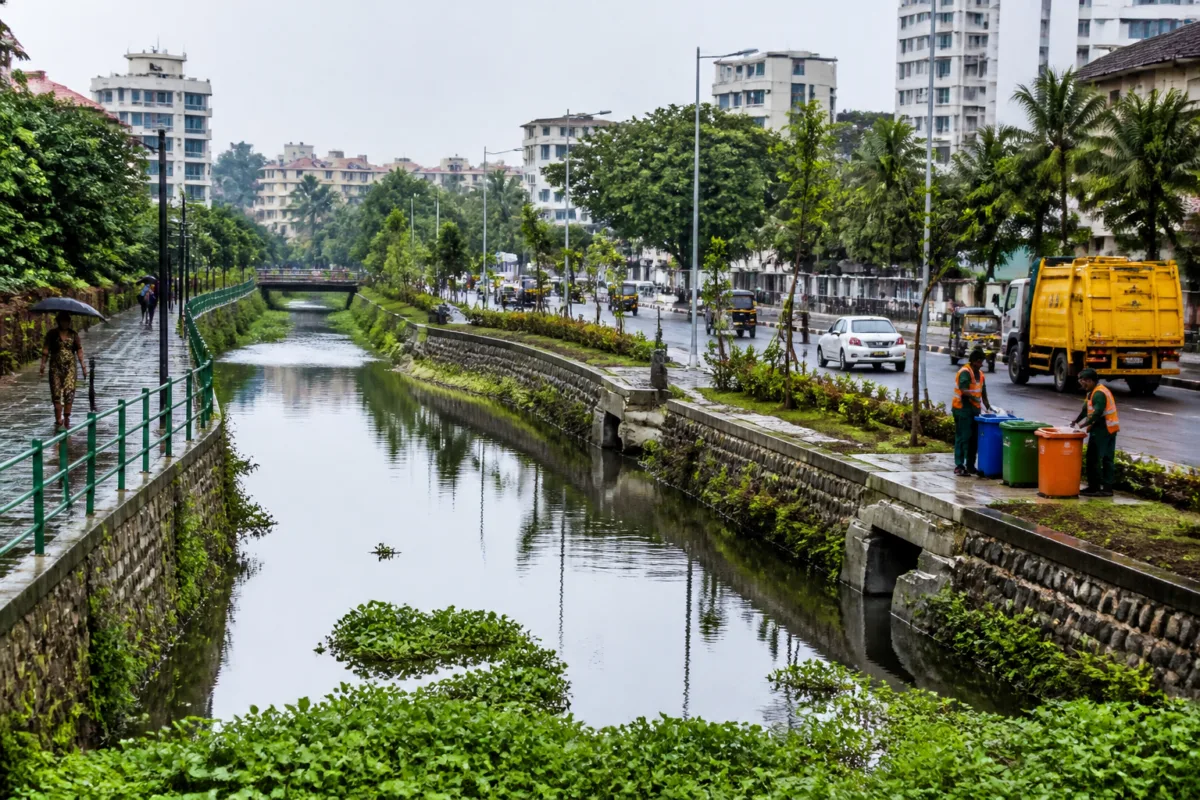
The second major component is the rejuvenation of urban waterbodies. The proposed list includes Parvathy Puthanar, Akkulam lake, Amayizhanjan canal, the Karamana River and Killiyar. The corporation plans to explore pollution control, waste removal, scientific treatment and restoration, while also improving the waterbodies’ potential as environmental and recreational assets.
The breadth of this list reveals that waterbody restoration is being treated as an urban systems issue rather than as an isolated beautification exercise. Canals, rivers and lakes are connected to waste flows, sewage treatment, land use and public space. Yet the report does not specify the condition of each waterbody, the source of pollution, the responsibilities of other agencies or the proposed treatment methods. It also does not identify which sites would be taken up first. The council-stage proposal will need to clarify these institutional boundaries because the corporation alone may not control every activity affecting the listed waterbodies.
Municipal bonds form the plan’s most important financial proposal. Thiruvananthapuram Corporation is examining Ahmedabad’s experience of raising resources through municipal bonds to finance infrastructure. The stated objective is to mobilise funds for large-scale projects and reduce dependence on conventional funding sources.
A municipal bond is not simply an alternative announcement of funds. It places questions of project selection, revenue capacity, repayment arrangements, financial disclosure and institutional credibility at the centre of urban development. The report confirms that the corporation wants to explore this mechanism, but it does not provide details of a proposed issue, the size of borrowing, the projects that would secure the funds or the revenue stream for repayment. These unresolved issues are central to understanding whether bonds can move from an aspiration in the development plan to a usable financing instrument.
The proposed cooperation also extends beyond waste and water. The corporation has identified road infrastructure, water supply, sewage treatment, technology-driven municipal administration, digital governance and civic-service delivery as additional areas. It also intends to explore tourism development, investment promotion and the possibility of bringing more centrally sponsored development projects to the capital.
This wider agenda gives the programme its institutional importance. The plan is not limited to copying a waste facility or financing one road. It is an attempt to use a municipal partnership to influence how the corporation plans projects, delivers services and mobilises funds. Corporation secretary J Mohammed Shafi described the programme as a potential “game changer” and said the intention was to replicate Ahmedabad’s implementation experience in waste management, waterbody rejuvenation and municipal bond issuance. His statement is an institutional expectation, not evidence that the proposed outcomes have already been achieved.
The governance structure is similarly important. The mayor and corporation secretary have publicly supported the proposal, but the council remains the immediate decision-making forum identified in the report. The council’s approval is expected to move the programme into the execution stage. That means the political and administrative durability of the plan will depend on how the proposed projects are translated into resolutions, budgets, tenders, departmental responsibilities and monitoring arrangements.
The political context adds another layer. The report notes that Thiruvananthapuram is Kerala’s first corporation under BJP rule, while Ahmedabad has been a BJP stronghold in municipal administration for decades. The partnership therefore connects two municipalities through both administrative cooperation and a shared political context. Opposition parties have criticised the Thiruvananthapuram administration for not introducing a major development project during its first year. The proposed programme is consequently also being presented amid a demand for visible civic delivery.
That context does not establish whether the projects will succeed or fail. It does explain why a broad partnership has acquired importance beyond technical exchange. For the corporation, it offers a framework for demonstrating an urban development agenda. For residents, the relevant question is whether the framework produces measurable improvements in waste collection and processing, cleaner waterbodies, better sewage treatment, more reliable civic services and infrastructure that can be funded without creating opaque liabilities.
The evidence currently supports a narrower conclusion. Thiruvananthapuram has identified four linked pressure points: waste, waterbodies, infrastructure finance and municipal capacity. It has sought an institutional partner with experience in the models it wants to study. It has also indicated that implementation will follow council approval. What remains unestablished are the project designs, funding requirements, legal and administrative responsibilities, execution timetable and benchmarks against which results will be assessed.
The special council meeting is therefore the next important milestone. Its outcome should show whether the urban development programme will be approved as a broad policy direction or with specific projects and financial commitments. Until those details are made public, the Ahmedabad partnership is best understood as a proposed governance and infrastructure platform rather than a completed development plan. Its significance will ultimately be measured by whether the city can convert inter-municipal learning into accountable, funded and locally workable civic systems.

