


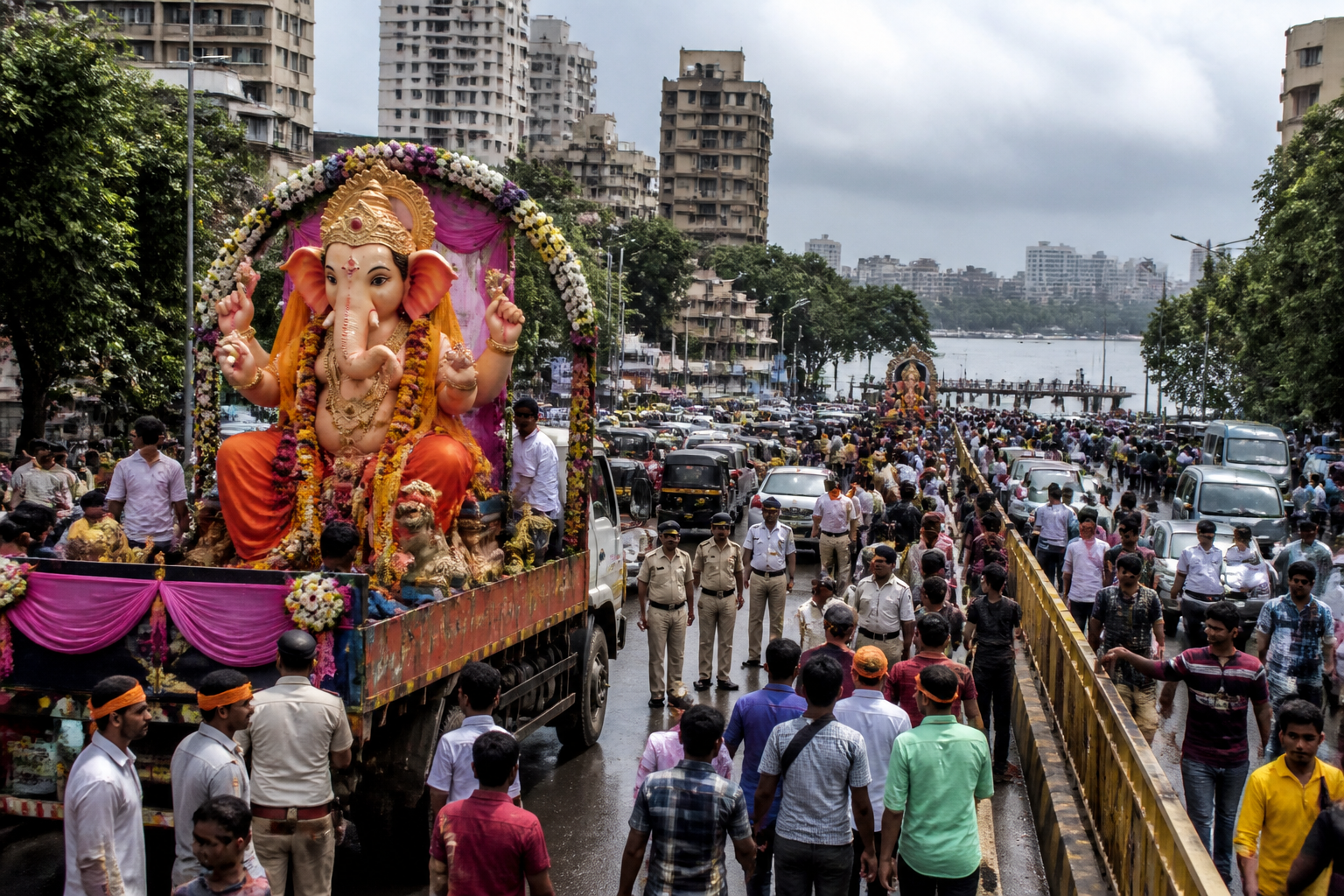
Thane Ganpati visarjan arrangements will face a major test on Friday, with 796 public Ganesh idols and 40,267 household idols scheduled for immersion across the Thane Police Commissionerate area. Police and civic authorities are preparing for crowding, traffic congestion, loudspeakers, DJ use and the enforcement of Bombay High Court directions during the processions.
The Thane Police Commissionerate covers Thane, Kalwa, Mumbra, Diva, Dombivli, Kalyan, Ulhasnagar, Ambernath, Badlapur and Bhiwandi. With thousands of processions expected across this urban region, police have focused on procession routes, immersion ghats and locations likely to experience heavy crowds.
The scale of the operation extends beyond policing. The municipal administrations of Thane, Kalyan-Dombivli, Ulhasnagar and Bhiwandi have made arrangements at immersion ghats and are expected to provide the facilities and measures required for devotees. The report did not specify the number or location of individual facilities at the ghats.
Traffic congestion is expected in Thane, Kalwa-Mumbra, Diva, Dombivli, Kalyan, Ulhasnagar, Ambernath, Badlapur and Bhiwandi. Traffic police will introduce changes on procession routes and around immersion ghats wherever necessary. The stated objective is to manage vehicle movement while allowing devotees to reach the ghats.
Noise regulation is another central enforcement challenge. Loudspeakers and DJ systems used during immersion processions have been a recurring subject of concern during festivals. This year, police will also have to implement Bombay High Court directions relating to sound levels, permitted timings and other rules applicable during festivals, according to the report.
Court directions concerning the use of firecrackers in public places will also apply during the festive period. The report said the police response to DJs, loudspeakers and firecrackers will be closely watched. Environmental groups have previously complained that court directions on noise pollution are not implemented effectively, making enforcement at the scale of Friday’s immersions a significant administrative task.
The arrangements bring together several urban functions that usually operate separately: policing, traffic management, municipal services, crowd control and environmental regulation. For residents, the immediate effects are likely to be concentrated around procession corridors and immersion sites, where road access, noise levels and pedestrian movement may change during the day. Authorities are expected to implement traffic measures as required around the routes and ghats during the immersion operations.
