


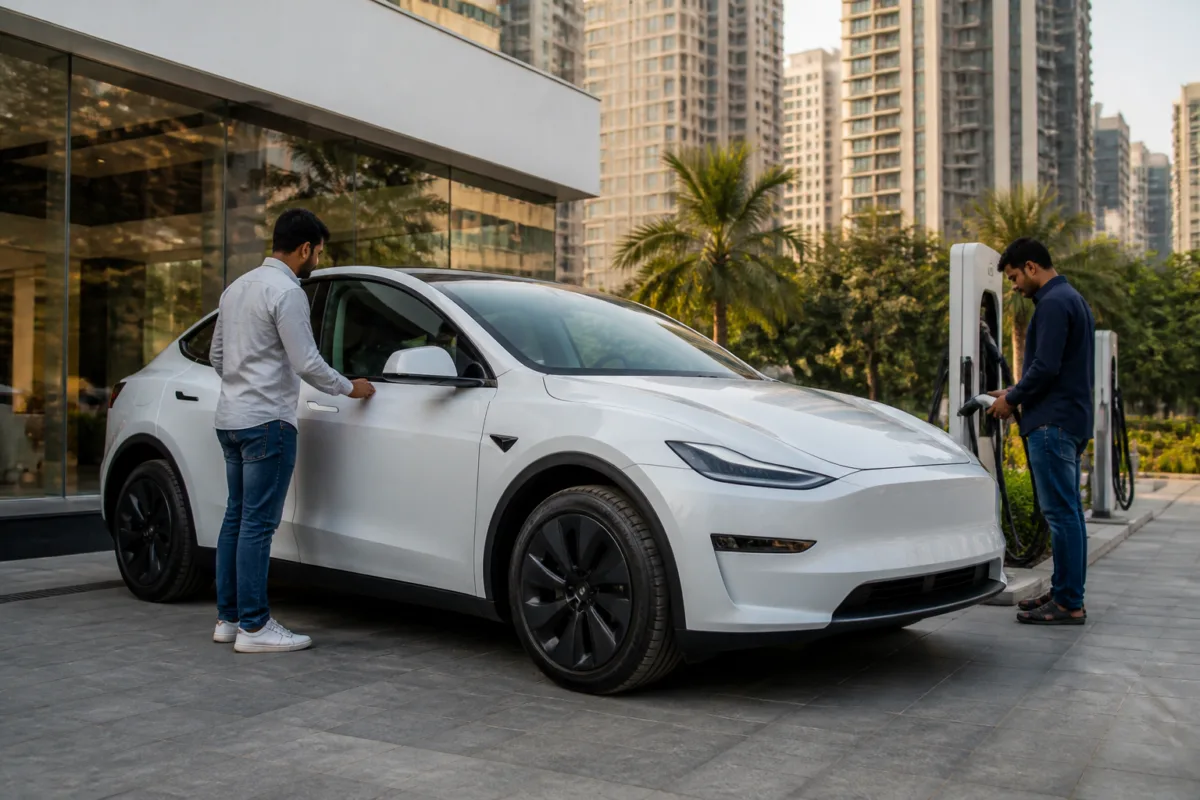
Tesla’s latest Model Y offer in India makes an ambitious affordability pitch: an effective monthly cost of Rs 19,990 after estimated fuel and maintenance savings. But the actual financial commitment is a Rs 39,990 monthly instalment under a seven-year step-up EMI plan, alongside a Rs 6 lakh down payment. The difference between those two figures captures a larger shift in how electric vehicles are being sold in Indian cities—not only through sticker prices, but through projected savings over the life of ownership.
The offer, announced for Tesla’s three-day Switch and Save Carnival from October 23 to 25, is available at Tesla experience centres in Noida, Delhi, Gurugram, Chennai, Hyderabad, Bengaluru and Mumbai. The company is also offering on-the-spot vehicle exchange valuations, financing through partner banks and a complimentary Wall Connector for purchases made during the event. Tesla has not stated how many vehicles it expects to sell through the carnival.
The central issue is that the Rs 19,990 figure is not a reduced loan repayment. It is an advertised effective cost created by subtracting estimated monthly fuel and maintenance savings from the actual EMI. Buyers therefore still need to meet the financier’s scheduled payment of Rs 39,990, subject to approval, while the Rs 6 lakh down payment is required upfront. The offer uses a seven-year repayment period and an annual interest rate of 8.5%.
That distinction matters because vehicle finance is a monthly cash-flow commitment, while running-cost savings accumulate gradually and vary by user. A household replacing a petrol or diesel SUV may drive enough kilometres to realise substantial savings, but a low-mileage owner will save less. Electricity tariffs, fuel prices, charging behaviour, vehicle efficiency and maintenance costs will also determine whether the projected difference is achieved.
Tesla’s calculation uses a set of assumptions. The Model Y is estimated to consume 14.3 kWh of electricity per 100 km, while the comparable petrol or diesel vehicle is assumed to deliver 8 km per litre. The calculation applies an electricity tariff of Rs 7 per kWh and maintenance costs of Rs 2 per km. On that basis, Tesla estimates monthly fuel and maintenance savings of Rs 20,000.
These assumptions turn everyday travel into the foundation of the sales proposition. The more a vehicle is driven, the more important its operating cost becomes in the ownership calculation. However, the source material does not establish the monthly distance used in Tesla’s estimate, nor does it identify the exact comparison vehicle, petrol or diesel price applied, or the maintenance schedules behind the calculation. Those details are important because the savings figure cannot be separated from the baseline against which it is measured.
The offer also shows how the economics of electric-car ownership are increasingly tied to the built environment around the vehicle. Electricity consumption is only one part of the equation. Owners need reliable access to charging, suitable parking and the ability to install or use charging equipment where they live. Tesla is including a complimentary Wall Connector with purchases during the carnival, but the supplied announcement does not specify installation conditions, apartment permissions, electrical-upgrade requirements or the operating cost of public charging.
This is particularly relevant in India’s larger cities, where many prospective EV buyers live in apartment buildings or use shared parking. A vehicle may have attractive theoretical running costs, yet the practical ownership experience can depend on whether a resident society permits charger installation, whether a dedicated parking bay has electrical access and whether long-distance trips require dependable public charging. The offer’s availability across Delhi-NCR, Mumbai, Bengaluru, Chennai and Hyderabad places that question in several different urban housing and mobility contexts.
The financing structure adds another layer. A seven-year loan lowers the immediate monthly payment compared with a shorter repayment period, but it extends the period over which the buyer remains financially committed to the vehicle. The published offer does not provide the total repayment amount, processing charges, insurance costs or registration expenses. It also does not explain the precise step-up schedule under which the EMI may rise. As a result, the headline monthly number does not by itself describe the complete cost of ownership.
Tesla’s approach reflects a broader tension in the Indian electric-car market: EVs can be presented as expensive purchases with lower operating costs, but buyers must bridge the gap between upfront affordability and long-term savings. Financing makes the initial purchase more accessible, while fuel and maintenance calculations make the higher-priced vehicle appear more comparable with conventional SUVs. The effectiveness of that proposition depends on whether the buyer has both the income capacity for the loan and the driving pattern needed to realise the estimated savings.
The comparison is also shaped by what a buyer is replacing. Tesla’s assumed conventional vehicle returns 8 km per litre, but the announcement does not identify its model, engine, usage profile or age. A relatively inefficient vehicle driven heavily in a city could produce greater fuel savings after replacement. A more efficient vehicle, or one driven fewer kilometres, would produce a smaller monthly benefit. The same applies to maintenance: actual costs vary with vehicle age, usage, servicing history and the definition of maintenance included in the estimate.
For urban consumers, this makes the advertised figure less a universal price than a personalised calculation. The Rs 19,990 effective cost may be relevant to a high-mileage household with access to affordable home charging and a costly petrol or diesel replacement. It may be less representative for a low-mileage user who relies on public charging, pays higher electricity rates or cannot easily install a Wall Connector. Insurance and registration, which buyers must also account for, sit outside the advertised savings calculation according to the report.
Tesla’s sales event is therefore doing more than offering a temporary finance package. It is testing whether a premium electric SUV can be made legible to buyers through a combination of instalment finance, trade-in support and operating-cost claims. The company is also allowing customers to compare the Model Y with the six-seater Model Y L during the event, widening the product conversation from powertrain choice to vehicle format and household use.
The institutional arrangement behind the offer is similarly important. Tesla is responsible for the vehicle, the savings assumptions and the sales carnival, while partner banks or other financiers determine loan approval and repayment terms. Approved collision centres are listed in Pune and Ahmedabad, while experience centres hosting the event are located in seven other urban markets. The announcement does not provide a wider service-network map or explain whether repair access differs between these locations.
That separation between seller, financier and urban infrastructure is central to the buyer’s decision. A low advertised effective cost can attract attention, but the final ownership experience depends on the terms approved by the financier, the buyer’s driving distance, local energy prices, charging access and the availability of maintenance and collision support. These are not merely private financial details; they are conditions created by the way cities house vehicles, distribute electricity and provide mobility infrastructure.
The numbers in the offer clarify both its strength and its limitation. Tesla is asking for Rs 6 lakh upfront and presenting a Rs 39,990 monthly EMI, while estimating Rs 20,000 in monthly fuel and maintenance savings. The resulting Rs 19,990 figure is easy to communicate, but it should not be mistaken for the amount debited from a buyer’s account. The actual value of the offer can only be assessed against a buyer’s mileage, comparison vehicle, electricity tariff, charging arrangements, loan approval and additional ownership expenses.
The larger urban question is whether electric mobility will become accessible through lower vehicle prices, better financing, lower operating costs or a combination of all three. Tesla’s Model Y carnival provides evidence of the third route: preserve the headline EMI, then use estimated savings to frame the vehicle as more affordable. What remains uncertain from the announcement is how many buyers will qualify, how many vehicles will be sold and how closely real-world savings will match the company’s assumptions. Those details will determine whether the offer represents a meaningful affordability pathway or primarily a sharper way to market the cost of premium EV ownership.

