


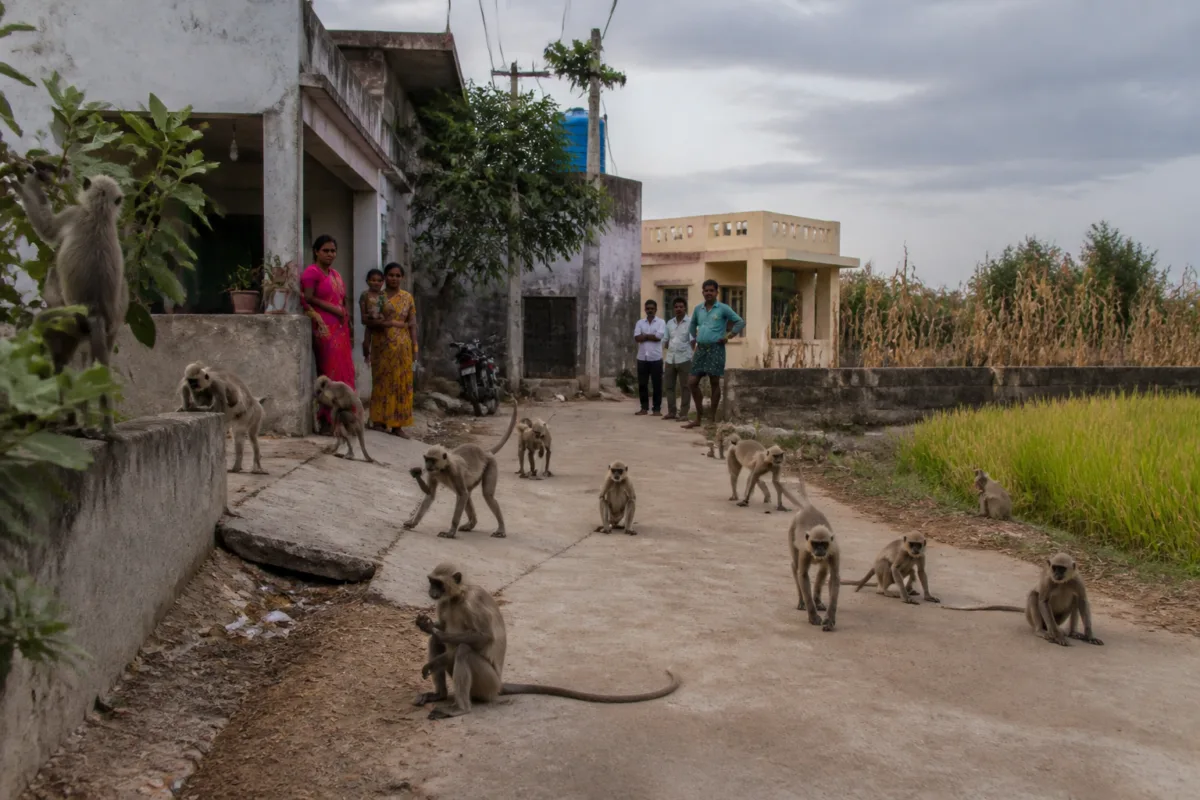
Telangana’s decision to conduct a survey through e-panchayats on the monkey menace in villages is more than an exercise in counting animals. It is an attempt to convert a persistent, locally managed crisis into an administrative problem that can be recorded, compared and acted upon. The survey will document monkey presence, crop damage, fear and inconvenience among residents, while the reported death of a villager in Karimnagar district shows the consequences when the problem is left largely to households and local political promises.
Panchayat officials are consulting villagers and recording details through the e-panchayat system. According to Sreemala, district panchayat officer of Peddapalli, a report will be submitted to higher officials after the survey, following which steps will be initiated based on the findings. The process places local government at the centre of a problem that cuts across agriculture, public safety, household security and wildlife management.
The significance of the exercise lies in the type of information being collected. The survey is not limited to the presence of monkeys. It also asks about crop damage and the fear and inconvenience caused to people. That distinction matters because the impact of human-wildlife conflict is often experienced through a series of smaller disruptions: residents changing how they use open spaces, farmers losing vegetables or grain, families spending money on protective measures and people taking personal risks to drive animals away.
The report describes residents adopting improvised methods to keep monkeys away. Some households have placed photographs of langurs in front of their houses, while wealthier families have installed solar fencing around urban properties. These responses point to a fragmented pattern of protection, where the ability to reduce risk depends partly on what an individual household can afford. They also show how a public problem is being transferred to private property and private expenditure.
That transfer becomes particularly significant when the affected area includes both villages and urban properties. The report refers to agricultural fields as well as houses, indicating that the conflict is not confined to one type of settlement. Crops including vegetables, maize, pulses and paddy have reportedly been damaged. Residents, meanwhile, have had to deal with monkeys entering or approaching homes and public spaces. The survey’s village-level structure could help establish whether the problem is concentrated in particular settlements, linked to specific crops or associated with recurring locations.
The available report does not provide a monkey population count, a district-wise map of affected villages, the total value of crop losses or a record of previous capture operations. Those gaps are important because a response cannot be assessed only by the number of complaints. Authorities would need to understand the frequency and severity of incidents, the locations where people and animals come into contact, the kind of damage reported and whether existing interventions have reduced the problem.
The human cost is already visible in the account of Kesireddy Vimala, 50, of Lingapur village in Shankarapatnam mandal. On December 31, she was working in front of her house when a group of monkeys arrived. While attempting to drive them away, she fell down several steps, sustained a head injury and died while undergoing treatment at the government area hospital in Huzurabad. The incident, as reported, shows that injury can occur without a direct animal attack. The act of trying to protect a home or family can itself become dangerous.
That detail changes the way the problem should be understood. A simple count of bites or direct attacks would not capture falls, road incidents, panic-related injuries or accidents that occur while people are chasing animals. The survey’s inclusion of fear and inconvenience therefore has practical importance. It can record the wider safety burden rather than treating each incident as an isolated household matter.
The problem has also entered the political life of the affected settlements. The report says the monkey menace has repeatedly been raised during gram panchayat and municipal elections, with candidates promising a permanent solution. Some candidates reportedly engaged monkey catchers to impress voters. Elected representatives have made efforts to fulfil those promises, but the report says the monkey population has continued to increase.
This pattern exposes a mismatch between the political demand for a permanent solution and the administrative complexity of the problem. A one-time capture exercise may generate a visible response, but the supplied report does not establish that it has produced a lasting reduction. Nor does it provide details of where captured monkeys were taken, how many were removed, whether the operations were repeated or what department was responsible for longer-term management. The absence of those details makes it difficult to judge whether earlier interventions failed because of scale, method, coordination or insufficient follow-up.
The e-panchayat survey is therefore significant as a possible shift from episodic action to structured evidence collection. Panchayats are closest to the residents reporting the problem, and their officials can identify locations, crops and household impacts that may not appear in a state-level administrative record. At the same time, the survey’s usefulness will depend on how the information is standardised. If one village records only sightings while another records crop loss and injuries, comparisons may be difficult. The report does not say what common method or assessment framework is being used.
The institutional question is equally important. Panchayat officials are collecting information, but the report does not identify which higher authority will evaluate the findings or which agency will implement the response. The issue touches local administration, agriculture, public health, wildlife management and possibly property-level safety. A local body can document complaints, but the next stage requires clarity about responsibility, funding and operational authority.
That division of responsibility matters because households are already paying for their own protection. The reference to solar fencing around urban properties suggests that some residents are investing in physical barriers, while others rely on low-cost visual deterrents such as langur photographs. The report does not establish how effective either measure is. It does, however, show that the absence of a uniform public response has produced unequal forms of adaptation.
The crop dimension adds another layer. Damage to vegetables, maize, pulses and paddy affects both household cultivation and agricultural livelihoods, but the supplied material does not quantify losses or identify which crops are most vulnerable. Without such information, authorities may struggle to distinguish between areas requiring immediate safety measures and those needing agricultural compensation or changes in crop protection practices. The survey’s questions on crop damage could provide a starting point, but only if the information is recorded in a form that can support decisions beyond the initial report.
The available evidence also reveals what remains unknown. There is no figure for the number of affected villages, no estimate of the monkey population, no timeline for completing the survey and no announced budget for follow-up measures. There is also no official statement in the supplied material on whether the government is considering capture, relocation, habitat management, waste-control measures or another intervention. These omissions do not diminish the importance of the survey, but they limit what can currently be claimed about the eventual policy response.
For residents, the immediate issue is not an abstract wildlife count. It is whether children and older people can move safely around their homes, whether farmers can protect crops and whether households must continue to respond individually to a shared public problem. Vimala’s death demonstrates how quickly an everyday encounter can become fatal. The reported use of monkey catchers during election campaigns demonstrates that the issue has public visibility, but visibility has not yet produced an established long-term solution.
The survey could help close that gap if it becomes the basis for a transparent administrative record rather than a one-time exercise. Its first test will be whether the findings are submitted to higher officials as promised. The next will be whether the authorities publish or communicate the scale of the problem, identify responsibilities and initiate measures that can be evaluated over time. Until those steps occur, Telangana’s monkey menace remains a case of recurring citizen harm being documented locally but managed without a clearly established statewide framework.

