


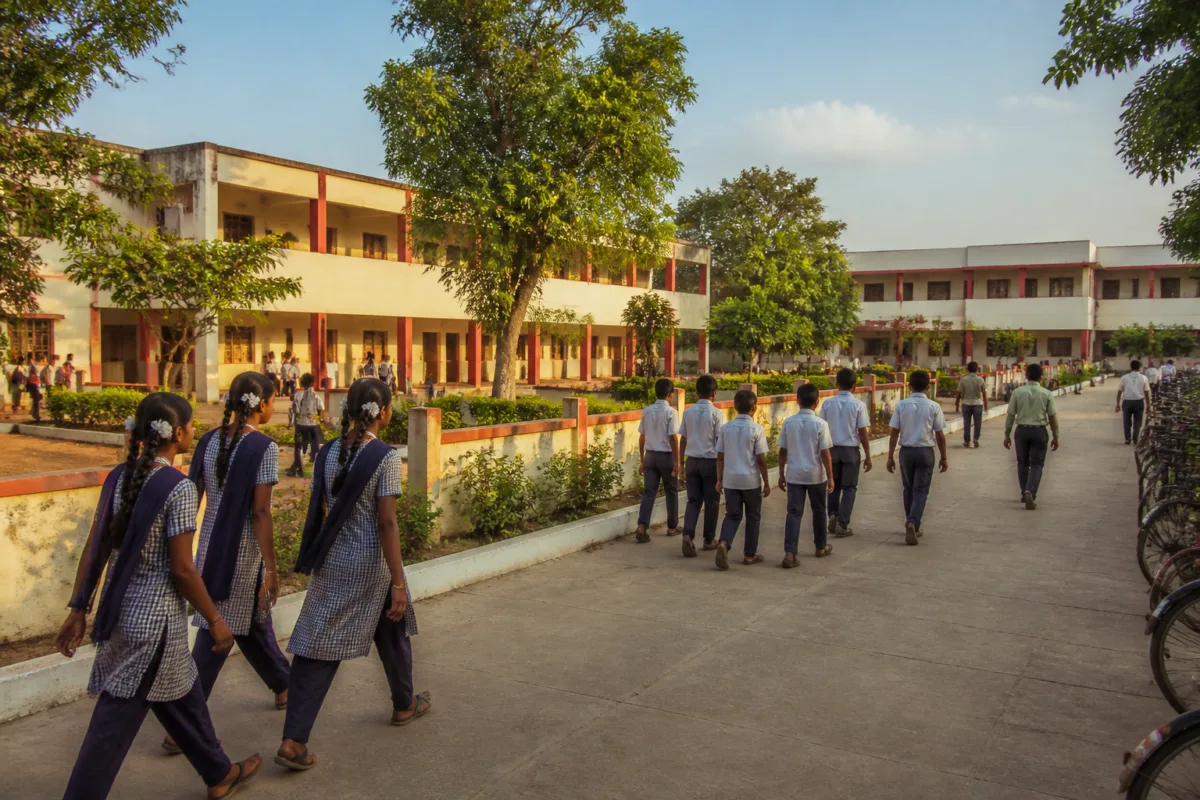
Telangana’s proposed KG-12 education system would reorganise government junior colleges and nearby schools into shared campuses and linked institutional networks, altering how senior-secondary education infrastructure is planned and managed across the state.
The state government plans to introduce a Bill in the Legislative Assembly in December to merge Intermediate education with school education, according to a report by Deccan Chronicle citing official sources. The proposal would create continuous schooling from kindergarten to Class 12 in phases beginning with the 2027-28 academic year and targeted for completion by 2030.
The Bill is being drafted on the basis of a report submitted by Core Group-5, headed by retired IAS officer Minnie Mathew. The proposed six-stage process would amend the Telangana Education Act, 1982, to bring Classes 11 and 12 under the school education department. It would also repeal the Telangana Intermediate Education Act, 1971, through legislation in the Assembly.
At the institutional level, the plan proposes integrating 430 government junior colleges with schools in two phases. In the first phase, during 2027-28, junior colleges located on the same premises as zilla parishad high schools would be merged. Between 2028 and 2030, the remaining government junior colleges would be linked to nearby schools.
The reported model would use different forms of campus integration depending on distance and existing infrastructure. Some government junior colleges located within one kilometre of high schools would operate as “twin campuses” under a single senior principal. Colleges between one and five kilometres away would be managed through a cluster or hub-and-spoke arrangement. A further group of colleges located more than five kilometres from high schools but having good infrastructure would be linked to nearby schools and gradually upgraded as Telangana Public Schools.
The proposal therefore treats school reorganisation partly as a question of institutional geography. Existing buildings, campus proximity and the condition of facilities would determine whether institutions are merged physically, managed as a network or upgraded while remaining separately located. The report does not provide a statewide inventory of building capacity, land requirements, accessibility conditions or the investment needed to adapt the campuses.
Around 1,140 government institutions, including Model Schools, Kasturba Gandhi Balika Vidyalayas and residential schools, already offer education up to the Intermediate level, the report said. These institutions could form part of the wider transition to an integrated senior-secondary system, although the government’s reported proposal does not set out how their existing administrative and residential arrangements would be aligned with the new structure.
The plan also proposes an autonomous Senior Secondary Board to conduct Class 10 and Intermediate examinations. A senior officer reporting to the secretary of school education would serve as board secretary. The proposed board would have separate examination units for Class 10 and Classes 11 and 12, while a Statutory and Academic Wing would handle college affiliations, equivalence and governing-body matters.
This administrative redesign would move examination and affiliation functions into a new structure while the physical education network is reorganised. The transition would therefore involve both campus-level changes and a redistribution of responsibilities between the school education department, the proposed board and individual institutions.
The private sector would also be brought into the planned senior-secondary system over three years. The report cited Telangana Board of Intermediate Education data showing 3,349 affiliated junior colleges in 2025-26, with 3,241 having received admission permissions for 2026-27 so far. It also said that more than 1,570 private junior colleges could be encouraged to join the integrated system.
Around 450 private colleges that already provide Classes 6 to 10 on a single campus and are willing to extend education to Class 12 could receive fast-track composite affiliation in the first year, according to the report. The proposed shift would give existing campus capacity a central role in determining which private institutions can move quickly to the new model.
For students and families, the practical effect would depend on how the government handles campus access, transport between linked institutions, classroom capacity, laboratories, sanitation, hostels and the distribution of teaching staff. These operational details are particularly relevant for colleges connected through cluster or hub-and-spoke arrangements rather than located on the same premises as a high school. The reported proposal does not yet specify those arrangements.
The government’s next formal step, as reported, is the introduction of the Bill in December. The legislation would establish the legal basis for bringing senior-secondary education under the school education department, create the proposed Senior Secondary Board and begin the phased restructuring of government and private institutions. Until the Bill is introduced and its provisions are debated, the campus structure, implementation timetable and affiliation rules remain proposals rather than enacted policy.

