


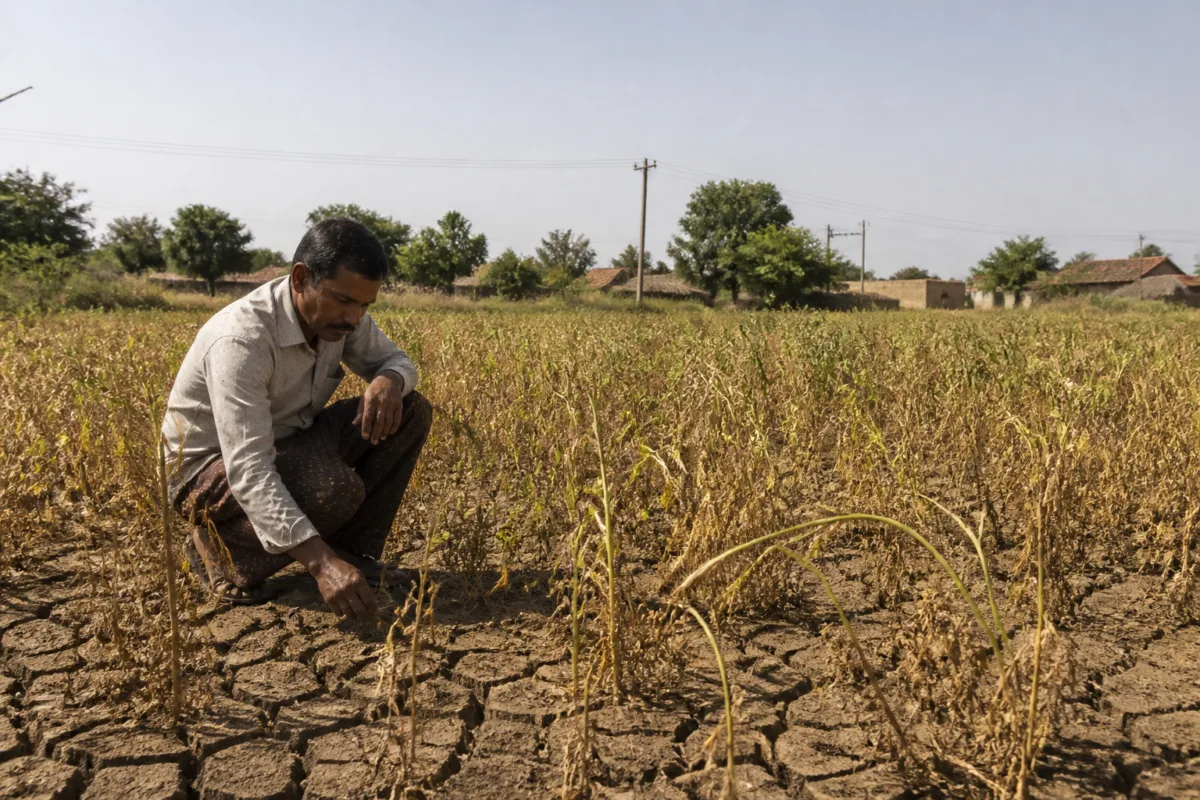
Telangana’s declaration of 365 drought-affected mandals for the Vanakalam 2026 season has exposed a gap between administrative drought classification and the conditions farmers say they are experiencing on the ground. The dispute is not only about the number of mandals included in the notification, but also about when the assessment was completed, how local crop losses were measured and whether the declaration will lead to timely assistance.
The State government announced that 111 mandals were severely drought-affected and 254 were moderately drought-affected across 31 districts. It said the remaining mandals would continue to be monitored by the State Drought Monitoring Cell and could be added through a supplementary notification if conditions warranted. That framework leaves the assessment open, but farmers’ organisations argue that the delay has already increased uncertainty for cultivators facing crop losses.
The declaration is therefore both an administrative decision and a trigger for the next stage of drought governance. A drought notification identifies affected areas, but it does not by itself establish the scale of compensation or guarantee that individual farmers will receive support. The source report says the government has not provided assurance on compensation for affected farmers, while farmers’ organisations have urged faster assessment and assistance.
That distinction matters because drought is not experienced uniformly across a mandal. Rainfall recorded at an administrative location may not reflect conditions in every village, crop or field. Rythu Swarajya Vedika convenor B. Kondal Reddy cited Talamadugu mandal as an example. The mandal was excluded because it had received normal rainfall, but he argued that a single heavy spell did not mean that the area had received normal rainfall overall. Farmers in several villages, he said, remained in distress.
The disagreement points to a central challenge in drought administration: the difference between aggregate weather data and actual agricultural damage. A mandal can record rainfall that appears adequate in official calculations while still facing crop losses caused by an uneven distribution of rain, a dry spell at a critical stage of crop growth or inadequate soil moisture. The supplied report does not provide the government’s detailed assessment criteria or village-level crop-loss data, so it cannot establish whether the exclusion of Talamadugu was technically incorrect. It does, however, document a clear contest over how the assessment should be interpreted.
The timing has become another source of criticism. The farmers’ organisations said the declaration was delayed and questioned when the second phase of drought assessment would begin. Kondal Reddy asked, “It is the last week of October. When will the State government initiate the second phase of drought assessment?” The question reflects the operational importance of the calendar. By the time an affected area is formally recognised, farmers may already have incurred input costs, lost standing crops and entered the next phase of seasonal planning.
The government’s decision to keep other mandals under monitoring indicates that the classification is not being treated as final. A supplementary notification could expand the list if conditions warrant. This creates a mechanism for correction, but its effectiveness depends on how quickly monitoring is carried out, what evidence is considered and whether the supplementary process is linked to a defined assistance timeline. None of those operational details are established in the supplied material.
Farmers’ organisations have also alleged that contingency measures were not implemented effectively, despite warnings from scientists and weather experts about the adverse impact of El Niño from February. The report does not specify which contingency measures were due to be implemented, which agencies were responsible for them or how their performance was evaluated. The allegation nevertheless raises an institutional question: whether early warnings are being converted into field-level action before crop losses become visible.
In a functioning drought-response system, monitoring should not begin only after losses have accumulated. Weather warnings, crop advisories, water availability assessments and local agricultural responses are expected to inform preparedness. However, the material available here does not establish the extent to which such measures were issued or implemented in Telangana during Vanakalam 2026. What it does show is that farmer groups believe the response lagged behind the warnings and that the delay in formal classification has weakened confidence in the assistance process.
The issue also has an intergovernmental dimension. According to the report, farmers’ organisations said Maharashtra and Karnataka had already submitted their drought assistance reports to the Centre, while Telangana was lagging behind. The source does not provide the dates, formats or contents of those reports, nor does it identify the precise stage at which Telangana’s submission stood. But the comparison highlights how State-level assessment affects access to assistance beyond the State administration itself.
A drought declaration can therefore be understood as part of a chain involving local assessment, State notification, preparation of an assistance report and potential support from the Centre. Delay at any point can postpone the next stage. The farmers’ organisations warned that a late submission could further delay the release of aid and add to farmers’ losses. The report does not confirm whether central assistance has been delayed or whether Telangana’s report has since been submitted. Those remain developments that require monitoring.
The classification of 365 mandals gives the scale of the official response, but it does not reveal the scale of the underlying damage. The available figures divide the notified areas into 111 severely affected mandals and 254 moderately affected mandals. They do not include the number of affected farmers, the acreage under damaged crops, crop-wise losses, the number of villages covered or the value of compensation being considered. Without those numbers, the notification cannot be used to estimate the financial impact on rural households.
This absence of publicly cited detail is significant for accountability. A drought assessment has consequences for farmers’ eligibility, government expenditure and the credibility of official monitoring. Transparent criteria would allow local communities to understand why one mandal was classified as severely affected, another as moderately affected and another excluded. It would also make the supplementary notification process easier to evaluate if additional areas are later included.
The controversy reveals that drought governance is not simply a question of declaring affected geography. It involves deciding which indicators carry weight, how local evidence is incorporated and how quickly administrative recognition is translated into support. Rainfall is an important measure, but the farmers’ response shows why rainfall totals alone may not settle the question of agricultural distress. Crop stage, rainfall distribution and village-level conditions can influence outcomes, although the supplied report does not provide a formal assessment of those factors in Telangana.
The immediate policy question is whether the State’s monitoring mechanism will resolve the dispute through a faster and more granular assessment. The government has said that unlisted mandals will continue to be monitored and may be added through a supplementary notification. Farmers’ organisations want the second phase of assessment expedited and compensation assurances provided. These positions are not necessarily incompatible, but their credibility depends on a visible process, clear milestones and evidence that affected villages are being examined rather than treated only through broad administrative averages.
The larger urban and regional planning lesson is that climate stress does not remain confined to farms. Drought affects rural livelihoods, food production, migration pressures and the economic stability of settlements connected to cities and towns. When assistance is delayed, the consequences can extend through local markets, household spending and demand for public services. The supplied report does not quantify those wider effects, but it establishes the immediate livelihood concern and the administrative delay at the centre of the dispute.
What the evidence confirms is that Telangana has officially classified 365 mandals as drought-affected for Vanakalam 2026, while continuing to monitor the remaining mandals. It also confirms that farmer organisations dispute the adequacy and timing of the assessment, cite exclusions such as Talamadugu and seek clarity on compensation and central assistance. What remains uncertain is the extent of crop loss, the basis for each classification, the status of the second assessment phase and the timeline for any assistance. Those are the next facts needed to determine whether the notification becomes an effective response or remains an incomplete administrative step.

