


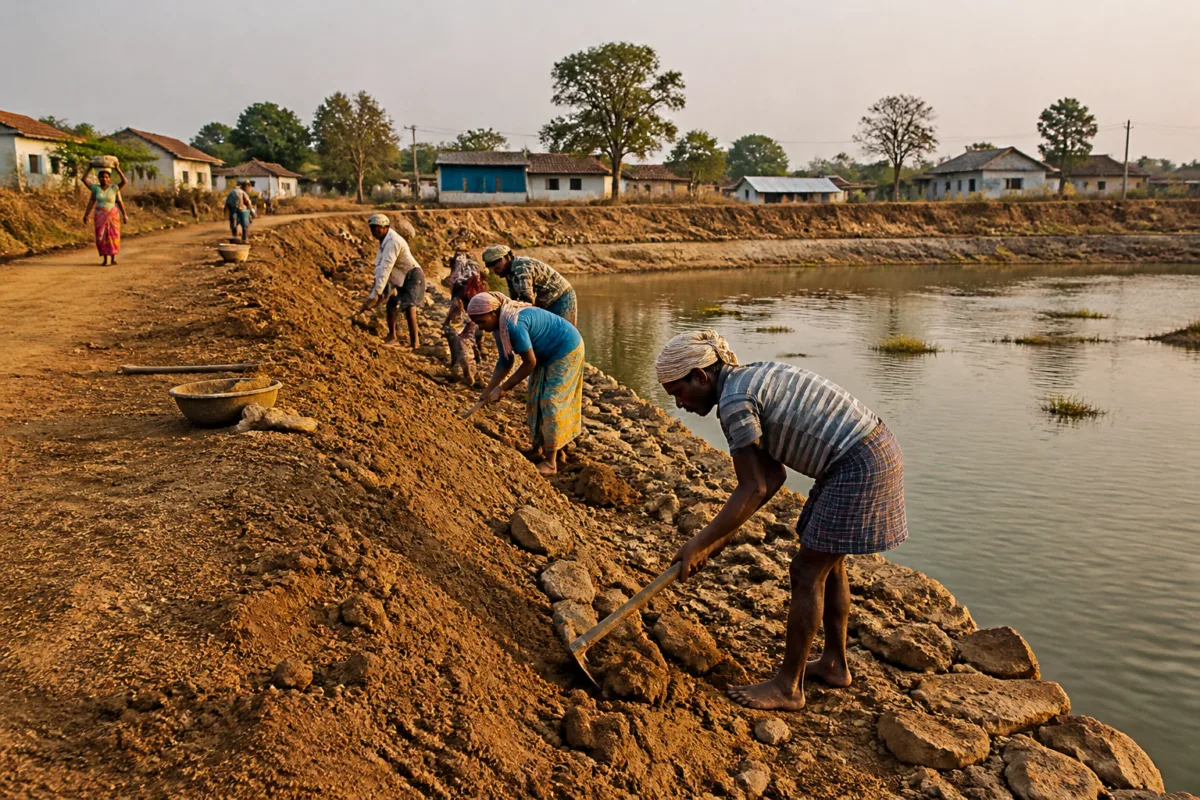
Telangana’s reported surge in rural employment under the VB-G RAM G programme has exposed a major demand for wage work, but conflicting figures in the available report make the precise single-day record unclear. The Panchayat Raj and Rural Development Department was reported to have provided employment to 5,00,166 persons on Tuesday, while the same report separately identified 2,54,812 workers on October 8 as the highest single-day attendance since the programme began.
The department attributed the increase in demand to drought conditions linked to the El Nino weather system. The report said average daily attendance during October this year was 2.16 lakh, compared with 24,750 in October last year. The figures indicate a sharp rise in the number of rural workers seeking employment through the state’s wage employment programme, although the relationship between the reported Tuesday figure and the October 8 figure remains unclear.
The report also compared October attendance over the previous five years. Average daily attendance stood at 1.28 lakh in 2021, 80,000 in 2022, 1.23 lakh in 2023 and 32,000 in 2024. It did not explain whether the figures refer to workers employed, workers who reported for work, or another programme measure, making a direct comparison difficult without clarification from the department.
Nalgonda recorded the highest district-level employment figure in the report, with 53,280 persons. It was followed by Medak with 27,296, Siddipet with 23,845, Vikarabad with 23,731, Sangareddy with 22,222, Kamareddy with 21,178, Jagtial with 18,918 and Nirmal with 18,300. Seventeen other districts reportedly provided employment to between 10,000 and 17,000 workers each, while five districts recorded fewer than 10,000 workers.
The VB-G RAM G Act, 2025, which the report said replaced MGNREGA, provides a statutory guarantee of 125 days of wage employment per rural household in a financial year. Telangana’s stated objective is to use the programme not only for wage support but also to strengthen village infrastructure and conserve natural resources.
Minister Danasari ‘Seethakka’ Anasuya congratulated officials on the reported increase and directed them to sustain employment generation. According to the report, she said wage employment should be linked with water conservation, village water resources and the creation of durable rural infrastructure.
The minister instructed officials to identify works according to the needs of individual villages and prepare plans to ensure continuous availability of employment for rural labourers. The priorities cited in the report included rainwater harvesting, development of water bodies and strengthening of rural infrastructure.
These directions place the programme at the intersection of livelihood security and local asset creation. In drought-affected areas, the effectiveness of the works will depend on how employment is measured, whether projects are selected according to village-level requirements and whether the resulting water and infrastructure assets are completed and maintained. The available report does not provide project-wise expenditure, work completion data or payment details.
The department’s clarification is needed on the conflicting attendance figures, the definition of the reported Tuesday total and whether the October 8 figure remains the programme’s highest single-day attendance. Further details on the works approved and the employment generated in each district would establish how the expanded programme is being implemented.

