


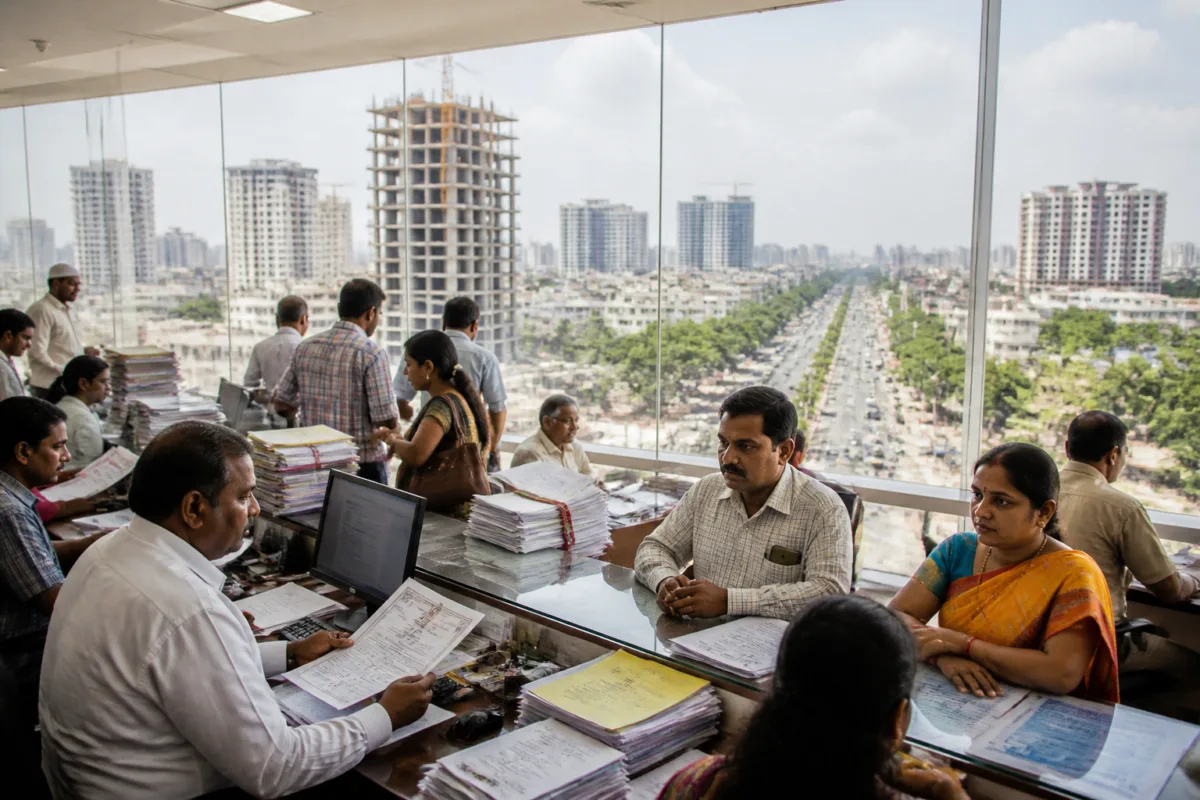
Telangana’s property registration revenue has risen sharply even as parts of the property market weaken, exposing a widening gap between the state’s collections and the number of transactions taking place. Official figures cited by the Registration and Stamps department show revenue of Rs 8,710 crore between April and October 19 in 2026-27, against Rs 7,217 crore in the corresponding period last year. The increase has come mainly after the state revised government land values and registration charges on June 5.
That distinction matters for understanding what the revenue growth represents. The state is collecting more from a broadly similar volume of registrations, but the underlying market is not expanding uniformly. Agricultural land registrations have declined in rural districts, while non-agricultural transactions, including housing plots, residential properties and commercial buildings, have recorded a modest increase. The result is a property market in which higher official values are supporting the exchequer even as rising prices affect demand.
The figures indicate that the state’s registration revenue is being shaped by both market activity and administrative valuation. Around 10 lakh documents covering agricultural and non-agricultural properties were registered between April and October 19 this year, compared with 9.94 lakh during the same period in 2025. The increase in transaction volume is therefore marginal when compared with the much larger rise in collections.
Registration department officials attributed part of the early increase in activity to buyer behaviour ahead of the revision in property registration values. Around 20,000 more documents were registered in April and May than during the same period last year, after the government indicated that values would be increased. According to an official quoted by the Times of India, monthly registrations fell by between 2,000 and 5,000 from June onwards.
This sequence suggests that the policy change brought forward some transactions before the higher values took effect. It also shows why headline revenue growth alone cannot be read as evidence of uniformly strong property demand. A portion of the revenue reflects the revised base on which transactions are assessed, while the number and type of transactions determine how widely that increase is distributed across the market.
The rural-urban divide is particularly clear in the agricultural land segment. Registrations of agricultural properties declined from 3.58 lakh in the corresponding period of 2025 to 3.37 lakh in 2026. Yet revenue from the segment rose from Rs 890 crore to Rs 1,189 crore. Department officials attributed the increase to higher land values used for registration.
The supplied figures show a direct relationship between the revised values and the state’s collections: fewer agricultural properties generated substantially more revenue. Industry representatives and officials cited rising land prices as a reason for the slowdown in rural transactions. Agricultural land in several districts is estimated to average around Rs 20 lakh per acre, a level that is affecting demand and slowing transactions, according to the report.
This creates an affordability question that is different from the revenue question. For the state, higher assessed values increase receipts from stamp duty and registration-related charges. For prospective buyers, however, the same revision raises the upfront cost of formalising a transaction. The effect is most visible in agricultural areas, where the fall in registrations indicates that some buyers may be delaying or reconsidering purchases as prices rise. The supplied material does not establish how many transactions were abandoned, postponed or shifted outside formal registration channels.
The non-agricultural segment presents a more resilient picture, particularly in the urban region around Hyderabad. Registrations increased from 6.35 lakh in 2025 to 6.63 lakh in 2026, while revenue rose from Rs 6,326 crore to Rs 7,549 crore. Government sources told the Times of India that property transactions continued to show momentum in the core urban region, or CURE, particularly in and around Hyderabad.
This urban concentration is significant because non-agricultural registrations include housing plots, residential buildings and commercial properties. The segment therefore captures several parts of the built environment at once: land conversion into urban use, housing transactions, commercial real estate activity and the formal transfer of property rights. Its performance suggests that demand around Hyderabad has remained stronger than demand for agricultural land in rural districts, although the available figures do not separate the contribution of each property type or location.
The state’s registration system is consequently doing more than recording transactions. It is also functioning as a fiscal mechanism through which changes in government-assigned values influence public revenue. The June revision has made that mechanism visible. A policy decision intended to update the official basis for property registration has simultaneously increased the state’s receipts and altered the cost of participating in the formal property market.
The institutional structure is important here. The Registration and Stamps department collects revenue through property registrations and stamp-related transactions, while government land values provide the basis for assessing charges. The department’s performance therefore depends on the interaction between valuation policy, transaction volumes and the mix of agricultural and non-agricultural properties being registered.
The figures also underline the limits of using a single revenue target as a measure of market health. Sources cited in the report said the department generated Rs 15,280 crore in 2025-26. Collections in the current year were described as nearing Rs 9,900 crore when stamp paper sales were included, and officials expressed confidence that the department could reach about Rs 18,000 crore by March 2027. The Rs 8,710 crore figure, meanwhile, refers to registration and stamps revenue between April and October 19, while the higher Rs 9,900 crore figure includes stamp paper sales. These are different measures and should not be treated as interchangeable.
The timing of the remaining financial year will also matter to the department’s target. October and November are traditionally important months for property transactions and revenue generation, according to officials. However, the report notes that registrations had not risen considerably in October despite the month generally being considered favourable for property activity. Officials remained hopeful of improved activity in November, but the supplied evidence does not yet confirm such a recovery.
For Hyderabad and its surrounding urban region, the data points to a property market that is still generating significant formal activity but is not moving as one system. Urban transactions are providing the stronger base for registrations, while rural agricultural land activity is slowing under the pressure of higher prices. This divergence has implications for how infrastructure expansion, peri-urban development and land-market formalisation are understood. Revenue growth in the registration system may reflect rising values in locations undergoing urbanisation even when transaction volumes elsewhere are weakening.
The broader urban question is whether fiscal gains from higher land values can remain separate from the affordability pressures they create. The available figures establish that Telangana is collecting more revenue and that non-agricultural registrations have increased modestly. They also establish that agricultural registrations have fallen while segment revenue has risen. They do not establish whether the additional revenue is being directed towards land records, urban infrastructure, rural services or market regulation.
What the evidence confirms is a shift in the composition of property registration revenue. Higher government land values have lifted collections across both agricultural and non-agricultural segments, while transaction growth has been concentrated more strongly in and around Hyderabad. What remains uncertain is whether the state’s revenue performance will continue if higher assessed values further reduce rural demand, and whether the expected November activity will be sufficient to support the department’s 2026-27 target.

