


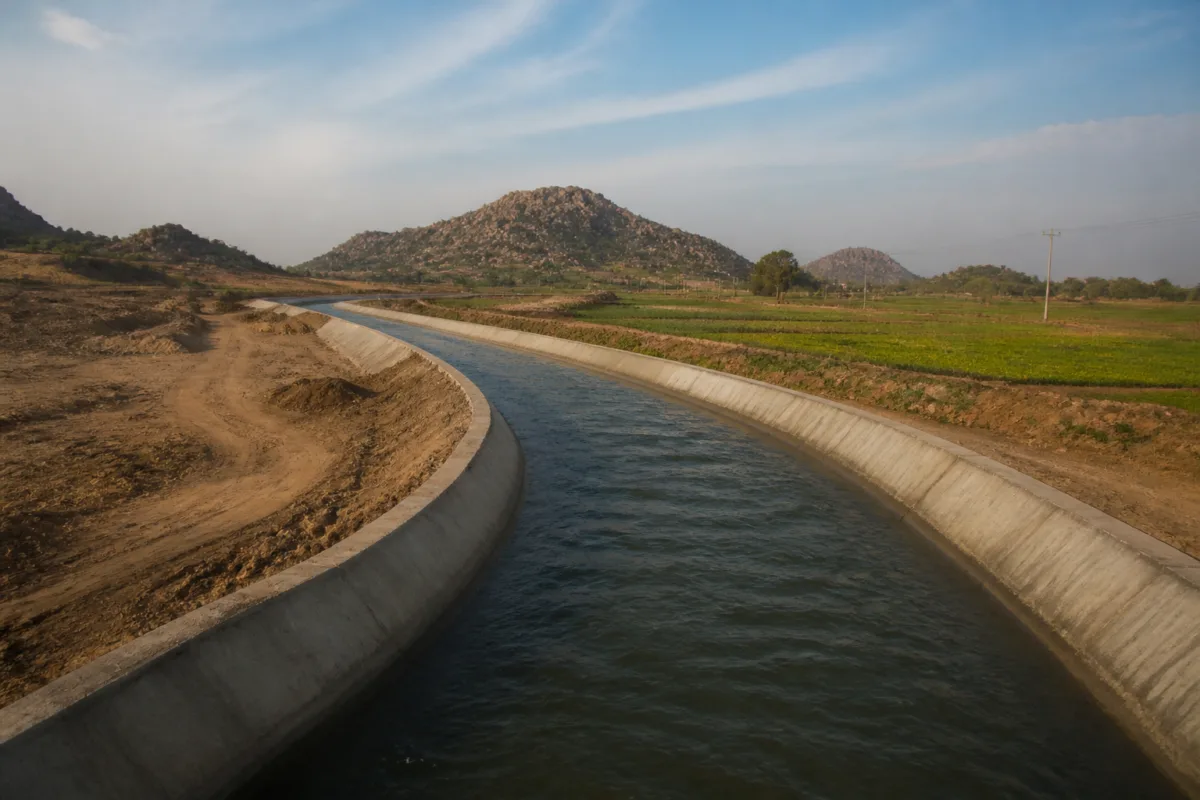
Telangana Chief Minister A. Revanth Reddy has said the state government is seeking a final award from the Krishna Water Disputes Tribunal-II (KWDT-2) within six to eight months, making the pending interstate allocation dispute central to its efforts to advance irrigation projects.
Speaking at a press conference, Reddy said Telangana was pursuing its case before the Brijesh Kumar Tribunal and the Supreme Court, while also taking legal and institutional measures to protect what he described as the state’s rightful share of Krishna river water. He said the government had engaged senior lawyers to present its arguments.
The tribunal was constituted in 2004, but its final verdict is still pending, according to the Chief Minister. Until the allocation question is settled, Telangana’s position on the volume of water available for its projects remains tied to proceedings involving Andhra Pradesh and other basin states.
Reddy said he had met the Chief Ministers of Maharashtra and Chhattisgarh to seek clearances for Telangana’s irrigation projects. He also said he had raised irrigation disputes with Prime Minister Narendra Modi and Union Jal Shakti Minister C.R. Patil on several occasions.
The Chief Minister accused the previous Bharat Rashtra Samithi government of weakening Telangana’s position on Krishna water. He claimed that, before the formation of Telangana, Andhra Pradesh had the capacity to divert about 4.47 thousand million cubic feet (tmc ft) of water a day, while projects added after K. Chandrashekar Rao became Chief Minister increased diversion capacity in the new Andhra Pradesh to 13.17 tmc ft a day.
Reddy alleged that the projects were planned in a way that could allow the diversion of virtually the entire river. He also said Andhra Pradesh was openly claiming that it was constructing projects on the basis of a 512-tmc ft allocation agreed during the BRS regime. Telangana’s government, he said, was arguing that the agreement was temporary.
These claims were made by the Chief Minister and were not independently established in the report. Their significance lies in how the dispute affects the planning and execution of irrigation infrastructure on both sides of the river. A final tribunal award would provide the institutional basis for determining the allocation that the competing project plans can rely on.
Reddy also linked the water dispute to the pace of project execution within Telangana. He said eight projects in Rayalaseema had been completed rapidly after the BRS came to power, while major irrigation projects in Telangana remained incomplete. He attributed the delays to inadequate land acquisition, incomplete rehabilitation and resettlement, and insufficient focus on finishing projects.
According to figures presented by the Chief Minister, the previous BRS government spent Rs 11,255 crore on land acquisition between 2014 and October 2023, averaging Rs 1,187 crore annually. He said the Congress government had allocated Rs 6,765 crore and was spending an average of Rs 2,417 crore a year.
Reddy said 45,000 acres still needed to be acquired for various projects. He claimed that the previous government had spent only Rs 3,315 crore on this requirement, making it difficult to complete projects without compensating affected farmers. The present government, he said, had spent Rs 3,518 crore and appointed a special IAS officer to oversee land acquisition.
He added that Rs 600 crore had been spent on rehabilitation and resettlement for the Uddandapur reservoir. The Chief Minister argued that greater spending on land acquisition and rehabilitation could have enabled the completion of pending irrigation projects in the erstwhile Mahbubnagar district.
The immediate policy challenge is therefore broader than the tribunal proceedings alone. Telangana must establish its allocation claim through the ongoing legal process while resolving the land, compensation and resettlement issues that can hold up projects even after funding is made available. The report does not provide the tribunal’s timetable, the status of individual projects or an independent assessment of the competing water-use claims.
For farmers and families affected by reservoirs and canals, the outcome will depend on both the eventual water allocation and the state’s ability to complete acquisition and rehabilitation obligations. The government’s six-to-eight-month target is a stated objective, not a confirmed tribunal deadline or final award.

