


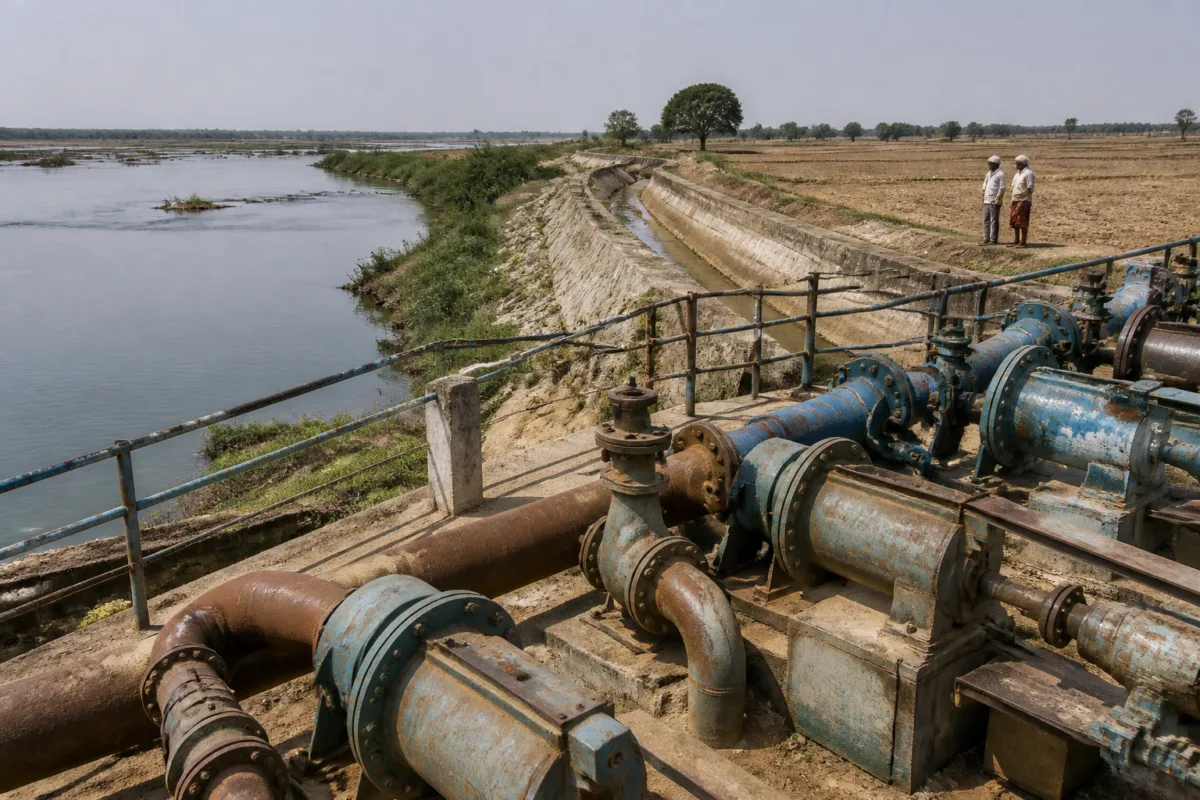
Telangana’s irrigation projects have become the centre of a fresh political dispute after BRS working president KT Rama Rao accused the Congress government of leaving major lift irrigation schemes idle despite substantial inflows into the Krishna and Godavari rivers.
Rama Rao alleged on Friday that the failure to operate pumps at the Palamuru-Rangareddy Lift Irrigation Scheme and the Kaleshwaram Lift Irrigation Scheme had contributed to drought-like conditions and left farmers struggling to protect their crops. His claims were reported by Telangana Today.
According to Rama Rao, the Krishna River received 250 TMCft of floodwater this year, while the Godavari River recorded inflows of 750 TMCft. He alleged that the available water was not being used to support agriculture because the pumps at both projects were not operated.
“This is not a drought brought by time, but one brought by the Congress,” Rama Rao posted on X, blaming the state government for what he described as a failure to utilise available water resources. The report did not include a response from the Congress government or an independent confirmation of the project operating status.
Rama Rao also alleged that farmers were being forced to purchase water transported by tankers to save drying crops. If accurate, the claim points to a gap between water availability in major river systems and the ability of irrigation infrastructure to deliver that water to fields. The supplied report, however, does not provide details of the number of affected farmers, the areas facing crop stress, or the volume of water being supplied through tankers.
The Palamuru-Rangareddy scheme is designed to lift water for irrigation in southern Telangana, while the Kaleshwaram project is a major multi-stage lift irrigation system drawing from the Godavari basin. Both depend on pumping infrastructure, power supply, operational decisions and water availability at their respective intake points. The report does not specify whether the alleged non-operation of pumps was linked to technical issues, administrative decisions, power constraints, maintenance or other factors.
The political dispute also highlights the importance of operating infrastructure after large irrigation projects are built. River inflows alone do not ensure that water reaches farms; the pumping network, canals, distribution systems and field-level delivery arrangements must also function as intended. The available account does not establish which part of that chain may have failed.
Rama Rao’s allegations come as farmers, according to the report, are attempting to save crops and are purchasing tanker water. No official crop-loss assessment, reservoir-level data, project-wise pumping schedule or government order was cited in the report. These details would be needed to independently assess the scale and cause of the reported water shortage.
The dispute is likely to remain tied to the operation of the two irrigation schemes and the state government’s response to the allegations. The supplied report does not mention any announced corrective action, official clarification or timeline for restarting the pumps.

