


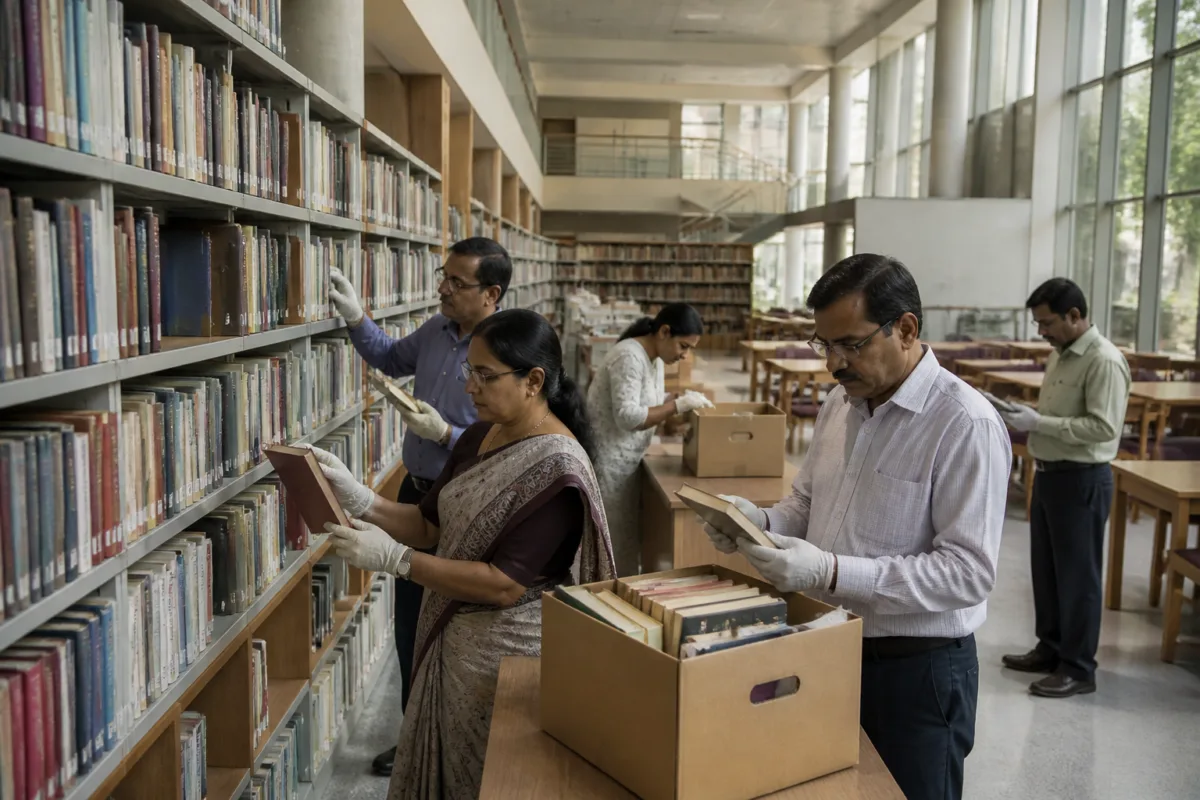
Tamil Nadu’s library procurement controversy is not only about allegedly fake books appearing on public shelves. It exposes what happens when a public institution attempts to build a large civic resource in a compressed political and administrative timetable, while the systems meant to verify quality, price and authenticity are unable to keep pace.
The issue concerns the procurement of books for five new government libraries: Periyar Arivulagam in Coimbatore, Kamarajar Library in Tiruchirappalli, Bharathidasan Arivulagam in Salem, Anjalai Ammal Library in Cuddalore and Quaid-e-Millath Library in Tirunelveli. According to the Times of India report, the government sought to procure one lakh books within three months before the model code of conduct for the 2026 Assembly elections came into force.
The procurement plan was designed with several layers of review. Subject experts from 53 domains were expected to recommend titles, 15 scholars were to shortlist them, a procurement committee was to negotiate prices and a high-level committee was to provide final approval. The committees were constituted on November 5, 2025, with the Periyar Arivulagam inauguration planned for February 2026.
That structure appeared comprehensive on paper. The problem was the scale and deadline. Experts initially submitted recommendations for around 20,000 books. With roughly 80,000 titles still to be identified, officials reportedly collected lists directly from publishers and forwarded them to the selection committee. A government source told the newspaper that it would have been impossible for 15 scholars to scrutinise such a large volume of titles in the available time.
This is the central institutional failure revealed by the episode: a multi-stage approval process can exist formally while becoming ineffective operationally. When the number of titles expands far beyond the capacity of the people assigned to verify them, the process risks turning into a paperwork exercise. The committees remain in place, but their ability to assess authorship, content, publisher credentials, ISBNs and pricing is diluted.
The alleged irregularities came to light after writer Perumal Murugan identified nearly 1,800 books from Agal Vilakku Pathippagam in the Tamil section on the fourth floor of Periyar Arivulagam. The books reportedly contained inflated prices, misinformation generated with artificial intelligence, fictitious author names and invalid International Standard Book Numbers.
The concerns were not limited to Tamil-language titles. Researchers also examined the English collection. S Satheesh Kumar, who verified the collection, found more than 200 titles from 3GE Learning Publications that allegedly carried fake ISBNs. The books were priced between ₹6,000 and ₹9,900, and some reportedly included doubtful publisher website details and fictitious author credentials.
In one cited example, a book on electronics and instrumentation named a Pakistani woman as its editor. She reportedly told Kumar that she was an environmental scientist. Kumar also found books containing more than 60% plagiarised content and books attributed to apparently fabricated authors. These findings, if established by the inquiry, would indicate more than poor editorial quality. They would point to failures in the basic identity and provenance checks expected in a publicly funded library system.
The numbers also raise questions about procurement economics. A source in the Public Libraries Directorate said the government spent ₹35 crore on 3.5 lakh books for the Kalaignar M Karunanidhi Centenary Library in 2022. By comparison, ₹20 crore was reportedly spent on fewer than one lakh books for Periyar Arivulagam. The comparison does not by itself establish wrongdoing, since collections can differ in subject, format, edition and procurement conditions. But it does make pricing, title selection and vendor scrutiny important parts of the investigation.
The controversy also highlights the role of procurement platforms. Publishers questioned why the state’s transparent procurement portal was not used for the new libraries. Emerald Publishers chief executive G Olivannan said that beginning procurement when construction started in 2024 would have given publishers sufficient time to prepare new titles. Kalachuvadu publisher Kannan Sundaram said the portal had supported transparent procurement for more than 4,000 libraries over two years, with readers and librarians reviewing titles and costs.
Officials, however, maintained that the portal was intended for existing libraries, while expert committees were responsible for choosing books for new institutions. That distinction is significant because it reveals a choice between two procurement models. One model relies on a digital and decentralised process involving librarians, readers and cost review. The other concentrates selection in expert committees established for a specific project. Neither model is automatically reliable. Each depends on adequate time, verifiable records and clear responsibility for approvals.
For a new public library, procurement is not a one-time construction activity. The building may be delivered on a fixed schedule, but the usefulness of the institution depends on the quality of its collection over many years. A library’s public value is created not simply by the number of books acquired, but by whether readers can trust the information, whether the catalogue is relevant to its community and whether public money is being spent at defensible prices.
That makes the reported deadline especially consequential. The push to complete procurement before the election-related model code of conduct created a narrow window for a task that normally requires subject expertise, publisher verification, catalogue preparation and financial scrutiny. The report does not establish that the election timetable directly caused the alleged irregularities. It does show that the deadline coincided with a procurement process in which officials had to find the remaining 80,000 titles rapidly.
The episode also shows why artificial intelligence creates a new verification burden for public knowledge institutions. AI-generated text can be produced quickly and made to resemble conventional reference material. If it is presented under fictitious author names, paired with invalid ISBNs or linked to dubious publishers, ordinary visual inspection may not be enough to identify it. Libraries therefore require processes that check not only whether a book exists, but also who wrote it, who published it, how it was registered and whether its content meets editorial standards.
In this case, the reported discovery by writers and researchers suggests that specialist scrutiny eventually exposed problems that the formal selection process had not detected. That does not mean external experts should replace institutional review. It means public procurement systems need clearly assigned verification responsibilities, auditable records and a mechanism for removing questionable titles before they enter circulation.
The Directorate of Vigilance and Anti-Corruption has begun an inquiry into library officials and members of the expert committees. Thousands of suspected fake books had been removed from libraries by the Friday cited in the report. Public Libraries Director R V Shajeevana did not respond to calls from the Times of India.
The inquiry will have to establish the extent of the irregularities, the identities of the vendors and individuals involved, the basis on which titles were approved, and whether the reported prices and bibliographic details were accurate. It will also need to distinguish between deliberate fraud, inadequate scrutiny, publishing errors and failures caused by the compressed procurement schedule.
The larger urban question is how governments build trustworthy civic institutions at speed. Libraries are public infrastructure, even when their assets are books rather than roads, trains or water pipelines. Their procurement systems determine whether the infrastructure serves citizens as intended. The Tamil Nadu case shows that a large building and a large collection can create the appearance of delivery while leaving the harder work of verification incomplete.
What is established so far is that suspected fake and questionable books were identified in new Tamil Nadu government libraries, that thousands of titles were removed, and that a vigilance inquiry is under way. What remains to be determined is the scale of financial loss, the chain of responsibility and whether the procurement framework itself was bypassed or simply overwhelmed. Those findings will determine whether the episode was an isolated vendor fraud or evidence of a wider weakness in how public knowledge infrastructure is commissioned.

