


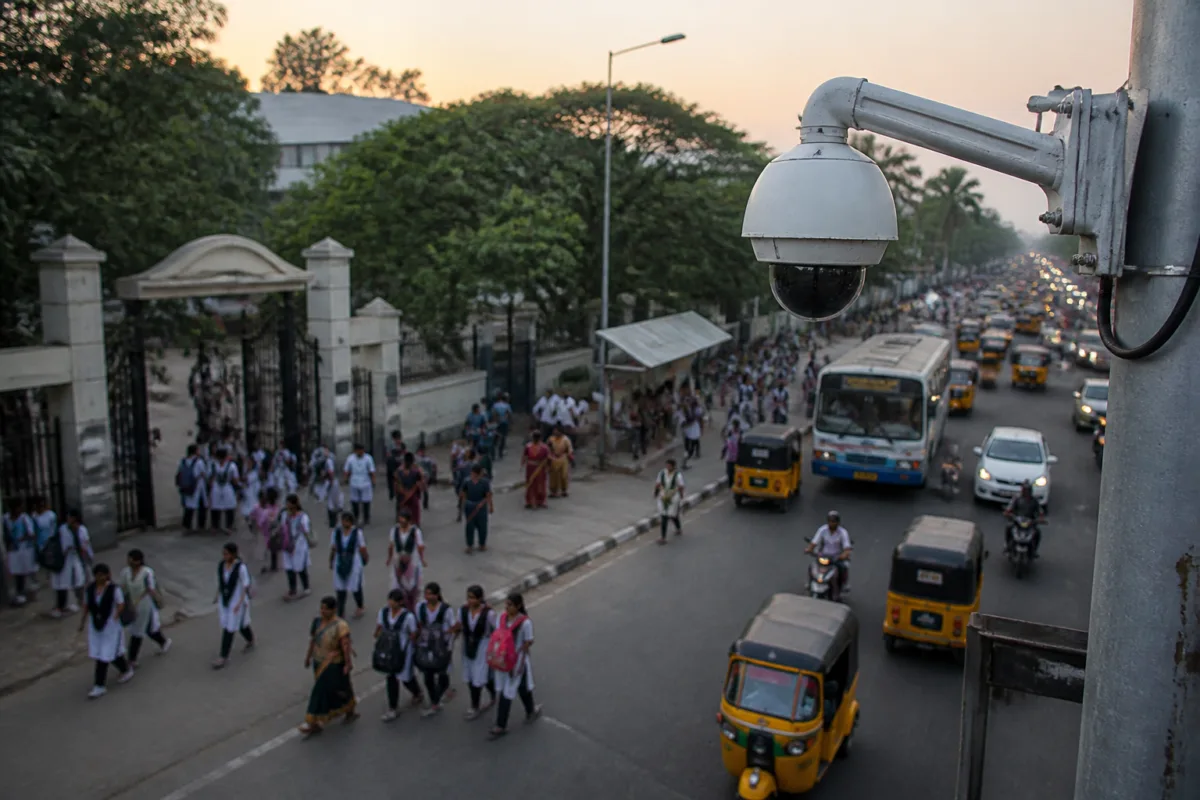
Tamil Nadu Police plans to install an AI-linked surveillance network across Chennai, Tambaram, Avadi, Madurai, Tiruchirappalli and Coimbatore to identify stalking, harassment and other potential threats in public spaces before they escalate. The supplied report gives two different figures for the proposed network: its headline refers to 2,350 cameras, while the article body and summary state that 2,355 cameras will be installed at 1,045 locations.
The proposed coverage includes women’s colleges, schools, working women’s hostels, information technology corridors, textile factories, bus stops, shopping areas, places of worship and other public locations. A senior police official told the Times of India that the sites were selected to improve surveillance in places where women study, work, commute and gather.
The system is expected to combine facial recognition, automatic number plate recognition and AI-based behavioural analytics. According to the report, tender documents specify that the cameras will analyse video feeds for loitering, aggressive behaviour and fights. The network is also intended to correlate repeated sightings across connected cameras, allowing control-room staff to review movement patterns rather than relying only on footage retrieved after an incident.
The report gives the example of a person repeatedly following a woman near a college entrance, appearing behind her at a bus stop and later being detected at a nearby junction. In such a situation, the system could flag the pattern for review, after which control-room personnel could assess the visuals and dispatch the nearest patrol. The proposed network would also detect unattended objects and intrusions at designated locations.
A police officer involved in the project linked the preventive approach to past incidents in Chennai, including the March 2018 killing of a college student outside Meenakshi College. The report also refers to the October 2022 murder of a college student at St Thomas Mount railway station after she was allegedly stalked for days. These references were presented by the officer as examples of incidents where earlier detection might have enabled intervention; the supplied material does not establish that the proposed system would have prevented either case.
The private agency awarded the contract will be required to provide real-time alerts to police control rooms. Recorded footage must be retained for at least 30 days so that investigators can retrieve it during criminal investigations. The report does not identify the agency, disclose the contract value or specify the deployment timeline.
The proposed system also raises an operational question about maintenance. Advocate R Vanitha told the Times of India that surveillance technology had traditionally been used to solve crimes after they occurred, while dysfunctional CCTV cameras had weakened its deterrent effect. She said real-time AI surveillance could help prevent crimes but argued that the government would need to maintain the system rather than allow it to deteriorate.
Before publication, the camera count, tender award, contract scope, deployment schedule and safeguards governing facial recognition and retention of video footage should be confirmed from the police department or the tender documents. The supplied report establishes the stated proposal, but not the final implementation details.

