


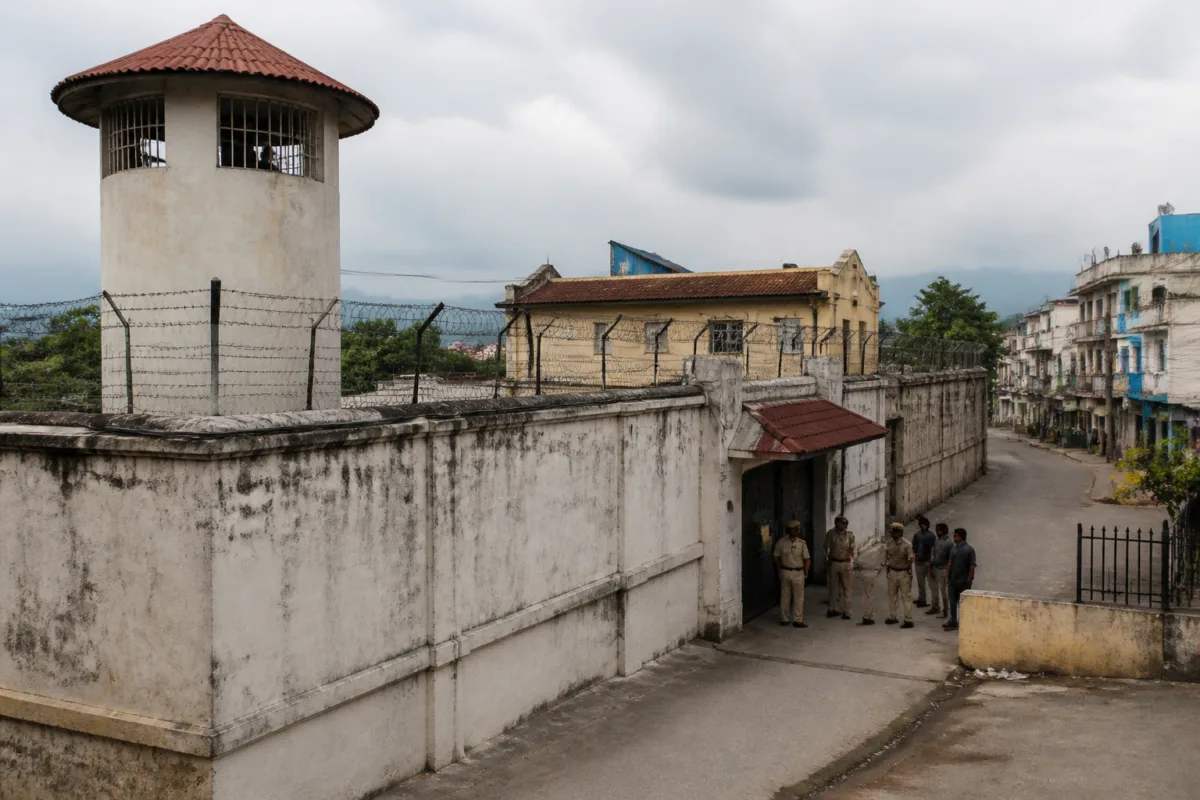
The escape of 17 prisoners from Theni sub-jail has exposed a structural weakness in Tamil Nadu’s prison system: the state is managing a growing inmate population with a sanctioned workforce that has remained largely unchanged for more than three decades. The immediate security failure at Theni therefore sits within a wider capacity problem involving staffing, accommodation and the use of prison personnel for functions beyond guarding and supervising inmates.
The figures reported by the prison department show the scale of the mismatch. Tamil Nadu’s prison system has a sanctioned strength of 5,489 personnel for 125 institutions, including nine central prisons, five special prisons for women and 12 district jails. Nearly 15% of these sanctioned posts are vacant. The effective workforce is further reduced when personnel are away on leave, leaving fewer staff available for inmate management, surveillance and movement control.
The staffing baseline itself is not aligned with current demand. A senior official cited in the report said the sanctioned strength had remained unchanged for more than three decades, even as the prison population and the number of institutions’ responsibilities increased. That means the problem is not simply that vacancies have emerged within an otherwise adequate establishment. The underlying sanctioned capacity may itself be outdated.
This distinction matters. A vacancy rate is usually treated as an administrative recruitment problem: posts exist, but people have not been appointed. In Tamil Nadu’s prisons, the report points to a deeper institutional issue. Even if the vacant posts were filled, the sanctioned strength may still not reflect the number of inmates, the distribution of prisoners across facilities or the additional activities now managed by prison staff.
The pressure is visible in occupancy levels. Tamil Nadu’s prisons have a combined authorised capacity of 24,342 inmates, but several facilities are operating beyond their permissible limits. Seven of the state’s nine central prisons are reported to be overcrowded. District jails and sub-jails have been functioning at between 115% and 130% of capacity for several months, according to prison officials cited in the report.
Theni illustrates the problem more sharply. On the day of the escape, 334 prisoners were lodged in a facility designed to accommodate 200, taking occupancy to 167% of capacity. At that level, the challenge is not limited to beds or floor space. Overcrowding increases the number of people who must be counted, observed, escorted and managed by a workforce that is already below its sanctioned strength.
The report attributes part of the increase in inmate numbers to a recent rise in arrests linked to drug peddling and related offences. It does not provide a statewide time series showing how arrests, undertrial populations or prison occupancy have changed. But the available figures establish a clear operational imbalance: inmate numbers have risen in facilities where the staffing structure has not been revised for decades.
That imbalance is distributed unevenly across the prison network. Personnel reported overcrowding not only at Theni but also at Puzhal Central Prisons I and II in Chennai and six other central prisons. An assistant jailer who joined the department 31 years ago said that, apart from Vellore and Cuddalore, inmate numbers in other central prisons had crossed permissible levels.
The geography of the problem is important. Central prisons carry a large share of the state’s inmate population, while district jails and sub-jails operate with smaller staff complements. Smaller facilities may have fewer layers of supervision and less ability to absorb sudden increases in occupancy or staff absence. The Theni incident brings this vulnerability into view, but the reported capacity figures suggest that it is not confined to one institution.
Prison staffing is also being stretched by functions that are not limited to perimeter security and inmate supervision. Personnel are deployed to oversee prisoner-run industries, freedom bazaars, petrol bunks, stores and canteens. They are also assigned official duties and, according to a source at Prison Headquarters, some staff and drivers are used for senior officials’ work.
These additional assignments create a hidden capacity loss. The sanctioned strength may be calculated against the formal requirements of the prison system, but the number of staff physically available for guarding inmates at any given time depends on how many are assigned elsewhere. Leave, administrative duties and institutional activities therefore reduce operational strength beyond the headline vacancy figure.
This is particularly consequential during prisoner movement. Security inside a prison depends not only on locked cells or walls, but also on routine processes: counting inmates, opening and closing secure areas, escorting prisoners, supervising work and responding to emergencies. When the same limited workforce is divided between these tasks and other institutional functions, the system has less room to absorb disruption.
The report also highlights a responsibility gap. Prison personnel said senior government officials were aware of overcrowding but that corrective measures had not followed. Staff members said lower-level employees were often made scapegoats after a crisis, despite operating within a system constrained by vacancies, excessive occupancy and competing assignments. These claims are attributed to prison employees and are not accompanied in the report by a response from senior officials; the department did not respond to calls seeking its position on the manpower shortage.
That absence of an official response leaves important questions unresolved. The supplied report does not establish when the sanctioned strength was last comprehensively reviewed, whether a fresh staffing assessment has been commissioned, or what immediate security measures have been ordered after the Theni escape. It also does not set out the number of inmates held on remand, the duration of overcrowding at each facility or the status of recruitment against vacant posts.
Those gaps matter because prison capacity is shaped by institutions beyond the prison department. Arrest patterns affect admissions. Courts and trial timelines affect how long people remain in custody. Bail access, legal aid and the classification of prisoners affect where inmates are housed. Prison authorities control day-to-day management, but the pressure on their facilities can originate across the criminal justice system.
The report does not provide enough evidence to quantify the contribution of each of these factors in Tamil Nadu. It does, however, show how pressure becomes visible at the facility level. A sub-jail designed for 200 people is holding 334. A department with 5,489 sanctioned posts has nearly 15% vacancies. Seven of nine central prisons are overcrowded. Together, these figures describe a system operating with little spare capacity.
The institutional response cannot therefore be measured only by whether more personnel are recruited after an escape. The central question is whether the prison system’s authorised capacity, staffing norms and operational responsibilities are being reviewed against present conditions. If the sanctioned strength has remained unchanged for more than three decades, the administrative benchmark itself may no longer describe the system that staff are expected to run.
Tamil Nadu’s prison crisis is consequently both a security issue and a built-capacity issue. Buildings have authorised limits, but those limits are meaningful only when staffing and inmate numbers are managed together. A prison operating at 167% occupancy faces a different supervision challenge from one operating within capacity, even if both have the same number of sanctioned posts.
The evidence presently available confirms the scale of the strain but not the full policy response. The developments that warrant monitoring are the department’s explanation for the Theni escape, any review of sanctioned strength, recruitment against vacant posts, measures to reduce overcrowding and decisions on whether prison staff will continue to be deployed for ancillary activities. Until those questions are answered, the escape remains a warning about a wider system whose demand has grown faster than its authorised capacity.

