


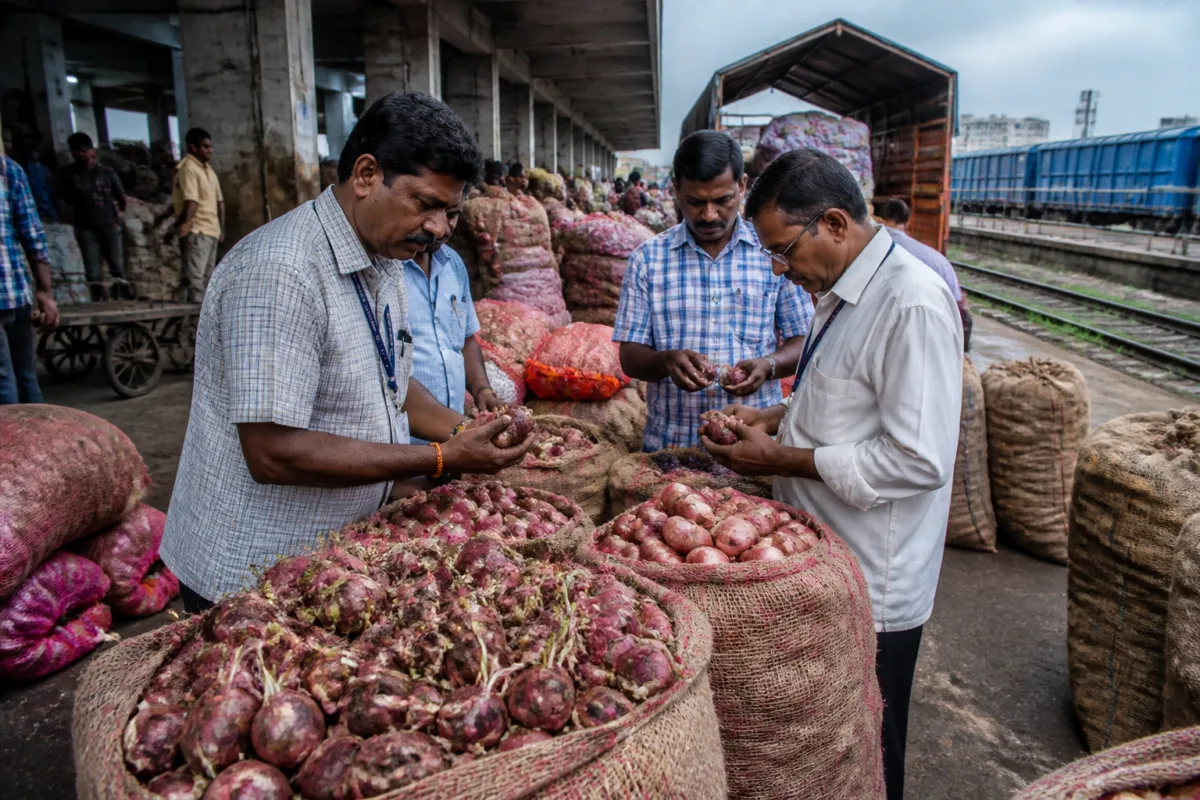
Tamil Nadu’s cooperative department has cancelled an order to procure onions for sale through ration shops after inspections found substantial quantities to be rotten, sprouted, fungus-affected or below the specified size. However, the quantity involved remains unclear in the available records, with the government statement referring to a 400-tonne order while other accounts cited in the report refer to 450 tonnes arriving in Chennai.
According to a press release attributed to the Tamil Nadu Cooperative Department, the Tamil Nadu Cooperative Marketing Federation placed an order with the National Agricultural Cooperative Marketing Federation of India, or NAFED, in October to procure 400 tonnes of onions at ₹29 per kilogram. The onions were intended for sale at lower prices through the state’s ration-shop network.
The procurement specification required Grade A onions with a minimum diameter of 45 millimetres. The department said its officials found Grade A onions mixed with rotten and rejected-quality produce during an inspection in Maharashtra. A further inspection was conducted on October 31 at the Korukkupettai terminal in Chennai by a team that included cooperative department officials.
The department said samples showed that between 20% and 26% of the onions were rotten, sprouted or affected by fungus and had to be treated as waste. It also said 50.20% of the onions were smaller than the prescribed size. Based on these findings, the Tamil Nadu Cooperative Marketing Federation cancelled the procurement and distribution order for 400 tonnes on October 31, according to the statement.
The department further said the onions reportedly lying at the Korukkupettai terminal belonged to NAFED and were not procured by the cooperative department. A regional NAFED official was quoted as saying that the organisation had taken back the onions that the Tamil Nadu government did not wish to purchase, but declined to provide further details.
The report also refers to a separate account that 450 tonnes of onions arrived in Chennai by goods train on October 31 and that the produce was not accepted after being found to be below quality standards. It cites railway officials as saying the onions had been taken away. Another political statement cited in the report referred to 250 tonnes purchased in northern states and kept at a Korukkupettai warehouse for distribution to other districts.
These differing quantities are central to understanding what happened to the consignment. The available report does not include the procurement order, inspection report, railway consignment records, rejection documentation, weighment records or disposal and return details. It therefore does not establish whether the 400-tonne order, the 450-tonne consignment and the 250-tonne reference relate to the same transaction or to separate stages or consignments.
The episode highlights the operational importance of quality controls in public procurement of perishable commodities. A procurement system supplying ration shops must verify grading before dispatch, during transit and at the receiving point, while also documenting responsibility when goods are rejected. In this case, the department’s stated inspection findings provide a basis for rejecting the produce, but the supplied material does not establish the complete chain of custody after rejection or quantify the onions that were ultimately wasted, returned or redirected.
The immediate public-interest questions are whether any payment was made, who bore the transport and storage costs, how the rejected onions were handled, and whether replacement procurement was ordered for ration-shop distribution. The supplied report does not provide answers to these questions. Primary records from the Tamil Nadu Cooperative Marketing Federation, the state cooperative department, NAFED and the railway authorities are required before the quantity, financial loss and final disposition of the onions can be confirmed.

