


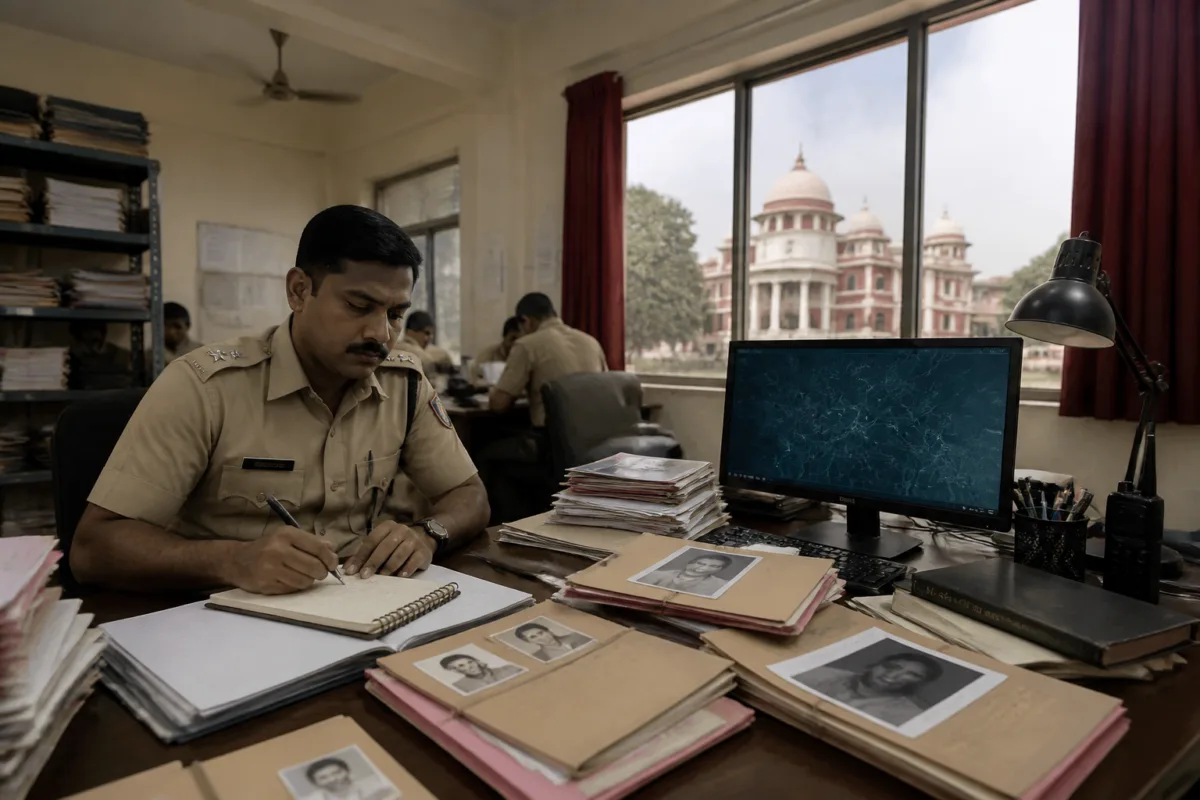
The Madras High Court’s direction to the Tamil Nadu Director General of Police to submit a statewide account of missing-person cases has turned an individual disappearance into a wider test of how the state records, investigates and reviews cases that remain unresolved. The court has asked not only how many people have gone missing, but also how many have been found, how many investigations remain open, who is still untraced and what steps the police are taking to close pending cases.
The order arose from a habeas corpus petition filed by Bhuvaneswari, a resident of Tirukoilur in Kallakurichi district. She alleged that her husband, Shankar Raj, was being held unlawfully by his father and brother in connection with a property dispute. She sought directions for his rescue and production before the court. The police disputed the suggestion that no steps had been taken and told the court that measures had been initiated to trace him.
A division bench comprising Justice A.D. Jagadish Chandira and Justice P. Karthikeyan directed the DGP to file the report within three weeks. The case therefore has two distinct dimensions. The first is the immediate question of what happened to Shankar Raj, whose disappearance was the subject of a case registered in 2021. The second is the court’s decision to seek a consolidated picture of missing-person investigations across Tamil Nadu.
That distinction matters because missing-person cases are often handled as individual police files, while the administrative problem is statewide. A case may begin at a local police station, require coordination across districts and states, depend on records held by different agencies, and remain open even when the initial leads have weakened. The court’s questions indicate that it wants the police to present this chain as a measurable system rather than as a series of isolated investigations.
The requested report is expected to include the total number of missing-person cases registered across Tamil Nadu, the number of people successfully located and the number of cases still under investigation. The bench has also asked for details of people who remain untraced and the efforts made to find them. These categories are important because they can reveal whether the state is distinguishing between cases that have been resolved, cases that are active and cases that have effectively become dormant.
The supplied report does not provide the statewide figures sought by the court. That absence is itself central to what the proceedings may establish. Until the DGP files the report, it is not possible from the available material to determine the scale of the backlog, the proportion of missing people who have been traced or the number of cases that have remained unresolved for extended periods. The court’s request creates the possibility of a common administrative baseline, but that baseline has not yet been placed before the public through the material supplied here.
The petition involving Shankar Raj illustrates why timelines and supervisory responsibility become important in such cases. His disappearance dates back to 2021, and the High Court has now directed the Tirukoilur Deputy Superintendent of Police to oversee the investigation. The court also noted that Shankar Raj’s father, Ponnan, had earlier filed a habeas corpus petition concerning his son’s disappearance. The existence of more than one petition connected to the same disappearance points to a case that has continued to require judicial attention rather than reaching an early resolution through ordinary investigation.
The court’s direction for supervision by the Tirukoilur DSP places a defined officer above the local investigation. In administrative terms, that can make responsibility easier to identify, particularly when a case crosses police-station boundaries or requires follow-up over a long period. The order does not, however, establish why the investigation remained unresolved or determine whether any individual officer failed in duty. Those questions would require findings from the investigation or from an official record beyond the details currently reported.
The proceeding also raises the question of how Tamil Nadu uses technology in missing-person investigations. The judges observed that police forces in several other states are using artificial intelligence to locate missing people and said it remained unclear whether similar tools were being used in Tamil Nadu. The court has asked the DGP to explain the use of modern technology in searches and the measures being taken to expedite pending investigations.
The reference to artificial intelligence should not be read as a finding that technology alone can resolve missing-person cases. The available report does not identify the systems being used elsewhere, the tools under consideration or the results achieved through them. It also does not establish whether Tamil Nadu has a statewide technology framework for matching identities, analysing movement or connecting police records. What the hearing clearly does is place technology within a broader accountability question: whether the police can show what methods are being used, where they are being used and whether they are helping investigators pursue unresolved cases.
For an urban and regional governance system, this is significant even though the individual petition originates in Tirukoilur. Missing-person investigations are not confined to major cities. People may disappear from towns, villages, transport corridors, workplaces or family settings, while the search may require coordination across the state. The effectiveness of the response therefore depends on institutional links between local police units and higher supervisory offices, as well as on the quality and accessibility of case information.
The court’s request for numbers can also be understood as a demand for consistency. Without common categories, a state may know how many complaints were registered but not how many remain active, how many were closed after a person was traced or how many require renewed investigation. The order specifically asks for located persons, cases under investigation and people who remain untraced. Such distinctions can help separate activity from outcome, although the available report does not say what definitions the DGP will use in the submission.
The property dispute alleged by Bhuvaneswari gives the case an additional legal dimension. She alleged that Shankar Raj was being held captive by members of his own family, while the police maintained that steps had been taken to trace him. The court has not, according to the supplied report, accepted either version as established fact. Its directions are therefore focused on obtaining information, ensuring supervision and examining whether the investigation is progressing effectively.
The request for a possible transfer of the case to the CB-CID reflects the petitioner’s argument that effective steps had not been taken to locate Shankar Raj. The court has not been reported as ordering such a transfer. Instead, it directed the Tirukoilur DSP to oversee the investigation and sought a broader report from the DGP. The distinction is important: judicial scrutiny has increased, but the supplied material does not show that the investigation has been transferred to the state’s specialised crime branch.
The three-week deadline gives the proceedings a measurable next step. The DGP’s report is expected to address the statewide caseload, tracing outcomes, pending and untraced cases, technology use and measures for speeding up investigations. The court may then have a basis to assess whether the police have a functioning mechanism for reviewing unresolved cases or whether the information reveals gaps requiring further directions.
At present, the evidence confirms a court-directed review, not the final condition of Tamil Nadu’s missing-person investigation system. The statewide numbers, the status of technology use and the explanation for delays remain to be placed before the High Court. The immediate institutional test is whether the DGP’s report can convert scattered case records into a clear account of what has happened to missing-person investigations across the state and what action is being taken in cases that remain unresolved.

