


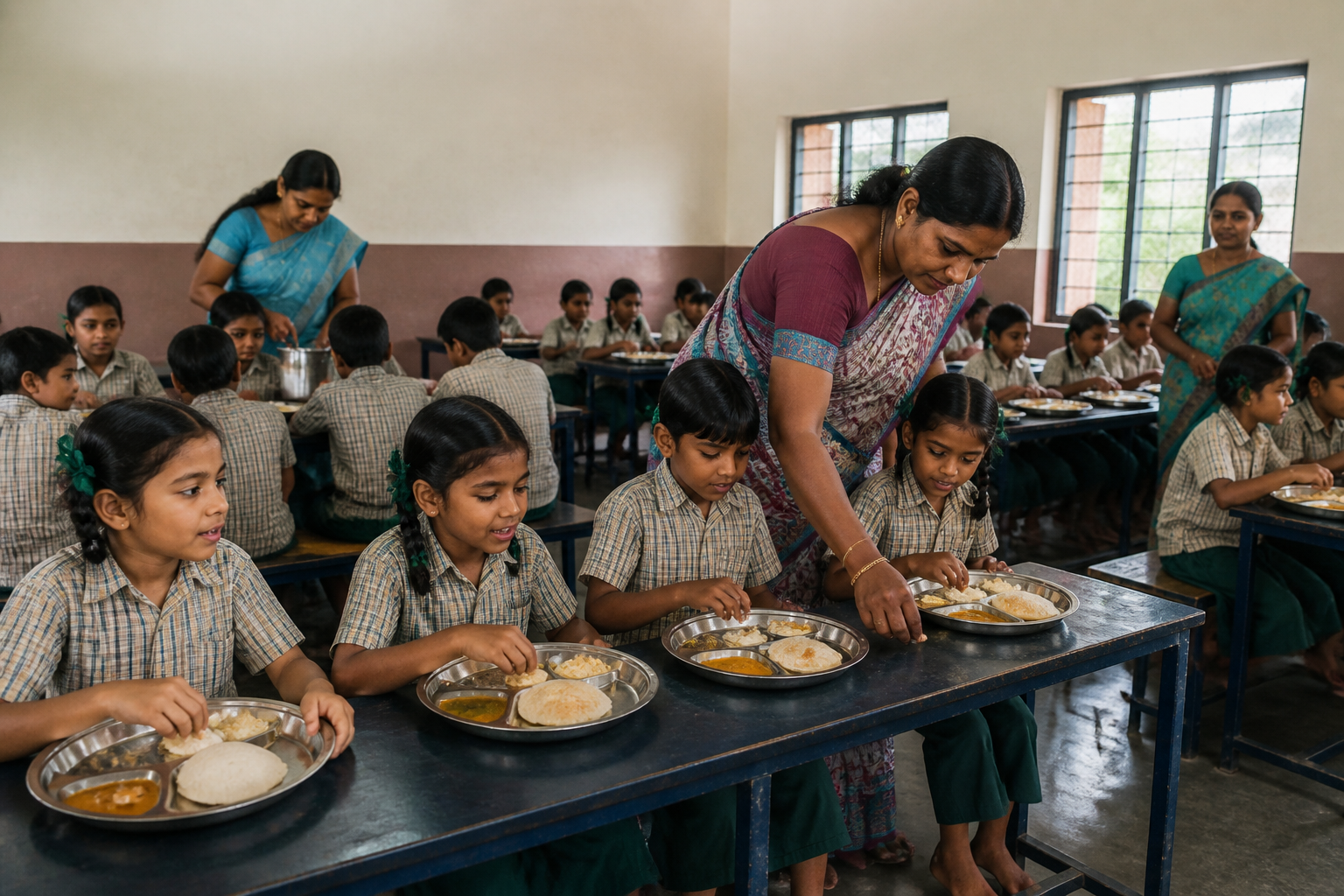
Tamil Nadu’s expansion of its breakfast scheme to students in Classes 6 to 8 is more than an increase in the number of children receiving a morning meal. It extends a state-built welfare system across 44,984 government and government-aided schools, placing nutrition, school attendance and the daily functioning of public education within the same policy framework.
Chief Minister C Joseph Vijay launched the expanded Perunthalaivar Kamarajar Breakfast Scheme at Chennai Middle School in Gandhigramam, Thiruvanmiyur, where he ate breakfast with students. The expansion adds Classes 6 to 8 to a programme that previously covered younger children. The state government has allocated an additional Rs 217.63 crore in the current financial year for the expansion.
With the latest move, about 34.64 lakh students in Classes 1 to 8 are expected to receive breakfast. The total allocation for the programme is Rs 724 crore. The government said the measure is intended to improve children’s nutritional status, prevent them from attending classes hungry and help them concentrate better on their studies.
The scale of the programme is significant because it links a household-level problem with an institutional response. The rationale cited for the scheme is that some children reach school without eating, either because they travel long distances or because their families face economic difficulties. A school breakfast therefore becomes part of the public education system’s operating environment rather than a separate nutrition intervention.
The programme’s expansion also shows how a policy can grow incrementally through existing administrative networks. It began in 2022 as the Chief Minister’s Breakfast Scheme for students in Classes 1 to 5. Its first phase, announced on May 7, 2022, covered about 1.14 lakh children in 1,545 schools at a cost of Rs 33.56 crore. The programme was launched that September with a rotating menu including upma, kichadi and pongal, along with rava or semiya kesari on some days.
Coverage widened in stages. The scheme reached corporation and municipal schools in February 2023, all government schools in August 2023, rural government-aided schools in July 2024 and government-aided primary schools in urban areas in August 2025. By that stage, the government said 17.53 lakh children across 34,987 schools were covered. Coverage of Classes 1 to 5 later reached about 19.34 lakh students before the latest expansion added older children.
This sequence is important because the programme did not rely on a single announcement to achieve scale. It expanded through school categories, administrative jurisdictions and age groups. Each stage brought new kitchens, procurement arrangements, distribution systems and monitoring requirements into the programme’s orbit, although the supplied material does not provide a detailed account of those operational systems.
The available attendance evidence provides the strongest indication of the scheme’s possible institutional effect. An early evaluation by the Tamil Nadu State Planning Commission examined 1,543 schools after the programme began in September 2022. Of these, 1,319 recorded increased attendance in January and February compared with the preceding June-July period.
In 1,086 schools, attendance rose by up to 20 percent, while 22 schools recorded increases of more than 40 percent. The evaluation also found that all beneficiary schools studied in Tirupathur, Perambalur, Ariyalur and Tiruvarur districts recorded gains. A comparison with 414 neighbouring schools located within one to two kilometres found a stronger positive attendance trend among schools covered by the breakfast programme.
These figures do not establish that breakfast alone caused every increase in attendance. The supplied report does not describe the evaluation methodology in sufficient detail to separate the programme’s effect from other factors. They do, however, indicate that the scheme was associated with a stronger attendance trend in the schools examined. That distinction matters as the programme moves from a targeted intervention towards a large statewide service.
The government’s stated policy logic combines three outcomes: nutrition, attendance and learning. The first is a direct input, because children receive food before classes. The second is an institutional measure, because schools track whether students attend. The third is an educational outcome that depends on several variables, including classroom conditions, teaching quality, household circumstances and health. The supplied material records the government’s intention to improve concentration and learning, but does not provide a statewide learning assessment of the breakfast programme.
The programme also sits within a much older history of public feeding in Tamil Nadu. Its roots are traced to 1922, when P Theagaraya Chetty, then president of the Corporation of Chennai and a Justice Party leader, introduced meals for underprivileged children in selected Chennai schools. About 800 students benefited between 1922 and 1925 before the programme was discontinued under the British administration. It was reintroduced in 1927.
In 1956, Chief Minister K Kamaraj expanded the idea across Tamil Nadu by providing midday meals to children from poor families for 200 days a year. Chief Minister M G Ramachandran substantially widened the programme in 1982 through the Nutritious Meal Programme, initially targeting malnourished children aged 2 to 9 in rural preschools and primary schools before extending it to urban areas and older students.
Successive administrations added new components. In 1989, the M Karunanidhi government introduced one boiled egg every fortnight. The frequency was progressively increased until children aged 5 to 15 were provided one egg on every school working day, with a 100-gram banana for children who did not eat eggs. In 2013, the J Jayalalithaa government introduced variety meals such as vegetable biryani, tomato, lemon and tamarind rice, and masala eggs.
The history shows that school meals in Tamil Nadu have evolved through additions to an existing public system. Breakfast is the latest layer in that system. It extends the time horizon of state-supported feeding from the middle of the school day to its beginning, responding to a different problem: children arriving in class without having eaten.
The nutritional case remains relevant beyond the school gate. NFHS-5 data for 2019-21 showed that 57.8 percent of Tamil Nadu children aged six to 59 months were anaemic. The report also cites studies that found high anaemia prevalence among school-age children and links poor dietary diversity with micronutrient deficiencies, including iron, vitamin A and zinc. The supplied material does not provide a current statewide measure of anaemia among the students now covered by the breakfast scheme, but it establishes the wider nutritional challenge against which the programme is being implemented.
Local experiments have also formed part of Tamil Nadu’s nutrition policy. Primary school children in Ariyalur received 50 grams of millet ladoo twice a day, while malnourished children in Perambalur received 100 grams of cookies and chikki daily. The government said such programmes improved the Body Mass Index of participating children. These examples indicate that the state’s approach has not been limited to a single standard menu, although the latest expansion’s nutritional composition and delivery arrangements are not detailed in the supplied report.
The administrative challenge now is one of maintaining consistency at scale. The programme covers 7,537 additional government and government-aided schools through the latest expansion. A service of this size requires reliable budgeting, food procurement, preparation, distribution and school-level coordination. The current allocation establishes the financial commitment, but the supplied material does not specify per-child costs, kitchen capacity, procurement contracts, staffing arrangements or mechanisms for measuring food quality.
That gap is central to understanding the next phase. Expansion can increase access, but the programme’s effect depends on whether meals reach children regularly and meet the intended nutritional purpose. Attendance data can show whether children are coming to school, while nutrition and learning outcomes require separate forms of measurement. The early Planning Commission evaluation provides an important attendance signal, but it does not by itself answer the wider question of long-term health or educational impact.
The urban dimension is also visible in the programme’s institutional geography. It began with selected schools and later extended through corporation, municipal, government and aided-school networks. The launch in Thiruvanmiyur connects the statewide policy to a specific Chennai school, but the programme now operates across urban and rural administrative settings. Its reach therefore depends on the ability of different local school systems to deliver a common public service.
Tamil Nadu’s breakfast scheme demonstrates how a welfare measure can become part of urban and regional infrastructure without being classified as conventional infrastructure. Schools are not only places of instruction; for many families, they are also points through which the state delivers nutrition, attendance support and social protection. The programme’s expansion makes that role more explicit.
What the evidence confirms is that Tamil Nadu has built a large and steadily expanding school-feeding system, with the breakfast component now reaching students up to Class 8 and carrying a total allocation of Rs 724 crore. The available attendance findings show a positive association in the schools studied, while the long policy history explains why the state has been able to extend the model over time. What remains less established is the programme’s statewide effect on nutrition, learning and household food security. Those outcomes will depend on how the expanded system is monitored as it moves from policy announcement to daily delivery across 44,984 schools.
