


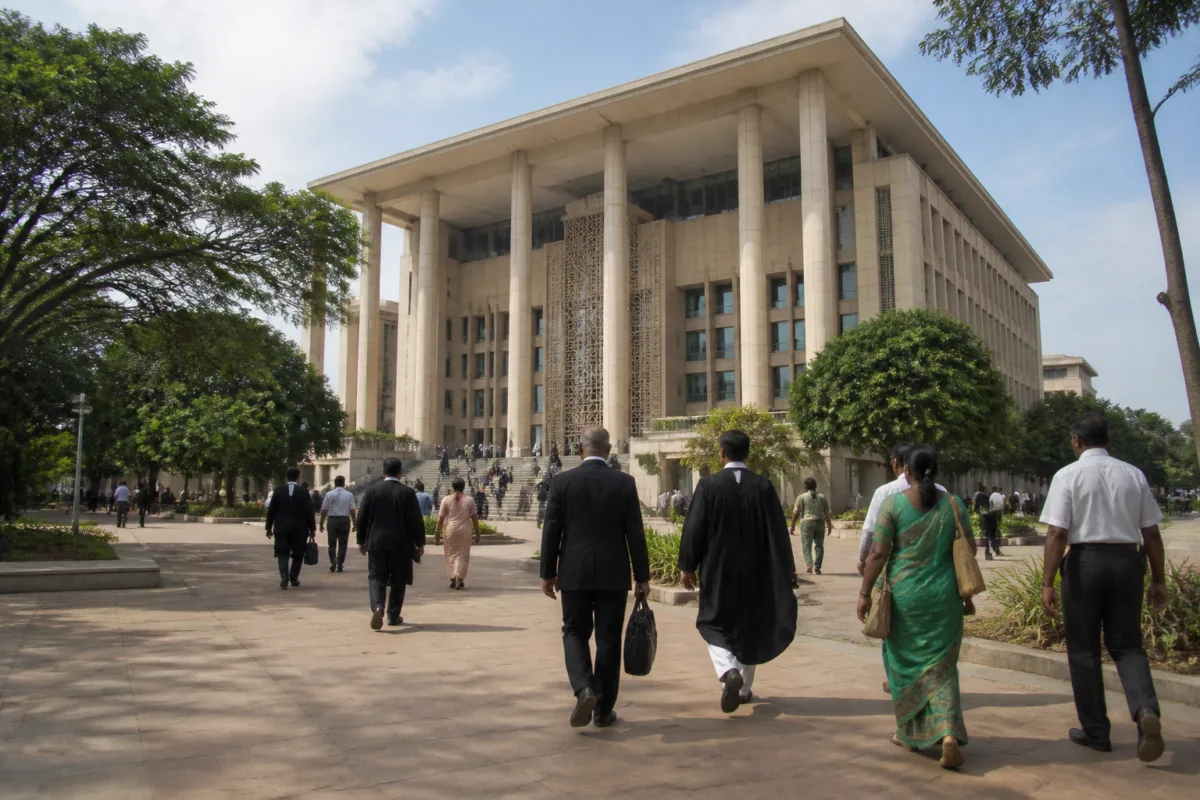
The proposal for a Supreme Court bench in Chennai has returned to the public debate with legal associations in Tamil Nadu and Puducherry backing Chief Minister C Joseph Vijay’s representation to Prime Minister Narendra Modi. Their support frames the issue not as a routine institutional relocation, but as a question of whether distance and cost are creating unequal access to India’s highest court for litigants from the southern states.
According to the Times of India report, the Bar Federation of Tamil Nadu and Puducherry and the Tamil Nadu Advocates’ Association welcomed the chief minister’s request for appropriate action to establish a regional Supreme Court bench at Chennai. The associations said the proposed bench would serve the southern part of the country and described the request as a long-standing demand of lawyers and litigants.
The immediate development is therefore limited but important: a political representation has received public support from organised sections of the legal profession. The report does not establish that the Union government, the Supreme Court or the Chief Justice of India has accepted the proposal. It also does not indicate that a location, timetable, budget or operating structure has been approved. The distinction matters because the proposal has been discussed on previous occasions without being implemented.
The central urban issue is access. India’s apex court is located in New Delhi, while litigants from southern states must travel to the national capital when their cases require proceedings before the Supreme Court. The associations describe the resulting burden as a “distance penalty”, linking geography to financial constraints and the ability of ordinary litigants to pursue remedies before the country’s highest judicial institution.
That description places court access within the same broader urban pattern seen in other public systems: national institutions are often concentrated in a single metropolitan centre, while the cost of reaching them is transferred to citizens who live far away. In the legal system, the burden can include travel, accommodation, repeated appearances and the coordination of lawyers and documentation across cities. The supplied report does not provide figures for these costs, but the associations’ statement identifies financial constraint and physical distance as the principal barriers behind their demand.
The proposal also exposes the difference between formal equality and practical access. Every litigant may have the same legal right to approach the Supreme Court, but the cost and logistics of reaching the court are not distributed equally across the country. For people living in the southern states, the associations argue, the location of the apex court can make that right more difficult to exercise. Their position is that a regional bench at Chennai would bring the administration of justice closer to the population it serves.
The constitutional mechanism cited by the associations is Article 130. They said the provision permits the Supreme Court to function from other places, provided that the Chief Justice of India recommends such an arrangement and the President approves it. This reference is significant because it places the demand within an existing constitutional route rather than presenting a regional bench solely as an administrative or political decision.
At the same time, Article 130 does not by itself establish that a bench will be created. The associations’ statement identifies the institutional steps they believe are necessary: consideration by the Chief Justice of India and the prime minister, followed by appropriate action. The report does not contain a response from either office, nor does it provide details on whether a formal proposal has entered a judicial or governmental review process.
This institutional uncertainty is part of the story’s significance. A regional bench would involve more than assigning courtrooms to another city. It would require decisions about jurisdiction, case allocation, judicial infrastructure, registry operations, staffing, technology, security, legal aid and the relationship between a Chennai bench and the Supreme Court’s principal seat. None of those implementation details is established in the supplied material. They are the practical questions that would determine whether a regional bench reduced access barriers or merely shifted some hearings geographically.
The demand also carries a federal dimension. The associations said a Chennai bench would reflect the “true federal character” of the nation and strengthen the independent character of the judiciary. Their argument connects the physical distribution of national institutions with the constitutional structure of India, where the effects of central decisions are experienced across states and regions.
That argument should be read as the stated position of the legal associations, not as an established conclusion. The report records their assessment that a regional bench would improve the administration of justice and make the apex institution more accessible. It does not provide an official judicial assessment, a government feasibility study or data comparing litigation access between regions. The available evidence therefore confirms the strength and continuity of the demand, but not the eventual institutional outcome.
The history outlined in the report is also important. The establishment of a regional Supreme Court bench has been discussed and proposed several times in the past, but has not materialised. This suggests that the present representation is part of a recurring institutional debate rather than the announcement of a completed policy. The new element is the current chief minister’s intervention and the public endorsement it has received from the two legal associations named in the report.
For Chennai, the proposal would place the city in the role of a possible southern judicial hub. The report does not identify a site or describe any construction plan, so there is no basis yet to assess land, transport, security or public-realm requirements. If the proposal advances, those urban questions would become inseparable from the legal and constitutional debate: how litigants, lawyers, court staff and visitors would reach the facility, how much supporting infrastructure would be needed and how the city would absorb a major national institution.
For the southern states, the argument is about more than the location of a building. It concerns the geography of constitutional remedies and whether the national institutions that decide matters of public importance are practically reachable from different parts of the country. The associations’ use of the term “distance penalty” gives the debate a clear citizen-facing frame, even though the source does not quantify the number of affected litigants or the cost of current travel.
The evidence currently supports three conclusions. First, the request for a Supreme Court regional bench in Chennai is longstanding and has not previously been implemented. Second, Tamil Nadu’s chief minister has made a representation to the prime minister, and legal associations in Tamil Nadu and Puducherry have publicly backed it. Third, the constitutional pathway cited by the associations involves a recommendation by the Chief Justice of India and approval by the President.
What remains uncertain is equally important. There is no reported decision from the Supreme Court, the Chief Justice of India, the President or the Union government. There is no announced timeline, administrative framework, jurisdictional plan, funding commitment or construction proposal. The next stage of the debate will therefore be determined not by the expression of support alone, but by whether the representation enters a formal process capable of addressing these institutional and operational questions.

