


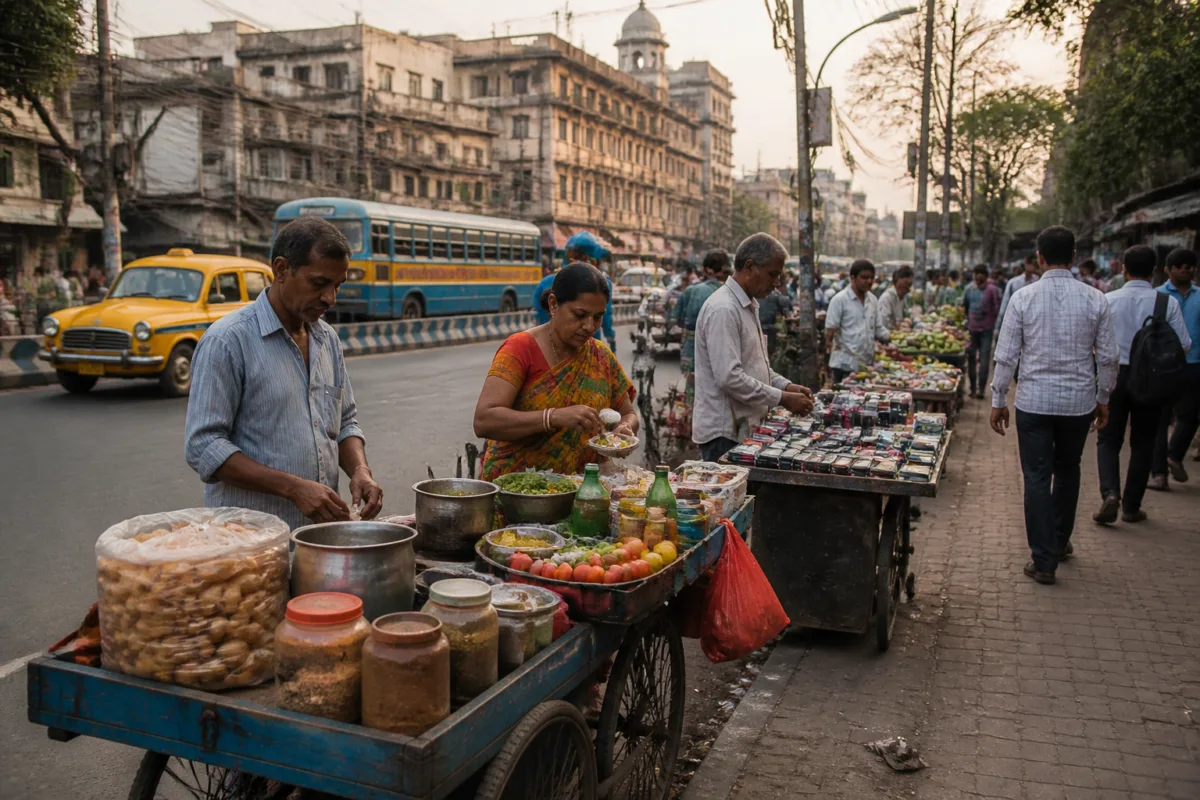
The Street Vendors Act in West Bengal has come under renewed focus after the Hawkers Joint Action Committee submitted a memorandum to Urban Development Minister Agnimitra Paul, seeking implementation of the central law across the state and stronger protection for vendors’ livelihoods.
The memorandum, signed by the organisation’s president Asit Saha and submitted at the minister’s office on Tuesday, alleged that the law passed in 2014 had not been properly implemented in West Bengal under the previous government. The organisation called for provisional town vending committees to be formed quickly in all municipal areas, followed by surveys and elections to establish permanent committees.
For Kolkata, the committee sought an immediate survey of all vendors under the Kolkata Municipal Corporation, along with registration and the issue of vending certificates. Such processes are central to determining who can legally vend in designated areas and how municipal authorities manage public space, although the report does not provide the current number of registered vendors or the status of the city’s survey.
The organisation also listed specific administrative gaps in towns and urban areas outside Kolkata. It called for the reconstitution of the inactive town vending committee in Siliguri, the formation of a committee and a survey under the Bidhannagar Municipal Corporation, and recognition of the committee in Rajarhat New Town so that its survey could be completed quickly.
In Darjeeling, the committee sought the early completion of an under-construction building intended for vendor rehabilitation. In Raiganj, it demanded the formation of a town vending committee and the issue of certificates to vendors.
The memorandum also raised concerns about access to loans under PM SVANidhi, the central scheme for street vendors. The organisation alleged that progress in West Bengal was not satisfactory and sought the minister’s direct intervention. The report does not include official figures on loan sanctions or disbursements, nor does it record a response from the state government.
Food-selling vendors’ need for training from the Food Safety and Standards Authority of India was another issue raised by the committee. It said that it was itself conducting training in the state as a member of the central board.
According to the organisation, its representatives had recently met the minister at Nabanna, where she assured them that the central street-vending law and state rules would be discussed. The committee said it expected a further meeting with the minister on the broader development of vendors.
The demands highlight how the effectiveness of street-vending regulation depends not only on legislation but also on functioning municipal committees, verified surveys, certificates, rehabilitation facilities and access to formal credit. The next public-interest question is whether the state and municipal bodies publish timelines or administrative decisions addressing these specific gaps.

