


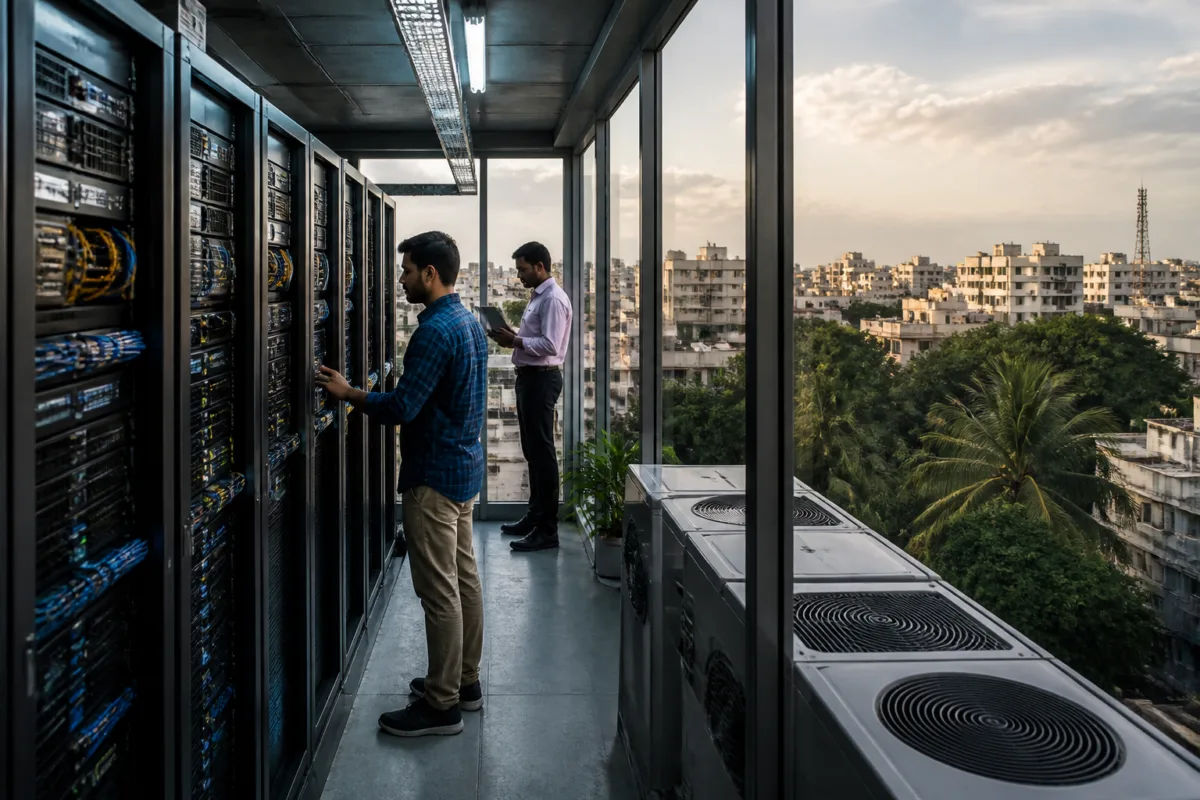
The proposal for small data centres, or “pico-clouds”, to support the use of artificial intelligence models points to a less visible but important infrastructure question: does every AI application need to depend on a large, centralised facility? IIT Madras director V Kamakoti has argued that smaller computing facilities could help bridge India’s AI divide while limiting the electricity and cooling demands associated with large data centres.
Kamakoti made the remarks while launching a conclave on AI governance at the IIT Madras campus. His argument rests on a distinction between training AI models and using them. Large language models may require large data centres for training, he said, but smaller data centres can be sufficient for inference—the process of using an already trained model to produce an answer, prediction or other output.
That distinction matters because AI infrastructure is often discussed as if training and everyday use require the same physical systems. They do not necessarily have identical computing needs. Training large models can demand extensive processing capacity, while inference can occur closer to the users or institutions that need it, depending on the application and the model involved. The IIT Madras proposal therefore shifts part of the conversation from building ever-larger facilities to distributing suitable computing capacity across more locations.
The available statement does not specify how many pico-clouds India would need, where they should be located, what hardware they would use or how they would be financed. It also does not establish the precise energy savings that could result. What it does establish is a strategic proposition: a national AI ecosystem may need both large facilities for model development and smaller facilities for deployment and access.
This is particularly relevant to the idea of an AI divide. If access to advanced computing is concentrated in a limited number of large facilities, institutions and communities without direct access to those systems may remain dependent on distant infrastructure and external service providers. Smaller data centres could potentially bring computing closer to users, but their effectiveness would depend on connectivity, technical skills, maintenance, cybersecurity and reliable electricity supply. None of these implementation details were provided in the IIT Madras remarks.
The infrastructure implications are also different from those of a conventional technology rollout. A large data centre is not simply a room filled with servers. It requires electricity, cooling systems, land, network connections and ongoing operations. Kamakoti specifically noted that large data centres need more electricity and cooling, and said such facilities are not necessary for inference from large language models. His position places resource consumption at the centre of the AI infrastructure debate.
Cooling is significant because computing equipment generates heat and must operate within controlled temperature ranges. The source material does not provide energy or water figures for either large data centres or pico-clouds, so it would be premature to quantify their comparative environmental performance. The more defensible conclusion is narrower: the choice between centralised and distributed computing will have consequences for energy systems and other natural resources, and those consequences need to be considered during planning rather than after facilities are built.
The governance dimension is equally important. Kamakoti said India should use AI responsibly and ensure that it does not adversely affect the country’s energy and other natural resources. That statement frames AI governance as more than a question of algorithms, privacy or employment. It also includes decisions about where computing infrastructure is built, who can access it, what resources it consumes and which institutions are responsible for monitoring its effects.
A distributed network of small facilities could create a different administrative challenge from a handful of large data centres. Centralised facilities may be easier to identify and regulate as major infrastructure projects, while smaller facilities could be spread across campuses, businesses, public institutions or local service networks. The source does not state whether such a regulatory framework exists or which agencies would oversee these facilities. That gap will matter if pico-clouds move from an institutional concept to a national infrastructure model.
The proposal also raises questions about the relationship between digital infrastructure and India’s existing urban systems. Data centres are generally discussed in terms of servers and software, but their operations depend on physical networks: power distribution, buildings, cooling equipment, fibre connections and secure sites. Smaller facilities could reduce the need for every application to connect to a distant central facility, but they would still require dependable local infrastructure. Their location would therefore influence both service quality and resource demand.
There is another potential benefit in distributing AI capability: it could allow institutions to tailor applications to local needs. IIT Madras has announced plans to release 500 videos on how AI is making India better and how technology can improve quality of life. The Centre for Responsible AI at IIT Madras is partnering with The Better India on the project, with each video expected to explore a different sector, including agriculture, space, legal services and manufacturing.
The video project is separate from the proposed pico-cloud model, but together the two initiatives show the breadth of the institution’s approach. One concerns public communication and sector-specific examples of AI use; the other concerns the physical and energy systems needed to make AI available. Wider adoption will require both. People and organisations need to understand what AI can do, but they also need access to infrastructure capable of delivering those applications.
The sector list mentioned by IIT Madras also indicates that AI deployment is not limited to technology companies. Agriculture, manufacturing, space and legal services operate across different institutional settings and have different data, security and reliability requirements. The source does not identify the specific applications to be featured in the videos or explain whether any of them will use small data centres. It does, however, underline that AI’s infrastructure requirements will extend beyond a narrow digital sector.
Employment is another part of the governance discussion. Professor B Ravindran, head of the Wadhwani School of Data Science and AI and the Centre for Responsible AI at IIT Madras, said AI need not replace all jobs. He argued that a job consists of different kinds of skills and that AI is not uniformly capable of replacing every one of them. Each job, he said, will have to be reimagined in light of AI’s impact.
That view moves the employment debate away from a simple replacement-versus-no-replacement question. It suggests that the effect of AI will vary within occupations, depending on the tasks that make up a job. The statement does not provide employment projections, sector-wise estimates or evidence of actual job losses or gains. It therefore cannot establish the scale of labour-market change. It does point to a need to examine how work is reorganised as AI tools become available across more sectors.
The central evidence from the IIT Madras event is consequently a set of linked propositions rather than a fully formed implementation plan. Large facilities remain important for training large language models. Smaller facilities may be sufficient for inference. More distributed access could help address an AI divide. Responsible deployment must account for electricity and other natural resources. And the effect on work should be assessed at the level of tasks and skills rather than through a single prediction about jobs.
What remains unresolved is how this model would operate in practice. The supplied material contains no cost estimates, technical specifications, deployment targets, energy benchmarks, location strategy or government policy framework for pico-clouds. It also does not say whether the proposal has been adopted by a public authority or converted into a funded programme. These are not minor details: they will determine whether small data centres become a practical complement to large facilities or remain primarily a concept in the AI governance debate.
For India’s cities and institutions, the larger question is how digital growth can be matched with physical and environmental capacity. AI adoption is often presented as a software challenge, but the IIT Madras intervention highlights the infrastructure underneath it. The next phase of the discussion will need to establish where computing should be located, how its resource use will be measured and how access can be widened without reproducing new forms of concentration. Until those questions are answered, pico-clouds offer a promising direction, but not yet a defined national solution.

