


The Siwan firecracker blast has killed six people, but the most consequential fact emerging from the debris is not only the scale of the explosion. Police say the premises used for manufacturing firecrackers had not had its licence renewed after 2010. That places the incident within a larger administrative question: how did a hazardous activity allegedly continue for years inside a house in Alampur village without a valid licence stopping it?
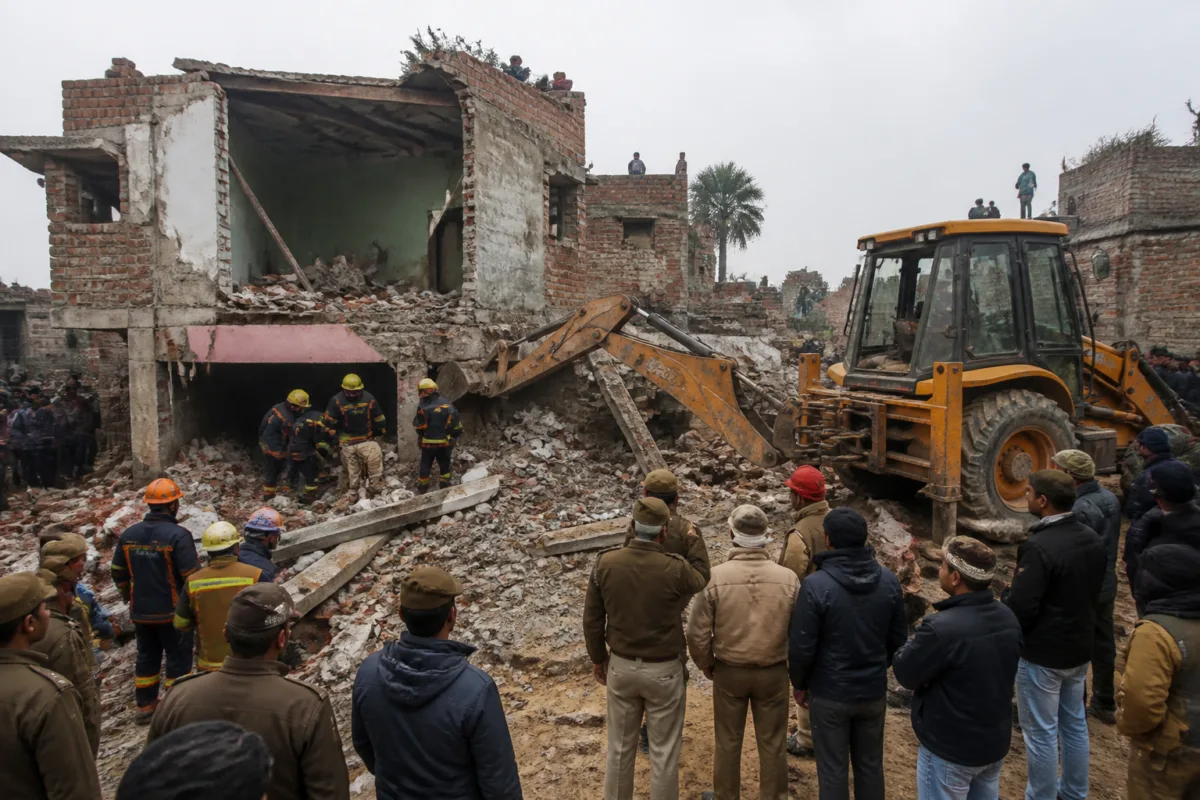
The latest development came when rescuers recovered the body of 21-year-old Muskan Siddiqui from the rubble four days after the explosion. She had been missing since the blast and was found during the demolition of the badly damaged house. The structure had been severely weakened, forcing the district administration to use heavy machinery during the search and debris-clearance operation.
Muskan’s recovery also corrected an earlier identification. Police had initially believed that another woman’s body was hers, but later identified that body as Ishrat Siddiqui, 20, daughter of late Marham Azad. Muskan’s family identified her remains at the site before the body was sent to Sadar Hospital for post-mortem examination. Police suspect she was inside the kitchen when the explosion occurred and that a section of the ceiling collapsed over her.
The confirmed toll now includes Amruddin Ahmad, 70; Khushbu Siddiqui, 10; Arshad Siddiqui, 8; Rajkumar, also known as Bhola, 35; Ishrat Siddiqui, 20; and Muskan Siddiqui, 21. The victims’ ages show that the blast affected people across a household and neighbourhood setting, rather than a formally separated industrial workplace. The available account does not establish the exact relationship of each victim to the manufacturing activity, but it does establish that the explosion occurred at a house where firecrackers were allegedly being made.
That distinction matters for understanding the governance failure. A licensing system is meant to do more than record that a business exists. For an activity involving explosive or combustible materials, licensing should identify the premises, establish operating conditions and give authorities a basis for inspection and enforcement. In this case, police said the firecracker licence had not been renewed after 2010. The central question is therefore not simply whether the unit had once been authorised, but whether the lapse was detected and acted upon.
The supplied account does not say when the administration last inspected the property, whether renewal applications were filed, whether any complaints had been received, or which agency was responsible for intervening after the licence expired. Those gaps are important because the incident appears to involve a breakdown across more than one stage of regulation. The unit allegedly continued operating, explosive material was present, and the activity took place in a structure that was ultimately so damaged that demolition became necessary before the search could be completed.
The blast also demonstrates how licensing records and physical risk can diverge. A licence may be formally expired while an activity continues on the ground. If enforcement depends mainly on applications, renewals or post-incident action, an unlicensed unit can remain invisible until a fire, explosion or structural collapse exposes it. The Siwan case, based on the police account, raises precisely that question without yet answering how the premises escaped detection.
The administrative response began after the explosion. Police and the district administration launched a crackdown on the illegal manufacture, storage and sale of firecrackers. Officials are examining the source of the explosive material and whether the unit had the required licence. These steps address the immediate enforcement problem, but the source material does not yet indicate how many other premises are being checked, whether inspections cover residential areas, or whether authorities have mapped licensed and unlicensed firecracker activity across Siwan.
That missing information is central to the public-interest value of the case. A crackdown can be broad or narrowly reactive. It can involve a systematic review of records and premises, or it can remain limited to seizures and action against units identified after the incident. The difference cannot be established from the available report. What is established is that the administration is now examining both the explosive material and the licensing status of the premises, while the police have publicly linked the licence to a renewal failure dating back to 2010.
The physical setting adds another layer. The explosion occurred at a house in Alampur village under Jamo Bazar police station. The damaged structure was not immediately safe for unrestricted entry, and the search had to be stopped after poor light interrupted the operation on Monday evening. It resumed on Tuesday morning, when rescuers found a foot and then recovered the body from the kitchen area. This sequence shows how an industrial or quasi-industrial hazard inside a domestic structure can turn rescue, identification and evidence collection into a structural-safety operation.
The use of heavy machinery was necessary because the house had been severely weakened. That does not by itself establish whether the building complied with any construction or safety requirement, and no such conclusion should be drawn from the available evidence. It does, however, show that the blast’s impact extended beyond the initial explosion. The administration had to manage an unstable building, a delayed recovery and the risk of further collapse while families waited for identification.
The identification error further illustrates the consequences of a high-energy incident in a confined setting. Severe burns made Muskan’s body and clothes difficult to identify, according to police. A body initially believed to be hers was later identified as Ishrat’s. Such mistakes are not merely procedural details for families. They affect post-mortem records, legal documentation, compensation processes where applicable and the accuracy of the official death toll.
The evidence currently supports a narrow but serious conclusion. The Siwan explosion killed six people at a premises where firecrackers were allegedly being manufactured, and police say its licence had not been renewed since 2010. The evidence does not yet establish who permitted the activity to continue, whether officials knew about it, how the explosive material was sourced, or whether other similar units remain active. Those questions require documentary and administrative findings rather than assumption.
The case also illustrates why enforcement cannot be measured only by the action taken after a disaster. The police and district administration have now begun a crackdown, and officials are investigating the material and licence. But the more difficult institutional test lies in reconstructing the period before October 23: the status of the premises, the licensing record, inspections, complaints, supply channels and the responsibilities of the agencies involved. Without that reconstruction, the response may identify one illegal unit without explaining the conditions that allowed it to operate.
For residents, the immediate issue is safety around homes where hazardous materials may be manufactured or stored. For the administration, it is the visibility and enforcement of licensing rules. For the wider built environment, it is the risk created when a dangerous activity occupies a structure not clearly separated from domestic life. The Siwan blast has made those issues visible through six deaths, a collapsed house and a licence that police say had been inactive for 16 years.
The next significant evidence will come from the ongoing examination of the explosive material, the licensing record and the administration’s crackdown. Those findings will determine whether the incident is treated as an isolated illegal operation or as evidence of a wider failure to monitor hazardous activities in residential settlements.

