


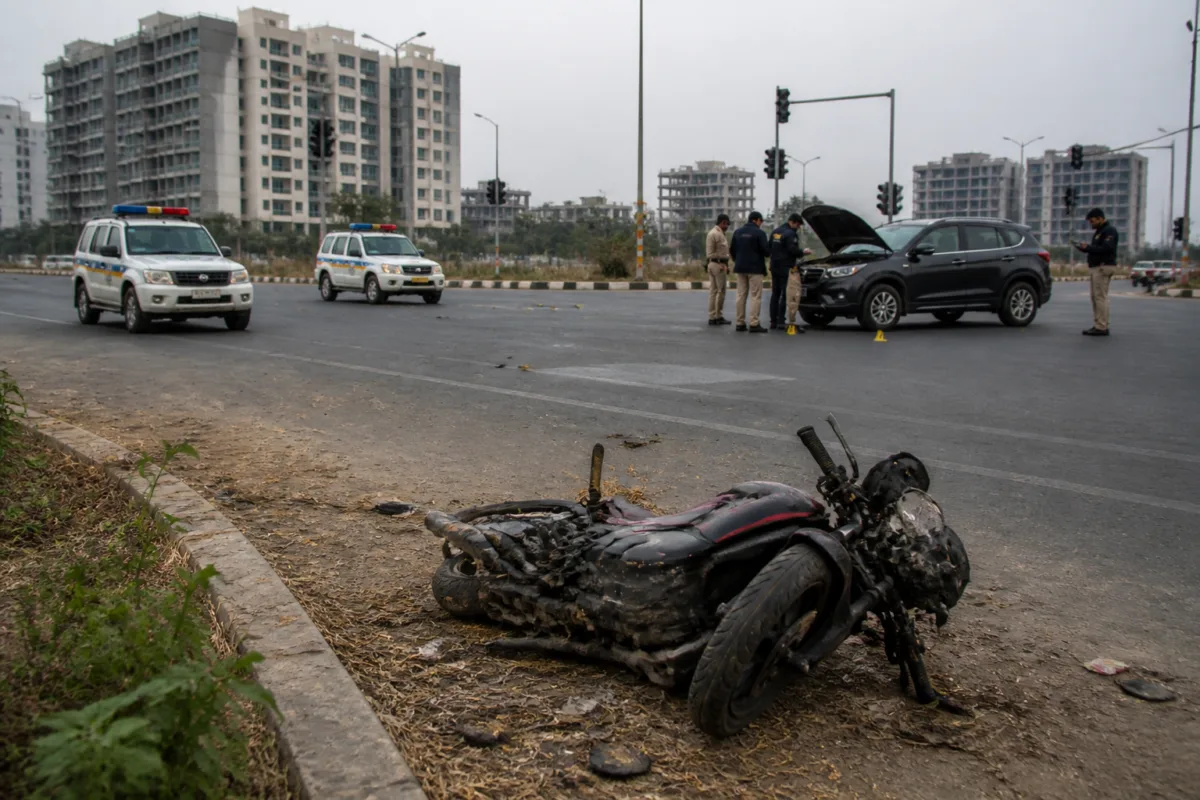
The Shela hit-and-run case in Ahmedabad has become a test of how police procedure operates when a fatal road crash involves the relative of a sitting legislator. A report by Gujarat Samachar says a motorcycle passenger died after a Range Rover allegedly struck the two-wheeler near Shela Circle, while the police account describes the collision as the result of a misunderstanding between the two vehicles. The report also raises questions about the timing of the suspect’s arrest, release on bail and blood test.
The supplied report identifies the suspect as Raghavendra Kushwaha, described as the nephew of Dinesh Kushwaha, the MLA from Bapunagar. It says the motorcycle was being ridden by a 50-year-old security guard who was also working part-time with Rapido. A passenger travelling on the motorcycle suffered serious injuries and later died during treatment. The rider sustained comparatively minor injuries.
The first issue requiring verification is the date of the crash. Several passages in the report identify the incident as having occurred on 11 October, while the police account reproduced in the same report refers to 11 November. Since the timing of the arrest, blood sample and subsequent legal action depends on the correct incident date, the FIR, station diary, arrest record and hospital documents would be needed to establish the chronology.
According to the complaint described in the report, the motorcycle had slowed near Gurukrupa Crossroads, close to Shela Circle, as the rider attempted to turn right. The complainant allegedly said that a car travelling at high speed and in a negligent manner hit the motorcycle after it had crossed most of the road. Both occupants fell. The passenger suffered injuries to the head, left leg and other parts of the body and was first taken to Sola Civil Hospital before being shifted to CIMS Hospital, where he died.
The report says the Range Rover left the scene after the crash. Its registration number was reportedly written down by a person present at the location and given to the motorcycle rider. Police later examined CCTV footage and identified a vehicle bearing registration number GJ 27 0600. The vehicle was seized and sent for forensic and Regional Transport Office examination, according to the DySP’s account carried by the report.
The police version differs in important respects from the complaint. The DySP is quoted as saying that both vehicles slowed and attempted to cross at the same time, creating a misunderstanding that led to the collision. The officer also said that the suspect claimed a vehicle ahead had suddenly stopped and that he had tried to avoid it before hitting the motorcycle. The report states that these versions are still subject to investigation and that technical reports are awaited.
The report says the suspect was traced to his home approximately 17 hours after the crash. It also says he was questioned and released on bail because the offences registered at that stage carried a sentence of less than seven years, according to the police explanation. The police said he had been served a notice requiring him to appear whenever called and that the investigation was being conducted by a police sub-inspector.
The timing of the blood test is central to the case because a delayed sample may affect the evidentiary value of testing for alcohol or other intoxicants. The report contains conflicting accounts on this point. It says the blood sample was taken approximately 30 hours after the accident, while also recording that the DySP initially avoided giving a clear answer about whether testing had taken place at the time of arrest. The police reportedly said that further legal sections could be added if the report showed consumption of an intoxicating substance.
The police have also disputed the suggestion that the vehicle was travelling at extreme speed. The DySP reportedly said the preliminary investigation did not indicate very high speed, although the exact speed would be examined through reports from the RTO, the Forensic Science Laboratory and the vehicle manufacturer. This creates a clear evidentiary divide between the complaint’s description of a vehicle travelling at full speed and the police’s preliminary assessment.
That divide illustrates why fatal road-crash investigations cannot depend only on verbal accounts. The legal significance of speed, evasive movement, road position, visibility, braking and the driver’s conduct after the collision must be established through the FIR, CCTV footage, vehicle damage, scene measurements, witness statements, forensic findings and medical records. In this case, the report says several of these processes were under way, but it does not provide the underlying documents or their final findings.
The case also exposes the institutional importance of the first few hours after a serious crash. The suspect’s location, the time of arrest, the condition of the vehicle, the collection of biological samples and the preservation of CCTV footage can affect the investigation. Where a death has occurred and the driver is alleged to have left the scene, the sequence of police actions becomes part of the public-interest story, independently of the suspect’s political connection.
The report says the vehicle was registered in the name of the suspect’s father, Mahesh Kushwaha. It further says the suspect had been returning from Kalol after attending a New Year party at a friend’s residence and was dropping friends when the collision occurred. These details are attributed to the police account and have not been independently established in the supplied material.
The police also reportedly said the suspect had no previous criminal case recorded against him at that stage, while adding that checks for other cases were continuing. The report says police planned to examine his call detail records to establish where he was during the period between the crash and his arrest. That inquiry is significant because the account of whether he remained at the scene, went home or appeared at the police station is itself disputed in the report.
The wider urban issue is not limited to one collision. Ahmedabad’s expanding edges combine high-speed vehicle movement, mixed land uses, construction activity, two-wheeler dependence and turning movements at busy junctions. A fatal crash at such a location raises questions about junction design and enforcement, but the supplied report does not include road-engineering assessments, speed-camera data, lighting conditions or a crash audit. Those questions therefore remain separate from the criminal investigation and cannot be answered on the evidence currently available.
The case also demonstrates the distinction between political association and legal proof. The suspect’s relationship to an MLA is relevant because the report says it has triggered public concern about police conduct. It is not, by itself, evidence that officers acted improperly or that the suspect received unlawful protection. Establishing that claim would require arrest records, the exact sections applied, bail documents, blood-collection records, CCTV evidence and statements from the investigating authorities.
At present, the supplied material confirms that a fatal collision occurred, that a motorcycle rider and passenger were involved, that a Range Rover was identified and seized, and that the police have offered an account of the collision and the subsequent investigation. It does not conclusively establish the vehicle’s speed, the suspect’s state of intoxication, the exact timing of the blood test, the reason for the delay before arrest or whether political influence affected police action.
The next decisive documents are the final forensic and RTO reports, the blood-test result, the call detail analysis, the CCTV assessment, the precise FIR and arrest timeline, and any court record relating to bail. The date discrepancy in the published account should also be resolved before the chronology is treated as settled. Until those records are available, the Shela hit-and-run case remains both a fatal road-crash investigation and an unresolved test of procedural transparency.

