


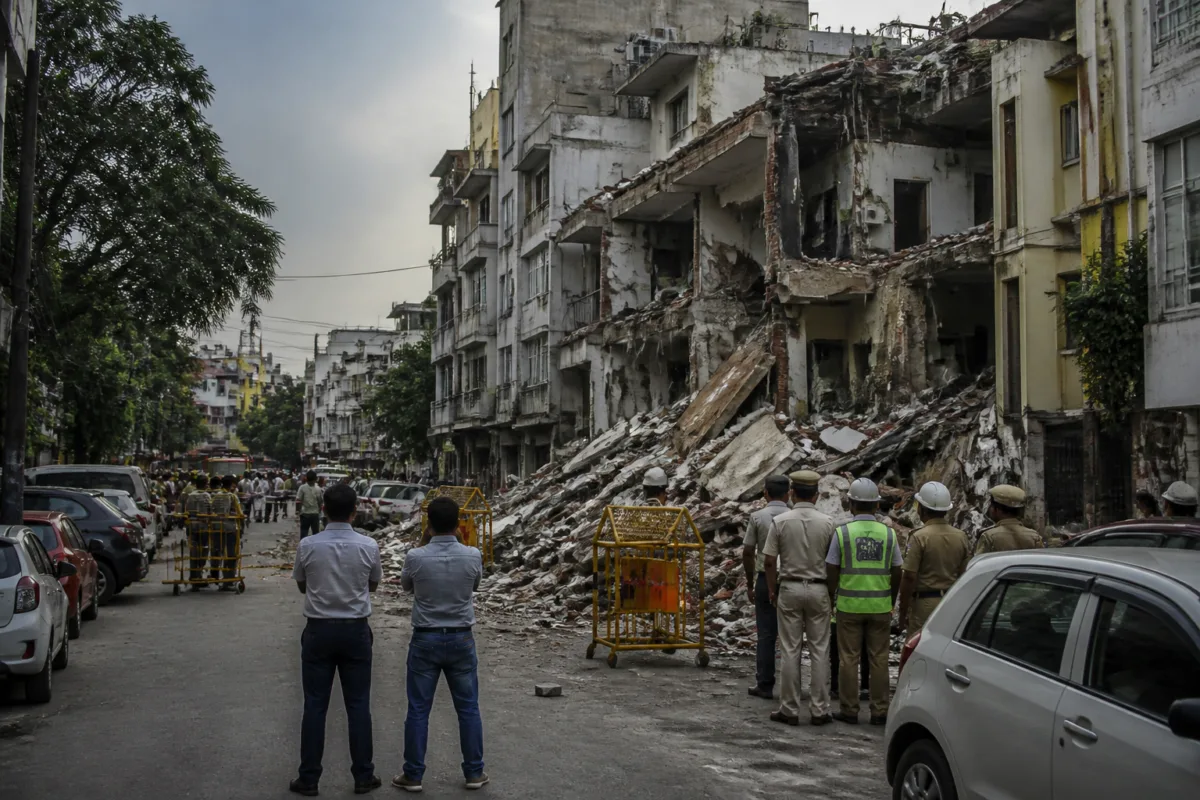
The Delhi Police chargesheet in the Satya Niketan building collapse, which killed seven people, has moved the case from an investigation into a formal prosecution involving six accused. The development is significant not only because it identifies those facing criminal charges, but also because the sections cited by the police place the tragedy within a wider chain of alleged failures involving danger to life, construction or repair work, injuries and damage to property.
The collapse took place at the Satya Niketan market in South Delhi on September 6. Several people were injured, according to the report by Jagran, while seven people died. The Delhi Police had registered a first information report at the South Campus police station. On Thursday, the police filed a chargesheet against six accused in the case.
The accused named in the chargesheet are Hari Ram Gupta, Urmila Gupta, Mahesh Gupta, Sanoj Kumar, Sudhanshu Lavneesh Kumar and Shubham Tyagi. The report identifies Hari Ram Gupta as the landowner. The chargesheet invokes several provisions of the Bharatiya Nyaya Sanhita, including provisions relating to negligent acts endangering life, common intention, culpable homicide not amounting to murder, negligence during the repair or construction of a building, intentionally causing hurt, and damage to public or private property.
The chargesheet is an important procedural step, but it is not a finding of guilt. The allegations will have to be tested before the court. The available report does not provide the full police account of how the building failed, the evidence collected during the investigation, the precise role attributed to each accused, or the court’s next hearing date. Those details matter because a building collapse is rarely understood fully through the final casualty figure alone. The central questions usually concern the condition of the structure, the nature of the work being carried out, the responsibility for authorising or supervising it, and whether warning signs were visible before the failure.
The legal provisions cited by the police indicate the broad direction of the investigation. The reference to negligent acts endangering life addresses the alleged risk created for people. The provision relating to common intention suggests that the police have attributed a coordinated or shared role to the accused, although the report does not explain the individual allegations against each person. The charge related to culpable homicide not amounting to murder reflects the seriousness with which the police have treated the deaths. The provision concerning negligence during building repair or construction connects the criminal case directly to the way work was undertaken at the site.
That connection is central to the urban safety question raised by the Satya Niketan collapse. In a dense market environment, construction and repair work do not affect only the owner or contractor. They can expose workers, tenants, neighbouring occupants, customers and passers-by to risk. A structural failure therefore becomes a matter of public safety as well as private property. The report, however, does not establish whether the building had received any prior notice, whether permissions were obtained, or whether any municipal inspection had taken place before the collapse. Those facts remain material to understanding the institutional chain around the incident.
The case also illustrates the difference between emergency response and preventive regulation. Once a building collapses, the criminal justice system can investigate deaths, injuries, negligence and property damage. It can identify accused persons and present a case before a court. But a chargesheet comes after the harm has occurred. It cannot by itself explain whether the building was monitored earlier, whether unsafe work was detected, or whether responsibility was divided among landowners, occupants, contractors and public authorities. The supplied report does not state whether any civic official or agency employee has been accused, suspended or questioned in connection with this case.
This distinction is especially important in markets and older urban neighbourhoods, where buildings may be modified over time for changing commercial or residential needs. The Satya Niketan report confirms that the police have included an offence relating to negligence during repair or construction. It does not, however, provide evidence about the building’s age, its approved use, the work under way, or the engineering findings. Those omissions prevent a more specific conclusion about the physical cause of the collapse. They also underline why the court record and the technical investigation will be important in the next stage.
The criminal case has several layers of accountability. First is the question of who controlled or carried out the work connected to the building. Second is whether the actions attributed to the accused created a foreseeable danger to people. Third is whether the deaths and injuries can be legally connected to those actions. Fourth is the question of whether property damage formed part of the same alleged conduct. The provisions listed in the chargesheet show that the police have pursued all four dimensions, but the report does not set out the evidence supporting each charge.
The naming of six accused also demonstrates that the police investigation has not been limited to a single individual. At the same time, the presence of multiple accused should not be read as proof that their roles were identical. The report names the individuals and lists the legal provisions, but does not distinguish the allegations against Hari Ram Gupta, Urmila Gupta, Mahesh Gupta, Sanoj Kumar, Sudhanshu Lavneesh Kumar and Shubham Tyagi. That distinction will be necessary for any clear assessment of responsibility.
For residents and users of Delhi’s built environment, the case raises a practical concern: safety enforcement is often judged after a failure rather than before it. The report provides no evidence that the collapse was preceded by a public inspection, a warning, an evacuation order or a recorded complaint. It also does not establish whether the authorities had identified the site as unsafe before September 6. Without those facts, it would be wrong to claim that the incident resulted from a particular regulatory failure. What can be established is that the tragedy has now entered a formal legal process that includes alleged negligence connected to construction or repair work.
The institutional roles around such cases are also different. The police investigate possible criminal conduct and file the chargesheet. The court evaluates the evidence and determines whether the accused should be tried and, ultimately, whether guilt has been proved. Civic agencies are responsible for the regulatory and administrative dimensions of building safety, but the supplied report does not identify the agency findings in this case. Keeping these roles separate is essential. A police chargesheet records the investigating agency’s allegations; it does not replace a judicial determination or a technical safety audit.
The case therefore needs to be followed through three kinds of documents and decisions. The first is the court’s treatment of the chargesheet and the charges against the accused. The second is the technical evidence explaining how the structure failed. The third is any administrative record showing whether the property had permissions, notices, inspections or prior complaints. None of these details is included in the available report. Until they become part of the public record, the causes of the collapse and the performance of the wider building-control system cannot be assessed conclusively.
The Satya Niketan collapse is thus more than a completed police filing, but the available evidence does not justify turning it into a final account of Delhi’s building-safety regime. It confirms seven deaths, injuries, an FIR at South Campus police station, and a chargesheet against six accused under several provisions of the Bharatiya Nyaya Sanhita. It also confirms that alleged negligence during construction or repair is part of the prosecution’s case. What remains to be established is how the building failed, what each accused allegedly did, whether any warnings were ignored and whether public authorities had information that could have enabled preventive action. The next significant developments will be the court’s consideration of the chargesheet and the disclosure of the technical and administrative evidence supporting the case.

