


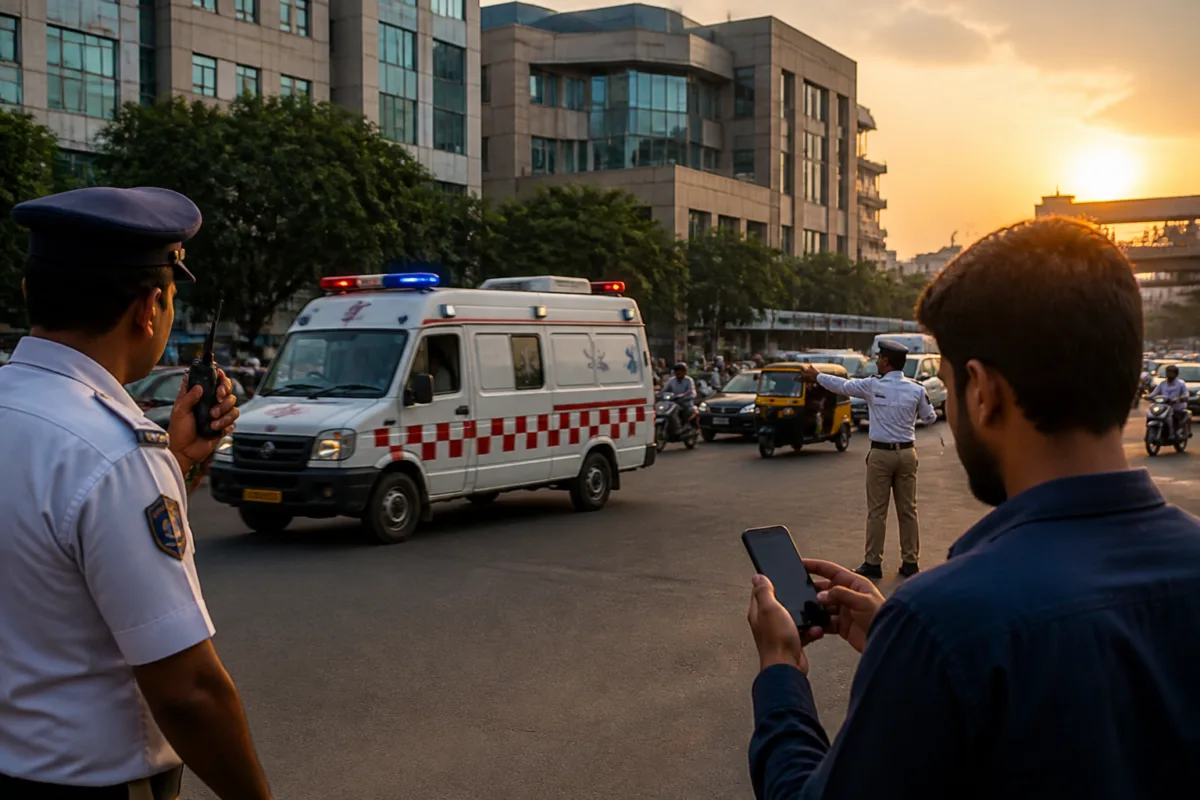
Four Hyderabad engineering students are developing Sarathi, a proposed emergency app that seeks to connect ambulance services, traffic police and hospitals on one digital platform. The project is significant not because it has already changed emergency response, but because it exposes a persistent urban problem: a medical emergency is often handled as a chain of separate tasks rather than as one coordinated journey from SOS alert to hospital handover.
The web-based platform is being developed by third-year Computer Science and Engineering students Ravi Raj Javvadi, Satvendra Giri Nihal Badam, Hrushikesh Anumula and Kalyan Reddy Bhoompally. According to the team, Sarathi would allow a user to raise an emergency alert, share their location, identify a nearby ambulance and receive navigation support. Once an ambulance is assigned, its location and estimated arrival time could be shared with other stakeholders involved in the response.
That proposed workflow places the app within Hyderabad’s wider urban infrastructure, where emergency response depends not only on the availability of an ambulance but also on information moving quickly between different institutions. Ambulance personnel need the patient’s location and relevant details. Traffic police may need advance notice of an approaching emergency vehicle. Hospitals may need information about an incoming patient so that medical teams can prepare. Sarathi is designed around the proposition that these exchanges should occur through a common system instead of disconnected communication channels.
The students describe the project as an effort to connect the entire emergency-response journey. Ravi Raj said the aim was to create a coordinated digital platform rather than rely on separate lines of communication. Nihal said that ambulance dispatch, GPS tracking and route guidance already exist in emergency services, but that the team’s focus is to bring ambulance personnel, traffic police and hospitals onto a common platform at the appropriate time.
This distinction is important. Sarathi is not presented as a replacement for ambulances, traffic management or hospital systems. Its proposed role is to coordinate information between them. In urban service delivery, that coordination layer can be as important as the individual systems themselves. A location-sharing feature may help identify where an emergency is taking place, but it does not by itself guarantee that an ambulance is available, that the route is clear, that traffic police receive the alert or that the receiving hospital can act on the information.
The project therefore raises a question about the structure of emergency mobility in cities: where does responsibility sit when a response crosses multiple agencies? An ambulance operator, a traffic authority and a hospital may each control one part of the process, while the patient experiences the entire sequence as a single emergency. Sarathi’s central idea is that the digital platform should reflect that experience by connecting the separate stages.
The evidence currently available does not establish that the system reduces response times. The team has not yet produced independently validated pilot results demonstrating an improvement. Instead, the students intend to assess the platform through measurable indicators, including the time between an SOS request and ambulance dispatch, ambulance arrival times, traffic-related delays and the time taken to communicate patient information to hospitals.
That proposed measurement framework is a useful departure from relying on broad claims about technology making services faster. Emergency response performance can be affected by several factors at once, including ambulance availability, road conditions, congestion, location accuracy, communications coverage and the readiness of the receiving hospital. Measuring the separate intervals could help show where a digital platform is making a difference and where the underlying operational constraint lies.
The distinction between a functioning platform and a tested platform is central to Sarathi’s current status. The students are still working towards validation and a controlled pilot in Hyderabad. They have no confirmed partnerships with hospitals, ambulance operators or government agencies yet, although they are seeking such cooperation. Without those institutional links, the proposed integrations remain designs rather than operational services.
The intended integrations include live traffic services, traffic police systems and hospital bed databases. Each would require technical access, permissions and cooperation from the relevant organisation. These requirements show why emergency technology projects cannot be assessed only as software products. A platform may be technically capable of transmitting an alert, but its usefulness depends on whether the responsible institutions can receive, interpret and act on that information in real time.
Hospital bed data also illustrates the difficulty of maintaining reliable urban information. The source material does not establish how such databases would be structured, updated or governed under Sarathi. It does establish that access to them would depend on cooperation from the relevant organisations. The same limitation applies to live traffic and traffic police systems. The proposed app’s reach will therefore be shaped by institutional permissions as much as by the design of its interface.
The project is being developed as a progressive web app, meaning it can be accessed through a browser and installed on compatible devices. This approach may reduce the need for users to download a conventional application, but the platform would still depend on dependable connectivity for live tracking, remote dispatch and real-time coordination. The students acknowledge that poor internet connectivity could disrupt these functions.
That limitation brings a second urban question into view: whether a digital emergency system can serve residents consistently across areas with unequal connectivity. The input does not provide a map of connectivity gaps or claim that Sarathi has solved the problem. It states that the team is exploring Internet of Things devices connected to satellite communication networks to transmit emergency information from areas with limited mobile connectivity. This remains a proposed future development and is not an operational feature of the platform.
The proposed satellite-linked approach also underlines the difference between resilience on paper and resilience in practice. A system designed for difficult connectivity conditions would require devices, network access, power, maintenance and operating procedures. None of those arrangements has been confirmed for Sarathi. At this stage, the students are exploring the possibility while focusing on validating the core workflows through a controlled pilot.
For Hyderabad, the project’s value lies in the problem it makes visible. Emergency response is often discussed through individual assets such as ambulances, roads, GPS systems or hospitals. Sarathi frames it as an information and coordination problem spanning all of them. The app’s proposed features—SOS alerts, location sharing, ambulance identification, route guidance, traffic notifications and hospital alerts—are intended to reduce the gaps between these assets.
However, the supplied information does not show that the city’s existing emergency services have adopted Sarathi or that any public authority has endorsed it. It also does not establish the number of ambulances, hospitals or traffic systems that could eventually be connected. Those details matter because a platform’s effectiveness would depend on coverage and participation. A system that reaches only a small part of the emergency network may not provide the continuity that its concept requires.
The next stage is therefore not a citywide launch but validation. Hrushikesh said the team wants to establish effectiveness through measurable results and controlled pilot testing rather than estimates of time saved. Kalyan said the immediate goal is to validate the core workflows and explore a controlled pilot in Hyderabad, while wider deployment would require collaboration with emergency services and evidence that the system works reliably in real-world conditions.
Sarathi should consequently be understood as a proposed coordination platform, not an operational emergency service. Its development offers a clear test of whether a city can connect existing emergency capabilities without creating another isolated digital tool. The outcome will depend on pilot evidence, institutional cooperation, access to live systems and the platform’s ability to function when connectivity is weak—the conditions under which emergency coordination matters most.

