


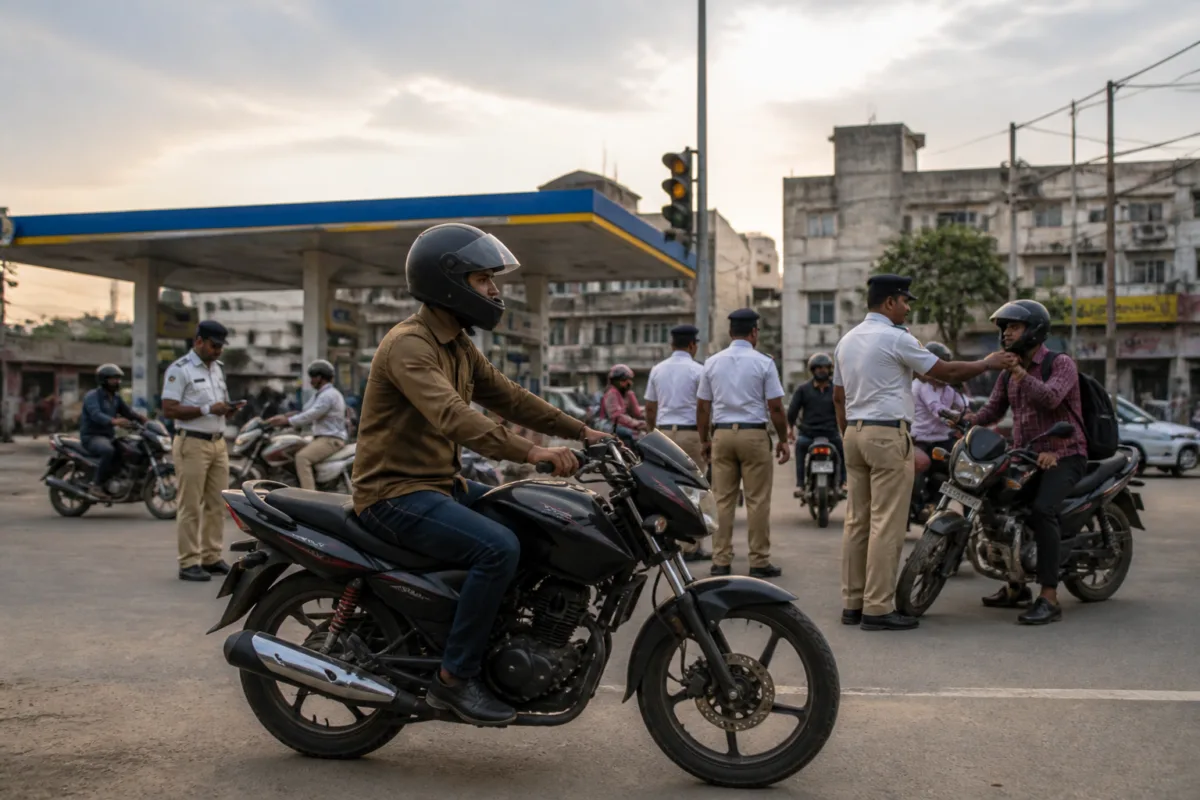
Rourkela’s road-safety problem is no longer only a question of whether police are conducting helmet checks. Police data cited by the Times of India show that 64 people died in road accidents involving helmetless riders in the Rourkela police district up to November 10, 2026, compared with 45 in the whole of 2025 and 37 in 2024. The increase points to a deeper urban enforcement problem: repeated drives and penalties have not translated into sustained helmet compliance on the city’s roads.
The figures also show that the consequences extend well beyond fatalities. In Rourkela, 69 people suffered grievous injuries and 27 sustained minor injuries in such accidents during the period covered this year. The comparable injury figures in 2025 were 30 grievous and 24 minor injuries, while in 2024 they were 27 and 18 respectively. The data therefore indicate both a rising death toll and a substantial increase in serious injuries associated with helmet non-use.
This makes helmet compliance an urban systems issue rather than a narrow traffic violation. Two-wheelers are embedded in everyday mobility across Indian cities, particularly for work, education, services and short-distance travel. When helmet use remains low, the risk is distributed across riders and pillion passengers, while the cost of severe crashes is absorbed by families, hospitals, police and the wider public system. The reported numbers do not establish the total number of two-wheeler crashes or the exact share attributable to helmet non-use, but they do show a clear rise in fatalities classified by police under that category in Rourkela.
The contrast with the wider Sundargarh police district is significant. Sundargarh recorded 70 deaths up to September 30, 2026, lower than the 108 deaths reported in 2024 and the 88 recorded in 2025. Of the 70 fatalities this year, 52 were riders and 18 were pillion passengers. The district also reported 65 grievous injuries and 23 minor injuries during the same period.
The district-level trend suggests that road safety outcomes are not moving uniformly across the region. In 2024, Sundargarh’s 108 fatalities included 72 riders and 36 pillion passengers. In 2025, the toll fell to 88, comprising 62 riders and 26 pillion passengers. Grievous injuries declined from 66 in 2024 to 53 in 2025, while minor injuries rose from 20 to 27. The 2026 figures show a lower fatality count than both previous years for the period reported, but the year-to-year comparison is not directly equivalent because the 2026 data run only until September 30.
The difference between Rourkela and Sundargarh raises an institutional question: why have measures that appear to be producing a decline at the district level not prevented a sustained increase in the Rourkela police district? The supplied data do not provide a definitive answer. They do, however, identify several parts of the enforcement chain that matter: routine checks, action against drunk driving, highway patrols, accident-prone locations, vehicle deployment and compliance at the point where riders purchase fuel.
Rourkela traffic deputy superintendent of police Sudarsan Panda said enforcement drives would be intensified in the coming days. Police sources cited in the report said helmet compliance remained low despite periodic drives. Triple riding and riding without helmets continue to be observed in several parts of the city. This suggests that enforcement has been periodic rather than sufficiently continuous to change daily behaviour, although the report does not provide the number of checks, penalties issued or repeat violations.
Sundargarh superintendent of police Amritpal Kaur described a broader enforcement arrangement across the district. Regular motor vehicle enforcement drives, including checks against drunk driving, were being conducted, she said. Two highway patrolling teams had been deployed along state highway-10, particularly at accident-prone locations. Five police stations — Birmitrapur, Rajgangpur, Bargaon, Sadar and Hemgir — were identified as highly accident-prone. GPS-enabled vehicles were also deployed in two shifts to prevent accidents and improve road safety.
These measures reveal how road safety is being administered: through police enforcement, targeted patrols and location-based deployment. But they also show the limits of measuring capacity by the existence of a drive or a patrol team. The relevant question for the public is whether riders wear helmets consistently, whether dangerous riding patterns are interrupted before a crash and whether high-risk locations receive sustained attention. The report provides evidence of enforcement activity, but not enough information to assess its frequency, coverage, penalty recovery or effect on repeat offenders.
The reported weakening of the ‘No Helmet, No Petrol’ campaign adds another layer to the implementation gap. The initiative was intended to make helmet use a condition for fuel access, creating a daily compliance point outside the road-policing system. Residents quoted in the report said the campaign had largely faded and petrol pumps were routinely serving riders without helmets. If accurate, that means a measure designed to reinforce enforcement through fuel stations is no longer operating consistently in practice.
This matters because road safety depends on more than post-violation penalties. A rider may avoid a traffic check on one road and still continue without a helmet elsewhere. A fuel-station rule, by contrast, could potentially reach riders during routine travel, but only if it is applied consistently and supported by clear responsibility for monitoring. The source material does not establish why the campaign weakened or which agency is responsible for its enforcement. That administrative gap itself is important: a safety measure can disappear from everyday practice even while formal enforcement drives continue.
The human behaviour described by residents also cannot be separated from the institutional response. S K Senapati, a senior citizen from Chhend, said riders should wear helmets for their own safety and called for more stringent action against violators. The comment reflects the familiar public-safety tension between individual responsibility and state enforcement. The available evidence shows that both remain unresolved in Rourkela: police report low compliance and plan stricter drives, while residents say enforcement alone will not work unless riders recognise the importance of helmets.
The numbers also caution against treating a decline in one geography as proof of a settled improvement. Sundargarh’s fatalities fell from 108 in 2024 to 88 in 2025, and stood at 70 through September 30, 2026. Rourkela, however, moved in the opposite direction, from 37 fatalities in 2024 to 45 in 2025 and 64 by November 10, 2026. The periods are not identical, and the data do not explain whether differences in traffic volume, road design, enforcement coverage, vehicle mix or reporting practices account for the divergence. What they do show is that district-wide averages can conceal serious deterioration within a major urban centre.
For Rourkela, the immediate policy challenge is therefore not simply to announce another enforcement campaign. It is to make helmet compliance measurable across time and location, connect police activity with injury and fatality outcomes, and clarify whether measures such as the fuel-station campaign are being implemented. The source report does not provide these operational indicators, so it is not possible to determine which intervention has worked or failed.
What the evidence confirms is narrower but serious: helmetless road fatalities in the Rourkela police district have risen sharply, injuries have also increased, and police acknowledge that compliance remains low. Sundargarh’s broader figures show a different trend but continue to record dozens of deaths and serious injuries. The next developments to monitor are the intensified enforcement drives announced by Rourkela police, the continued deployment of patrol teams and GPS-enabled vehicles in Sundargarh, and whether the ‘No Helmet, No Petrol’ measure is restored in practice.

