


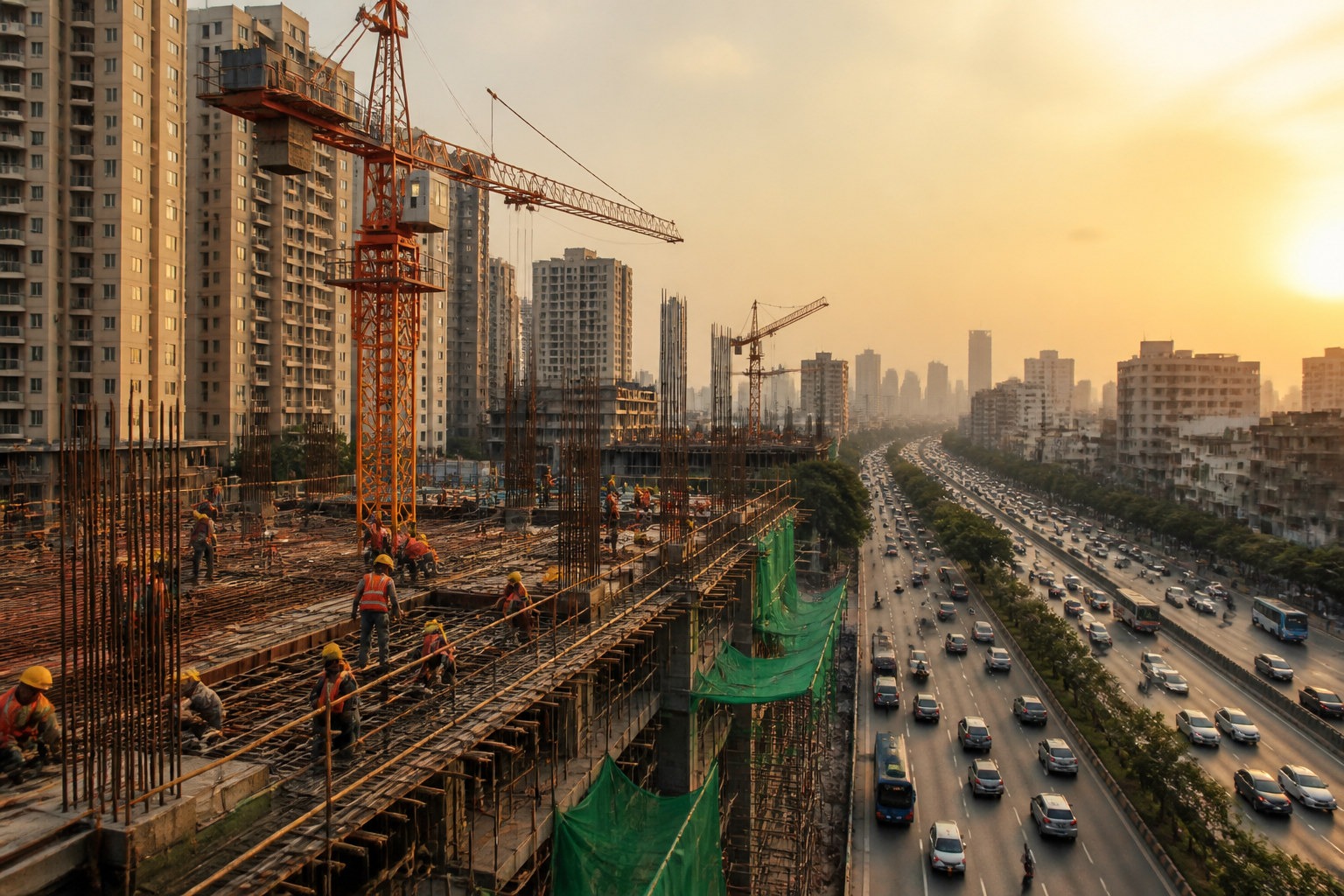
The RBI repo rate has been raised to 5.50% as the central bank responds to widening inflation pressures, even while upgrading its assessment of India’s economic growth. The decision creates a more complicated operating environment for housing, construction and infrastructure: demand remains resilient, but the cost of borrowing is moving higher just as the central bank signals that near-term rate cuts are unlikely.
The Monetary Policy Committee unanimously raised the policy repo rate by 25 basis points, while changing its stance to calibrated tightening in a 4-2 vote, according to the Economic Times report on the policy announcement. The Standing Deposit Facility rate now stands at 5.25%, while the Marginal Standing Facility rate and bank rate have risen to 5.75%.
For urban India, the significance lies in the combination of these decisions rather than in the rate increase alone. Housing is financed through a chain that includes homebuyers, developers, non-banking finance companies, banks, contractors and suppliers. Infrastructure projects also depend on credit conditions, particularly during construction, when expenditure occurs before assets begin generating revenue. A higher policy rate can therefore affect both household affordability and the financing assumptions behind new supply.
The increase is the first in nearly four years, the report said. RBI Governor Sanjay Malhotra indicated that the inflation outlook was no longer as benign as it had been last year and that rate cuts were not expected in the near term. Future policy action, he said, would be either a rate hike or a pause, depending on economic conditions and the outlook.
That guidance matters for the built environment because housing and construction decisions are sensitive not only to the current lending rate but also to expectations. A buyer assessing a long-term home loan, or a developer planning a multi-year project, must estimate financing costs over a period in which monetary policy may remain restrictive. The RBI’s stated preference for a pause or further tightening removes the immediate prospect of cheaper credit supporting demand.
At the same time, the policy does not describe an economy in retreat. Real GDP growth stood at 7.8% in the first quarter, supported by consumption and investment activity, which rose by nearly 12%, according to the report. The RBI has projected annual real GDP growth at 7.1%, with growth estimated at 7.2% in the second quarter, 6.9% in the third quarter and 6.8% in the fourth quarter. Growth in the first quarter of the following year is projected at 7.1%.
The 40-basis-point upward revision to the annual growth forecast indicates that the central bank sees enough economic strength to absorb tighter financial conditions. The report said manufacturing and services purchasing managers’ indices remained in the expansion zone during the second quarter, although the pace of expansion slowed from the previous quarter. Private consumption also remained broadly resilient, supported by discretionary spending.
For cities, this creates a split picture. Strong investment activity and the government’s infrastructure push can sustain demand for roads, transport systems, buildings and urban services. The report also identified strong capacity utilisation and robust credit flows as supports for investment. But a tighter policy stance can make the funding of those activities more expensive, particularly where projects depend heavily on borrowed capital or where construction schedules are vulnerable to financing delays.
The inflation numbers explain the shift. Headline inflation rose to 4.2% in August after remaining at 3.9% for three consecutive months. Food and fuel inflation increased partly because of unfavourable base effects. More significantly, the report said the weighted share of items recording inflation above 4% rose to about 37% in August. Core inflation also increased, while higher inflation appeared across a larger share of the consumer price index basket.
The RBI has projected consumer price inflation at 5.2% for the year, with estimates of 4.9% in the second quarter, 6% in the third quarter and 5.7% in the fourth quarter. Core inflation is projected at 4.4%. The spread of price pressures is important for construction because input costs do not move in isolation from household budgets. When food, fuel and other essentials become more expensive, households have less flexibility for rent, down payments, home improvements and discretionary purchases. Fuel and broader input pressures can also affect transport and construction logistics.
The policy response is also linked to international conditions. Malhotra cited the re-escalation of the West Asia conflict in September, volatile global crude oil prices, rising bond yields in advanced economies, an appreciating dollar and continuing trade uncertainty as factors contributing to financial-market volatility. Escalating energy costs and food prices, the report said, were expected to push up global inflation and encourage tighter monetary policy in major economies.
These external pressures expose the urban economy’s dependence on systems beyond municipal control. Cities may approve projects, developers may secure land and contractors may mobilise labour, but the cost of moving materials, financing construction and maintaining household purchasing power is affected by energy markets, exchange-rate conditions and central-bank policy. The RBI’s comments therefore place urban development within a wider macroeconomic chain rather than treating it as a purely local planning issue.
The report said the adverse impact of energy prices and supply-chain pressures was being contained through active diversification of supply sources. It also identified deficient southwest monsoon conditions and strong El Niño conditions as risks to agriculture and rural demand, while noting that foodgrain buffers and government policy interventions were expected to mitigate those risks. For cities, weaker rural demand could affect labour mobility, consumption and the flow of income between urban and rural economies, although the supplied material does not quantify those effects.
The urban demand outlook remains supported by services activity and broadly stable employment conditions, according to the governor’s assessment. Services exports are expected to remain buoyant, while bilateral trade agreements are expected to support merchandise exports. These factors can sustain employment and consumption in cities even as borrowing becomes more expensive. However, the policy evidence points to resilience rather than immunity: the RBI also noted some weakness in non-durable goods and domestic air passenger traffic, while the pace of expansion in manufacturing and services moderated from the previous quarter.
The central urban question is whether investment momentum can continue without weakening affordability. A rate hike may help contain inflation and protect macroeconomic stability, but it also changes the financial arithmetic of housing and infrastructure. Existing borrowers may face higher repayment costs depending on loan structures and transmission by lenders. Prospective buyers may reassess home purchases, while developers may review project phasing, pricing and borrowing requirements. The supplied report does not establish the size or timing of these effects, so their eventual scale will depend on how financial institutions transmit the policy decision and how inflation evolves.
The RBI’s decision also shows why infrastructure spending cannot be assessed only through announced project values. The central bank expects government infrastructure activity, credit flows and capacity utilisation to support investment, but those same projects require financing conditions that remain viable across several years. A tighter monetary stance may coexist with strong public investment, yet it can raise the cost of execution for contractors, lenders and project authorities.
The policy package includes financial-market and account-aggregation measures alongside the rate decision. The RBI is allowing interoperability among non-banking financial company account aggregators and facilitating the inclusion of deposit-account information in consolidated statements prepared by Securities and Exchange Board of India-regulated depositories. These measures are expected to be implemented by the end of the year. The governor also said the RBI would constitute a technical consultative committee for financial markets.
The immediate evidence is therefore mixed but coherent. India’s growth outlook has strengthened, investment remains a major support and urban demand has not collapsed. At the same time, inflation is broadening, global risks are elevated and the RBI has moved towards calibrated tightening. For housing, construction and infrastructure, the next phase will be defined not by a single rate increase but by whether growth remains strong enough to offset higher financing costs while households and businesses absorb wider price pressures. The next policy decisions will show whether the current hike becomes a pause or the beginning of further tightening.
