


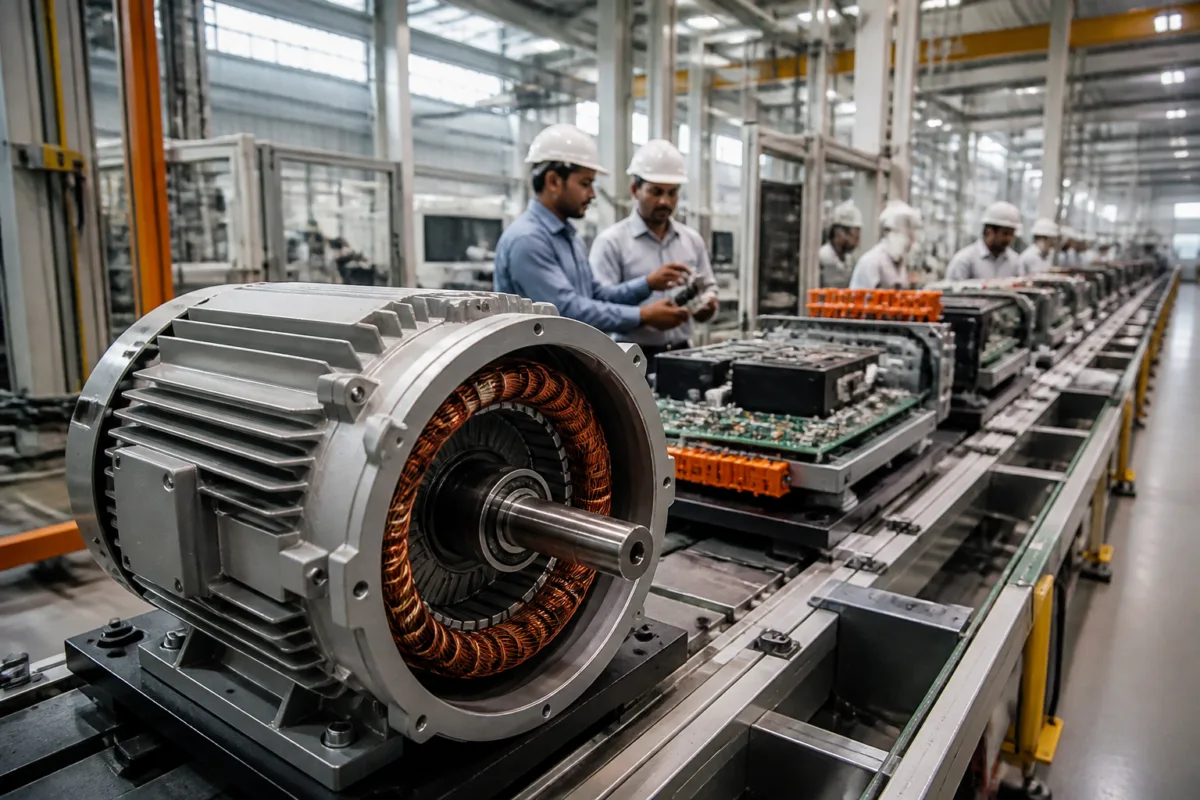
Vimag Labs’ plan to scale rare-earth-free electric motors from its Haryana facility is more than a company expansion story. It highlights a structural challenge for India’s electric mobility and industrial ambitions: building domestic control over the technologies and materials that determine whether electrification can scale reliably.
The company is targeting revenue of ₹100 crore in the 2027-28 financial year as it moves from technology development to commercial deployment. Its first manufacturing facility, located at MET City in Jhajjar, is intended to serve electric mobility, industrial equipment, commercial vehicles and strategic applications such as defence and aerospace.
Vimag’s stated proposition is a patented Virtual Magnet Synchronous Motor, or VMSM, which uses electronically controlled, software-defined magnetic fields instead of physical permanent magnets. According to CEO and co-founder Manish Seth, the technology is designed to eliminate the need for rare-earth permanent magnets while delivering comparable or superior efficiency, power density and overall motor performance. These performance claims are those of the company and have not been independently established in the supplied material.
The significance of the technology lies in the supply chain behind conventional electric motors. Rare-earth resources and processing capabilities are geographically concentrated, creating exposure to price volatility and geopolitical uncertainty. For a country seeking to expand electric vehicles, domestic defence manufacturing and advanced industrial production at the same time, dependence on imported critical inputs can affect both cost and continuity of supply.
This vulnerability is especially relevant to electric mobility because the motor is not an isolated component. It works with controllers, inverters, charging systems, power distribution equipment and semiconductor technologies. A domestic motor technology, even if commercially successful, therefore addresses only part of the broader manufacturing system. Vimag’s own expansion plans acknowledge this interdependence by covering motor controllers, power electronics and associated control systems alongside motors.
The company’s facility at MET City currently spans 10,000 square feet and is designed for digitally connected production, advanced automation and quality-controlled manufacturing. Vimag plans to invest ₹50 crore in the facility in phases and says the site can be expanded to 20,000 square feet. The scale of this investment indicates that the immediate challenge is not only inventing a motor but creating repeatable production capacity and integrating the motor with the electronics required for deployment.
Vimag has said that it has already exported its first production batch of controllers to the United States and Germany. It also plans to develop higher-power motors and propulsion systems, including applications exceeding 570 kilowatts, in the next few months. The company’s stated mobility focus includes two-wheelers, three-wheelers, electric buses and trucks, while its industrial ambitions extend to commercial vehicles and equipment.
That range matters because India’s electric mobility market is not a single technology segment. Two-wheelers and three-wheelers have different operating patterns and cost pressures from buses and trucks. Higher-power commercial applications also require more demanding thermal, control and reliability systems. The supplied material does not establish which vehicle categories will generate the company’s first large-scale commercial volumes, but the product strategy indicates an attempt to build a platform across multiple power segments rather than a single vehicle niche.
The company is also relying on an exclusive technology licensing, manufacturing and commercialisation agreement for a high-voltage power-electronics platform developed in the United States. The platform covers inverters, charging systems and power distribution capabilities and supports architectures of up to 1,200 volts. This arrangement shows that localisation does not necessarily mean producing every part of the technology domestically. Instead, Vimag’s model combines its motor platform with licensed international power-electronics capabilities.
That distinction is important for understanding India’s advanced manufacturing transition. Domestic production can reduce exposure to imported components without immediately creating a fully self-contained supply chain. At the same time, licensing arrangements can introduce their own commercial and technology dependencies. The supplied material does not provide the terms of the agreement, the share of locally manufactured content or the extent of technology transfer, so the long-term depth of localisation cannot yet be assessed.
Vimag’s business plan is being supported by a $5 million Series A funding round led by Accel, with participation from Chakra Growth Fund and Thinkuvate. The company says it intends to use its technology across electric mobility, industrial equipment, drones, high-performance electromechanical systems, defence and aerospace. These markets have different procurement processes, certification requirements and production cycles, although the supplied report does not provide details on approvals, customer contracts or confirmed order volumes.
The company’s ₹100-crore revenue target for 2027-28 is therefore best understood as a commercial milestone rather than evidence of established market scale. Vimag says it is in deployment mode and has begun production, but the information available does not disclose current revenue, production volumes, confirmed vehicle integrations or the number of customers using its motors. Those indicators will determine whether the technology moves beyond pilot deployments into sustained manufacturing demand.
For urban India, the importance of this transition is tied to the way electric mobility is built into city systems. Two-wheelers and three-wheelers affect daily commuting and last-mile connectivity. Electric buses and trucks influence public transport and urban freight. Industrial equipment supports the manufacturing and logistics networks that cities depend on. Motors and power electronics are therefore part of the operating infrastructure of electrification, even when they are not visible to commuters.
The urban question is not simply whether India can assemble more electric vehicles. It is whether the country can create a resilient component ecosystem capable of supporting vehicles and infrastructure at different power levels, with manageable exposure to imported materials and external supply shocks. Vimag’s rare-earth-free motor is one company’s response to that question, but its commercial progress will depend on manufacturing reliability, performance validation, integration with vehicle systems and the ability to win repeat orders.
The next phase will provide the clearest evidence. Vimag has said it will expand into higher-power motors and propulsion systems, continue production at its Jhajjar facility and pursue international markets. Its first controller exports and planned ₹50-crore facility investment establish early milestones. The more consequential test will be whether the company can convert its patented platform and initial production into dependable, scaled deployment across India’s electric mobility and industrial sectors.

