


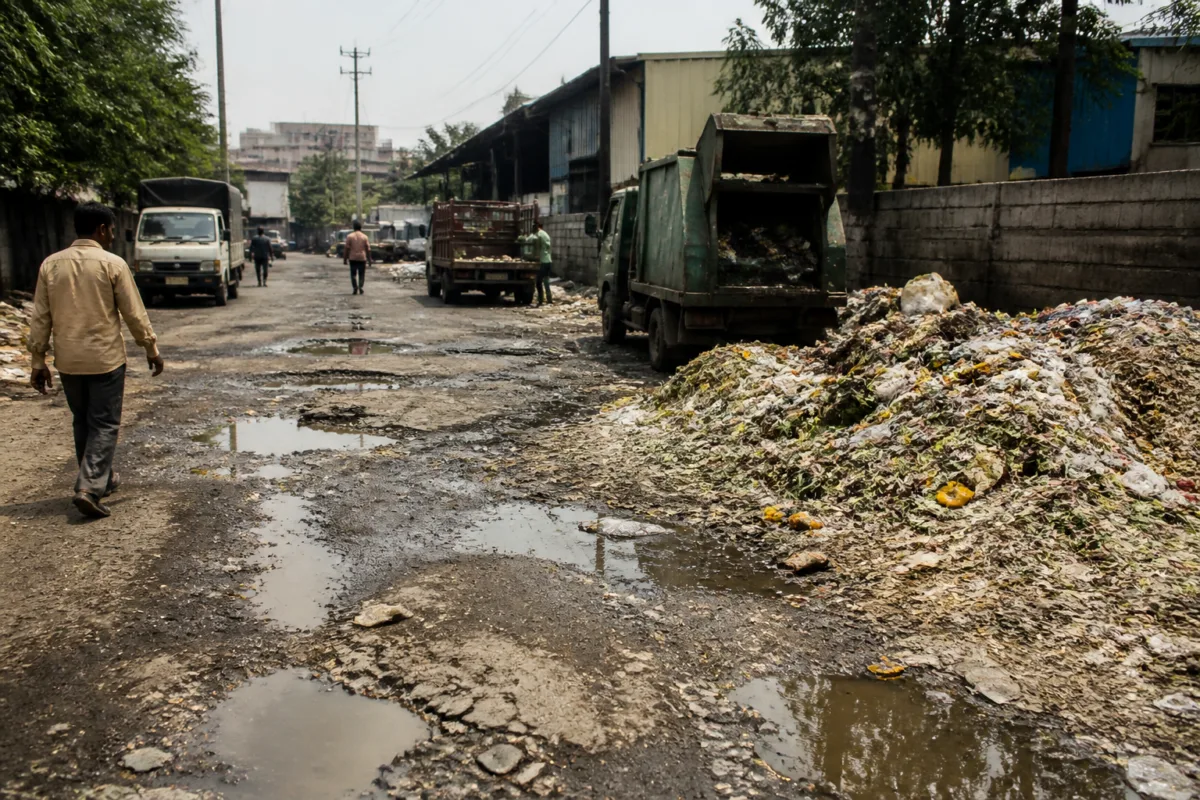
Pune’s Ramtekdi Industrial Estate has become a test of how the Pune Municipal Corporation (PMC) delivers basic civic services to industrial areas, with businesses reporting unrepaired roads, repeated garbage dumping and complaints that were closed without resolution.
Entrepreneurs and workers in the estate told Pune Mirror that Lane 1 has no proper road surface and has turned into an open dumping ground for wet and food waste. They said other lanes, including 1A and 2A, have also deteriorated because of potholes, pipeline work and alleged dumping of industrial waste.
The complaints are not new. According to the report, individual complaints have been filed with the PMC since 2023. Members of the industrial association brought civic officials to the site in July 2025. Following an inspection on July 20, PMC engineers reportedly assured the association that the road would be cement-concreted within 15 days. The work, however, had not taken place when the issue was reported.
Yash Lunavat, owner of Bluemark Promotions LLP, said he and association members had also met Additional Commissioner Omprakash Divate before the inspection. “It has been around 500 days, no action taken,” he said, according to Pune Mirror.
Lunavat said one industrial plot pays approximately Rs 8.78 lakh a year in property tax, including Street Tax and Conservancy Tax. He alleged that garbage is dumped on the road daily and sorted there, while a complaint to the PMC was closed without the problem being resolved. He also said two employees had contracted dengue.
The dengue claim was made by Lunavat and was not independently substantiated in the report. The account nevertheless points to the overlap between waste-management failures and workplace conditions in an industrial estate used by businesses and their employees.
Abhijit Yemul, owner of Dyna Filters, said the roads had not been resurfaced in nearly 15 years. He attributed their further deterioration to pipeline work, potholes and illegal dumping of industrial waste. He said a functional and clean industrial estate was essential for the area’s businesses.
The question of responsibility has also emerged within the civic administration. PMC Chief Engineer Rajesh Banker asked whether the industrial establishments themselves were responsible for repairing the roads and managing the garbage, given that the area is an industrial layout. After being told that the matter fell under the PMC Road Department and that more than five complaints had been filed since 2023, Banker asked for screenshots of the complaints and photographs of the site. He said he would discuss the issue with the engineering team before deciding the next steps.
Kunal Dhamal, Assistant Municipal Commissioner of the Hadapsar Ward Office, also requested the complaint records and photographs. These requests indicate that the corporation was still examining the administrative responsibility and documentary record when the report was published.
Waste management was addressed separately. Pune Mirror reported that large heaps had accumulated outside a garbage collection unit, creating a severe stench and a potential health hazard for nearby residents and establishments.
Sanitation Inspector Sandeep Rokade said he had received a complaint from Lunavat and had visited the site. Rokade said he and Lunavat approached the owner of the garbage collection unit and asked that the accumulated waste be moved inside the premises, but that no action had followed.
Rokade said dumping garbage outside designated premises violated PMC rules. He said a formal notice would be issued to the unit owner, directing the clearance of Lane 1 and the movement of waste inside the premises. He also said he would conduct another inspection. If the condition remained unchanged, he said, a fine and further action under PMC rules would follow.
The Ramtekdi dispute therefore involves more than a damaged internal road. It raises questions about how road, sanitation and tax-service responsibilities are divided in industrial layouts, how civic complaints are closed, and whether assurances made after site inspections are tracked to completion.
For businesses, poor access roads can complicate the movement of workers, vehicles and materials. Uncollected waste affects the immediate working environment and neighbouring establishments. The report does not establish the legal responsibility for every road or waste-management obligation, nor does it record a final PMC decision on the proposed cement-concreting work.
The immediate accountability question is whether the PMC’s promised notice, follow-up inspection and proposed enforcement will result in measurable action at Lane 1 and the affected roads. Until that happens, Ramtekdi’s experience remains an example of the gap that can emerge between property-tax collection, complaint registration and the delivery of basic urban services.

