


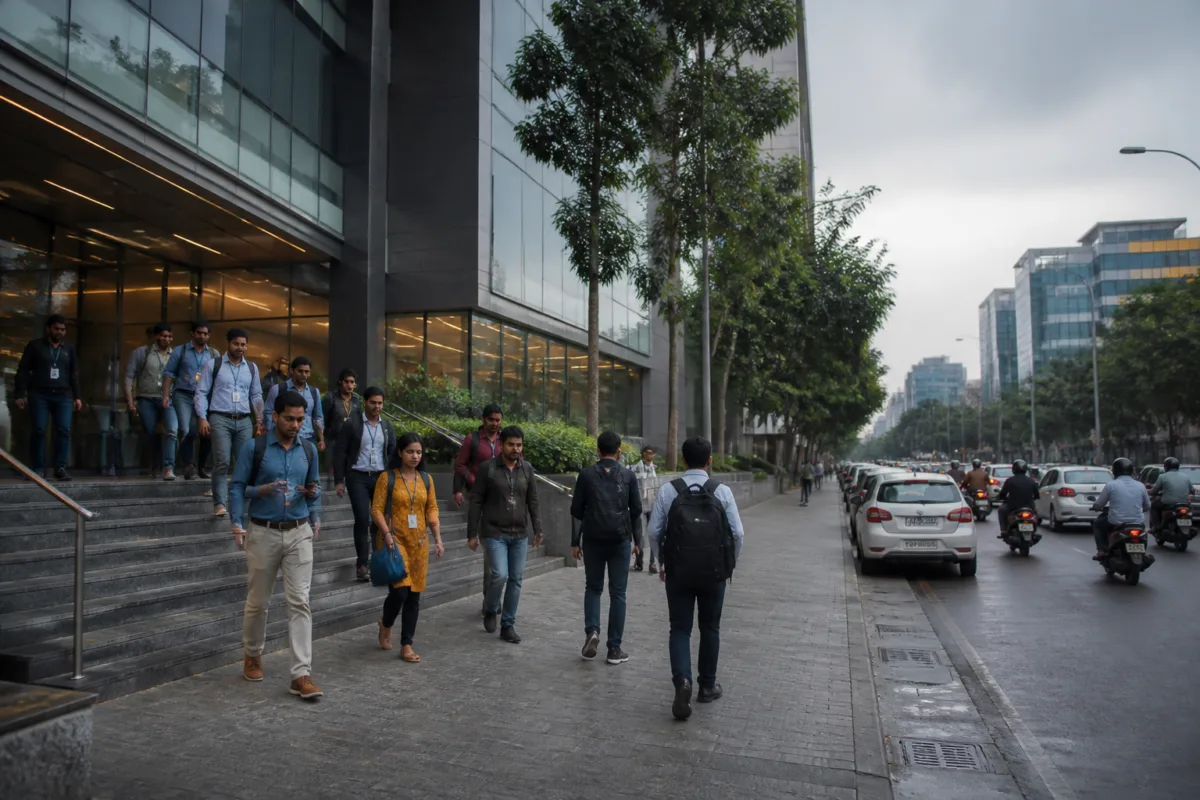
Qualcomm India layoffs have begun at the company’s Bengaluru facility, with around 1,000 or more jobs potentially at risk across the country. The cuts are part of a global restructuring at the US semiconductor company, but their urban significance is concentrated in four Indian technology centres: Bengaluru, Hyderabad, Delhi-NCR and Chennai.
The reported reductions show how closely the fortunes of India’s major technology cities are tied to decisions made in global corporate headquarters. Qualcomm’s Indian operations are not peripheral back offices. India is the company’s largest engineering base outside the United States, with approximately 20,000 employees working across research, development and engineering functions. A workforce reduction of the reported scale therefore reaches beyond individual employment contracts. It touches the concentrated urban ecosystems that have grown around high-value technology work.
According to the report, the first round of cuts began at Qualcomm’s Bengaluru facility on Monday and is expected to continue in phases across the company’s Indian operations. The exercise could affect around 7 per cent of Qualcomm’s global workforce of 52,000 employees. Applied to the company’s Indian headcount, that proportion would represent around 1,000 jobs or slightly more, although the final number of affected employees in India has not been established in the supplied reporting.
The distinction between a global restructuring and its local urban effects is important. A company can announce one worldwide workforce action, but the consequences are experienced through particular labour markets, office districts and household economies. Bengaluru, Hyderabad, Delhi-NCR and Chennai have each developed large concentrations of engineering and research work. Qualcomm’s presence connects those city economies to the semiconductor and smartphone industries, while also making them exposed to changes in global demand, product cycles and corporate cost decisions.
The reported cuts are understood to be broad-based, affecting both senior engineers and recent hires. Some employees asked to leave reportedly said they had not received prior performance-related feedback. In an internal memo to employees in October, chief executive Cristiano Amon described the workforce reduction as performance-focused and said the company needed to address areas where employees had consistently fallen short of expectations. Reuters reported that Qualcomm framed the exercise as an effort to strengthen its performance culture.
That explanation places the layoffs within a company-specific performance framework, but the timing also coincides with pressure in Qualcomm’s smartphone chip business. The company’s latest quarterly results, announced last week, showed handset revenue falling 26 per cent year-on-year to $5.14 billion in the September quarter. The figure was below the market estimate of $5.25 billion. Qualcomm’s overall revenue declined 8 per cent year-on-year to $10.32 billion from $11.27 billion a year earlier.
Qualcomm attributed part of the pressure on the smartphone market to rising memory chip costs. Those costs have pushed up device prices and weighed on global shipments, according to the report. The figures do not establish how much of the Indian restructuring is directly linked to handset revenue, but they place the workforce action within a difficult operating environment for one of the company’s key businesses.
For Indian cities, the immediate issue is not only the number of jobs at risk but also the type of work involved. Research, development and engineering roles support wider networks of contractors, office services, transport providers, food businesses and rental housing. The supplied report does not quantify those indirect effects, and it would be premature to convert the reported job figure into a wider employment estimate. It does, however, establish that the affected workforce is concentrated in urban technology clusters rather than distributed evenly across the country.
That concentration has shaped the growth model of India’s leading technology centres. High-value corporate offices attract skilled workers, specialised suppliers and supporting services. In turn, the resulting employment base contributes to demand for housing, mobility, commercial space and everyday services. When a large employer reduces its workforce, the first measurable impact may be on employees, but the exposure is embedded in a broader urban system built around specialised employment.
The Qualcomm case also highlights the difference between a city having a large technology workforce and having a diversified economic base. The report identifies India as Qualcomm’s largest engineering base outside the US, but it does not indicate whether the company plans to reduce its engineering presence, move work between Indian locations or alter its long-term research and development strategy. The available evidence therefore supports a conclusion about vulnerability to corporate restructuring, not a conclusion that India’s technology sector is in structural decline.
The reported severance terms offer a limited view of how the transition is being managed. Financial Express reported that affected employees were offered compensation equivalent to three months’ salary linked to tenure. Employees who signed their relieving documents within three days were reportedly offered an additional month’s salary. These terms may provide short-term support, but the supplied material does not establish how many employees accepted them, whether all locations received identical offers or what assistance was available beyond compensation.
The possibility of another round of job cuts in January adds uncertainty to the sequence of the restructuring. The report does not provide a final timeline for the Indian exercise or specify how many employees will be affected in each city. That uncertainty matters for local administrations and urban service economies because employment shocks are easier to measure after they occur than while they are unfolding.
At the institutional level, the episode sits at the intersection of corporate restructuring, global technology markets and city-level economic planning. The layoffs are being initiated by a private multinational, while the urban consequences are distributed across jurisdictions with different labour markets and infrastructure systems. Bengaluru, Hyderabad, Delhi-NCR and Chennai cannot determine Qualcomm’s staffing decisions, but their dependence on high-skilled corporate employment makes such decisions relevant to local economic resilience.
The available data also cautions against treating headline job numbers as a complete measure of impact. Qualcomm’s approximately 20,000 employees in India provide a clear scale for the company’s national presence, while the potential loss of around 1,000 jobs indicates the possible size of the current action. But the supplied report does not provide city-wise staffing, vacancy rates, relocation data, household exposure or information on alternative employment for affected workers. Those gaps prevent a more precise assessment of the impact on each urban market.
What the evidence confirms is narrower but significant. Qualcomm has started workforce reductions in India, beginning in Bengaluru, as part of a global restructuring that could affect around 7 per cent of its worldwide workforce. India’s role as the company’s largest engineering base outside the US means that the consequences are concentrated in important technology cities. The cuts are taking place alongside weaker handset revenue and lower overall quarterly revenue, while the company describes the process as performance-focused.
What remains uncertain is the final number of Indian job losses, the distribution across Bengaluru, Hyderabad, Delhi-NCR and Chennai, and whether another round in January will occur. Those developments will determine whether the current action is a contained corporate adjustment or a wider change in the employment footprint of one of India’s most important technology-sector employers.

