


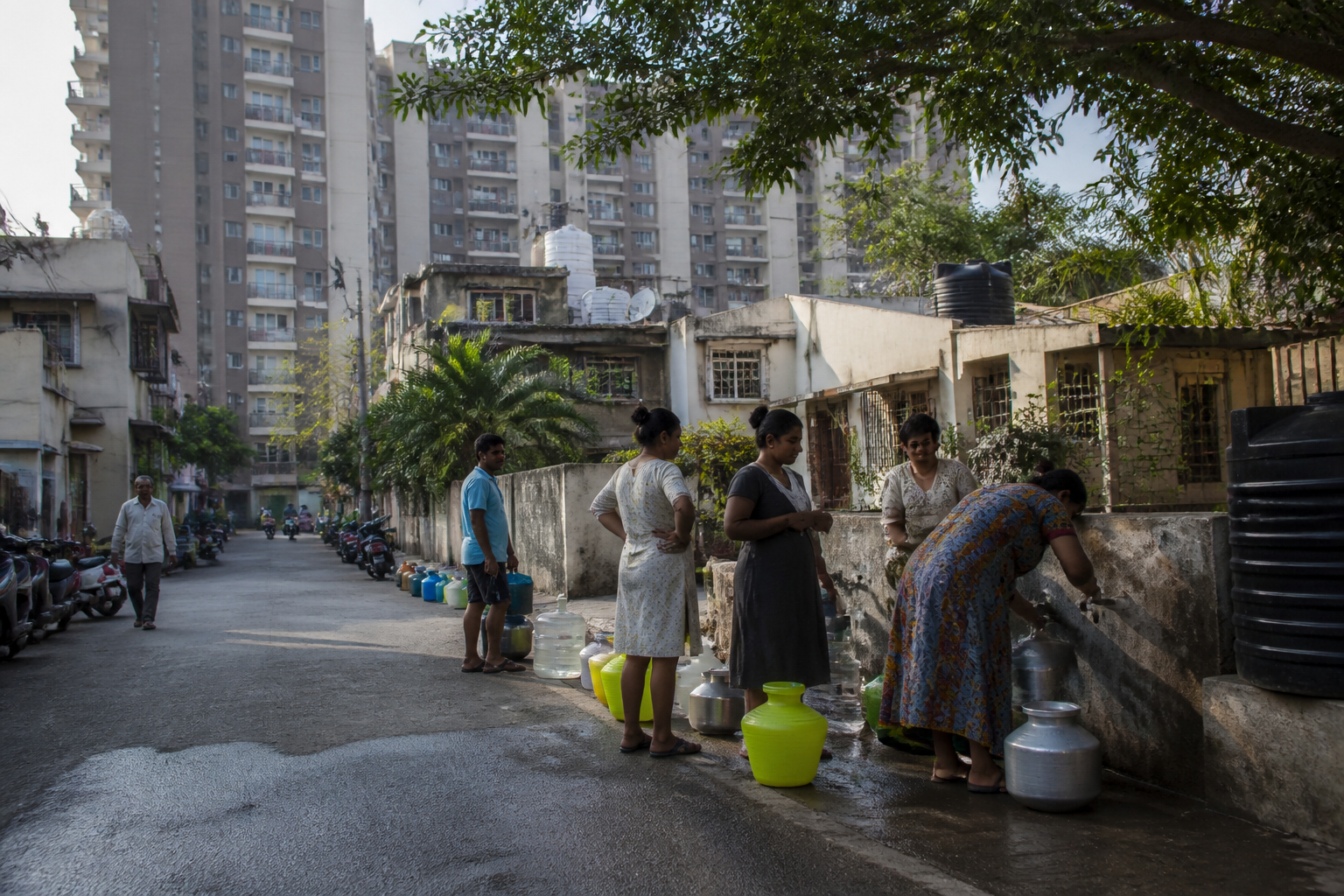
Pune water supply was disrupted in several parts of the city on Friday morning, with residents reporting delayed delivery and low pressure a day after the Pune Municipal Corporation began its weekly Thursday shutdown as part of water-rationing measures.
The affected areas included the central peths, Kharadi, Hadapsar, Aundh, Bopodi, Bibvewadi and Kondhwa. Water arrived late in some localities, while residents in other areas received inadequate quantities because of low pressure. The supply situation improved after complaints were received by the municipal corporation’s water-supply department, and officials said service had been restored in the affected areas by the afternoon.
The disruption followed the civic body’s decision to keep water supply shut across the city every Thursday. The measure came into effect on Thursday, October 15, after the state government directed authorities to reduce water use amid concerns over available storage in the Khadakwasla reservoir system.
The report by Sakal said Pune had received less rainfall during this year’s monsoon, with the El Nino effect cited as a factor. The Khadakwasla reservoir was reported to have around 3.5 thousand million cubic feet less water than at the same time last year. The lower storage has raised concerns within the administration about the possibility of more severe water scarcity in the future.
The weekly shutdown was intended to reduce consumption and manage the available stock. However, the first operational cycle also exposed the difficulty of restarting supply evenly across a city with different elevation levels, network conditions and distribution reaches. The municipal corporation’s explanation focused on areas located at the tail end of water pipelines, where supply can take longer to stabilise after a shutdown.
Nandkishor Jagtap, head of the water-supply department, said complaints had been received from areas at the end of the water-supply network. He said the water supply in those localities was subsequently stabilised.
The affected neighbourhoods span central Pune as well as rapidly urbanising eastern, western and southern parts of the city. This means that the immediate disruption was not confined to one local network or a single ward. It also highlights the dependence of residents on predictable schedules in a system where a one-day shutdown can affect the timing and pressure of supply on the following day.
For households, the revised schedule requires water storage and planning around the weekly closure. The impact is likely to be more acute in buildings without adequate storage capacity, in areas at the tail end of distribution lines and among residents who depend on timed municipal supply rather than continuous access. The municipal corporation has not, in the supplied report, announced any change to the Thursday shutdown schedule.
Officials said the immediate complaints were addressed and that supply had returned to normal by Friday afternoon. The weekly rationing arrangement remains in force as the civic administration manages lower reservoir storage and monitors the city’s water distribution network.

