


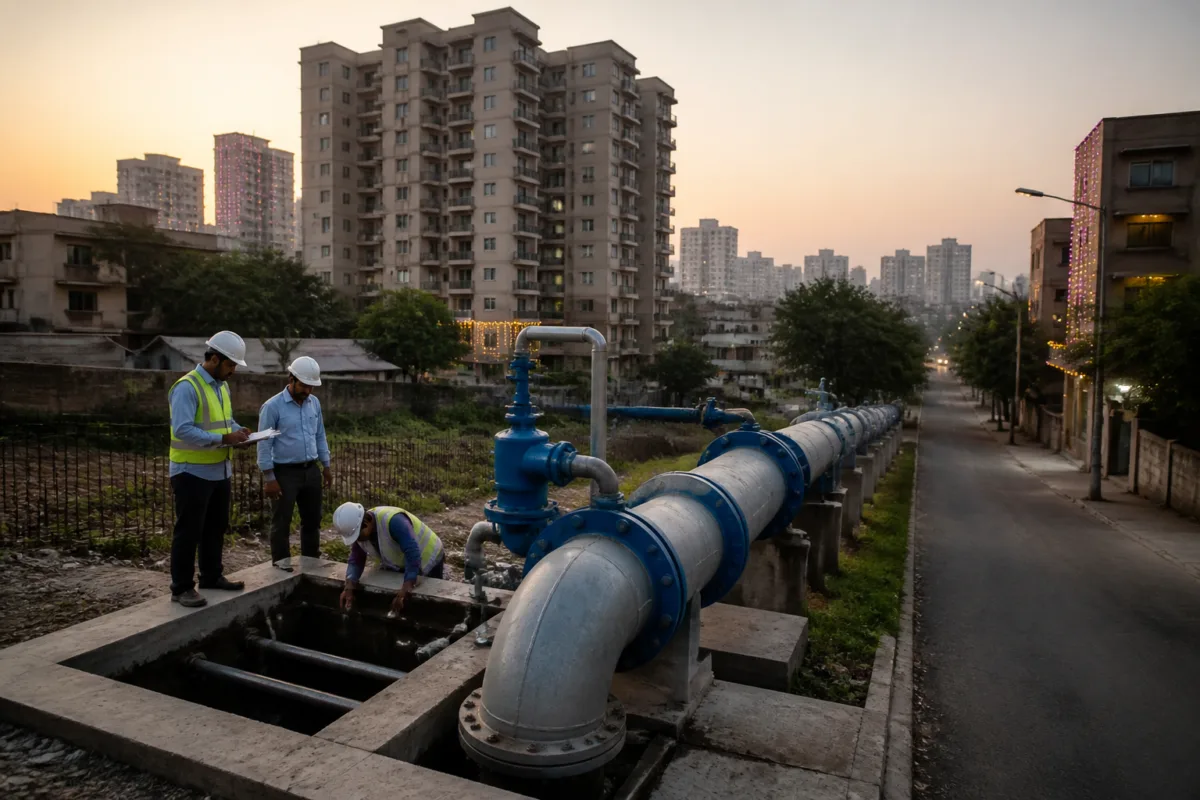
Pune’s water demand barely fell during the Diwali break despite thousands of residents leaving the city, according to data shared by the Pune Municipal Corporation (PMC). The civic body’s daily water draw declined by only 20-25 million litres per day during the festive period, while officials reported that water pressure improved and complaints of inadequate supply dropped sharply in several areas.
The pattern is important because Pune’s water debate has often been framed around population growth. The city has expanded rapidly as people have moved in for employment, education and business, and the growing population has increased demand for water. The civic administration has repeatedly sought a higher water quota from the state government and the irrigation department. Yet the Diwali figures suggest that the relationship between the number of people present in the city and the volume of water drawn is not as direct as the public debate often implies.
PMC data cited in the report shows that the civic body drew around 1,718 MLD on November 5, the first day of the Diwali period. The draw was 1,700 MLD on November 6, 1,688 MLD on November 7, 1,682 MLD on November 8, 1,698 MLD on November 9, 1,697 MLD on November 10 and 1,692 MLD on November 11.
Across those seven reported days, the average daily draw was about 1,696 MLD. The lowest figure, 1,682 MLD, was 36 MLD below the highest figure of 1,718 MLD. In percentage terms, even that gap was only a little over 2 per cent of the highest daily draw. The reported change therefore appears marginal when set against the overall volume being brought into the city.
The figures do not establish that every resident who left Pune would normally have consumed water directly from the municipal network, nor do they explain how demand changed across different categories of users. The supplied report also does not provide ward-level consumption data, household metering figures, industrial demand, commercial consumption or information on leakage. What the data does show is that a visible seasonal movement of people did not translate into a comparable reduction in the city’s total daily water draw.
That distinction matters for how Pune’s water requirement is assessed. A city’s water demand is not simply the sum of its registered or estimated population multiplied by a standard daily norm. It is also shaped by the size and condition of the distribution system, the timing of supply, storage practices, commercial and institutional use, and the quantity of water required to maintain pressure across a large network. The Diwali data cannot answer how much each factor contributes, but it indicates that aggregate water draw can remain high even when the city temporarily has fewer residents.
The improvement in pressure provides a second and potentially more significant signal. PMC officials said that complaints of inadequate supply dropped sharply and almost ceased in several areas during the holidays. Localities that had earlier struggled to receive adequate water also began getting supply, according to the officials cited in the report.
This creates a contrast between volume and service quality. The city drew only marginally less water, yet the network reportedly performed better for consumers. That could mean that the operational conditions created by the holiday period helped water move through the system more effectively, even without a large reduction in total demand. The supplied material does not identify the precise cause, so it cannot establish whether the improvement resulted from lower simultaneous demand, reduced commercial activity, changes in pumping or scheduling, or another operational factor.
Still, the contrast raises a structural question for Pune’s water administration: is the city’s problem primarily the amount of water available, or the way available water is distributed through the network? The evidence in this report does not resolve that question, but it shows why the two issues should not be treated as interchangeable. A higher quota may increase the total volume available to the civic body, but it does not automatically guarantee equitable pressure or reliable delivery in every locality.
Pune’s growth has made the question more urgent. The city has attracted residents because of its employment, education and business opportunities, and this expansion has placed additional demands on civic infrastructure. The PMC has linked its requests for a higher water quota to rising demand. That institutional response is understandable in a growing urban region, but the Diwali experience suggests that planning based only on population increase may overlook the performance of the distribution network.
The numbers also complicate the assumption that seasonal migration will substantially reduce municipal demand. Large numbers of people leaving the city may be visible in road traffic and public activity. The report notes that traffic congestion eased during the Diwali break. Water systems, however, respond differently. They operate continuously across multiple neighbourhoods and serve households, institutions and businesses with different consumption patterns. A fall in one category of use may be offset by storage behaviour, continuing activity in other premises or the need to maintain system operations across the network.
No evidence in the supplied report establishes which of these factors explains the limited decline. That absence is itself relevant to the governance question. Without more granular monitoring, a city may know how much water it draws but not precisely where demand is changing, where pressure is being lost or why some neighbourhoods receive better service when total consumption shifts only slightly.
The reported daily figures show a relatively narrow band of movement. The draw fell from 1,718 MLD on November 5 to 1,682 MLD on November 8, before rising again to 1,698 MLD on November 9. It then remained close to 1,700 MLD, at 1,697 MLD on November 10 and 1,692 MLD on November 11. This is not a pattern of a sharp collapse in demand followed by a rapid recovery; it is a broadly stable draw with modest daily variation.
For civic planning, that stability has two implications. First, the city’s baseline requirement may remain high even during a period when many residents are away. Second, service reliability may depend on managing pressure and distribution as much as on increasing the gross supply. The report’s evidence supports these as questions for further examination, not as final conclusions about the performance of the entire water system.
The institutional structure also matters. PMC is responsible for drawing and distributing water within the city, while the civic administration has sought a higher quota from the state government and the irrigation department. This means Pune’s water security involves more than a municipal operating decision. Allocation, source availability, infrastructure capacity and last-mile distribution are connected across different levels of government.
A request for more water therefore sits alongside questions about how existing water is moved through the city. If improved pressure during the holidays allowed previously underserved areas to receive better supply, the operational lesson may be as important as the reported reduction in demand. But the supplied material does not include information on pipeline capacity, reservoir levels, pumping schedules, leakage or pressure-management systems. Those details would be required to identify the precise administrative and engineering response.
The Diwali figures also underline the importance of measuring citizen experience rather than relying only on citywide totals. A daily draw of around 1,700 MLD can coexist with inadequate supply in some localities and improved service in others. Aggregate numbers describe the volume entering or being drawn by the system; they do not necessarily describe how evenly that water reaches households.
Pune’s water debate is therefore moving beyond a simple question of whether the city has enough water for its population. The available evidence points to a more difficult problem involving demand patterns, network operations and distributional equity. The fact that complaints almost ceased in several areas during the holiday period, even as the overall draw changed only marginally, makes that distinction visible.
What is confirmed is limited but significant: PMC’s reported water draw stayed close to 1,700 MLD during the Diwali period, the decline was marginal, and officials observed better pressure and fewer complaints in several areas. What remains unestablished is why the network performed better and how much of the improvement can be attributed to reduced occupancy or other operational changes. Further ward-level consumption, pressure and complaint data would be needed to answer that question. For Pune’s planners and administrators, the next challenge is to connect the citywide water quota debate with the everyday reliability of the distribution network.

