


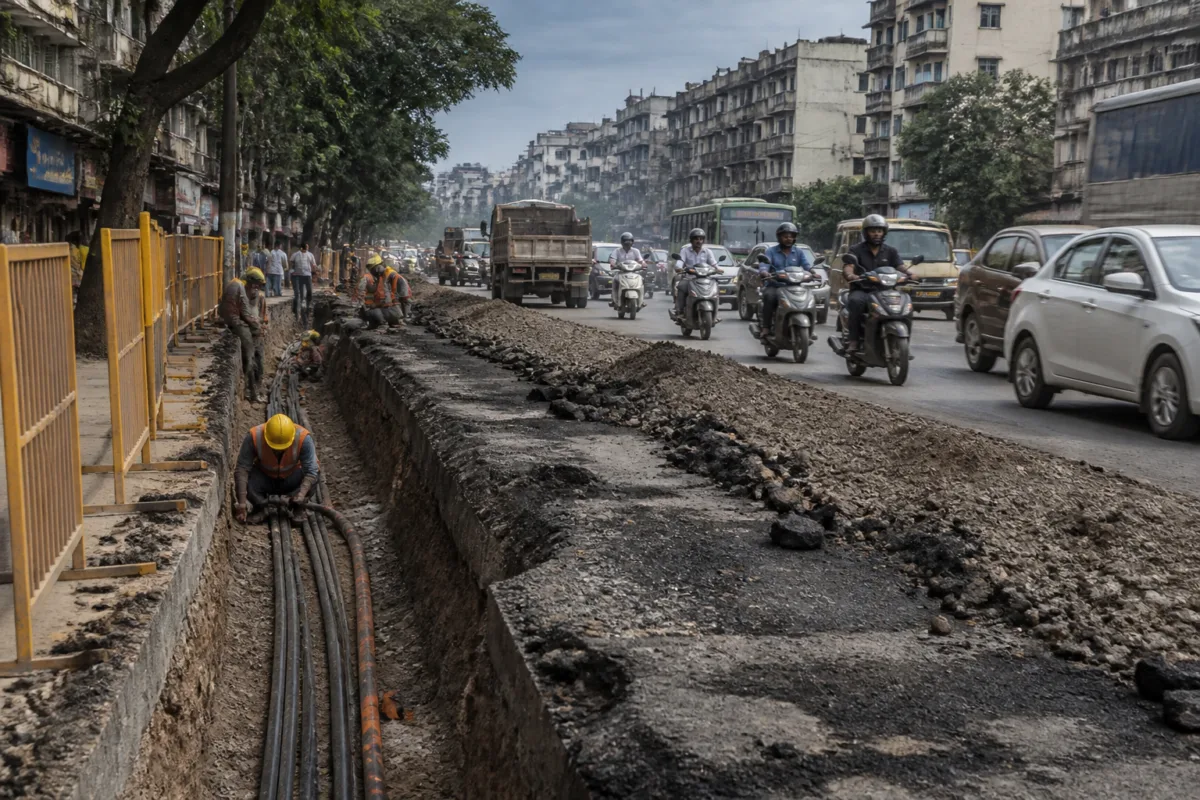
Pune has allowed nearly 1,495 kilometres of roads to be excavated for underground optical fibre cables since 2017, with repeated digging and uneven repairs raising concerns about road quality, public money and coordination between utility agencies, according to a report by Lokmat – Pune.
The Pune Municipal Corporation’s road department has issued 2,388 permissions for underground OFC cable work during the period, the report said. Roads that have been newly asphalted are also being dug up in some locations, forcing the civic body to undertake repairs again and leaving motorists to deal with potholes, raised surfaces and damaged stretches.
The road department permits government, semi-government and private companies to excavate roads for water pipelines, sewage lines, mobile and internet networks, electricity services and other utilities. The department generally allows road excavation during a specified non-monsoon window and carries out repairs after the excavation period, according to the report.
Civic officials have stated that permission would not be granted to excavate roads soon after they have been asphalted. However, instances have reportedly emerged in which roads were dug up only days after resurfacing, suggesting gaps in coordination between road restoration work and utility projects.
The municipal corporation charges different fees depending on the agency and excavation method. Private companies are charged ₹12,192 per running metre, while the reported rate for the electricity board is ₹2,350 per metre. Excavation using horizontal directional drilling attracts a charge of ₹4,000 per metre, while excavation involving pits is charged at ₹6,160 per metre. Other government companies are charged half the private-company rate, or ₹6,096 per metre, according to the report.
The report also cited 649 permissions issued before 2017 for underground OFC cables, for which the civic body collected ₹485.81 crore in charges. It said the permissions for overhead cables issued before 2017 were related to the municipal electricity department. Since 2017, the road department has not issued permissions for overhead OFC cables, while two temporary permissions were issued by the electricity department for cables associated with the disaster management cell.
The larger administrative problem is the absence of a consolidated digital map showing the location of underground water, sewage, electricity, gas and internet networks, the report said. Without a common record of existing utilities, agencies carrying out new work can damage older pipelines and other services. In some cases, retired officials are reportedly consulted to identify the location of older water lines, while incidents of water pipelines being damaged during excavation continue to occur.
For residents, the consequences extend beyond the immediate inconvenience of road closures. Repeated excavation can leave roads with uneven surfaces, increase repair requirements and complicate traffic movement, while the absence of coordinated utility planning means that a newly restored road may remain vulnerable to further disruption. The next steps will depend on how the municipal corporation coordinates excavation permissions, road restoration and the mapping of underground infrastructure.

