


The Pune MPSC protest case has moved from a dispute over a cancelled permission to a police case involving 15 student representatives. The incident is significant not only because of the charges filed, but because it shows how quickly a civic demonstration can become an urban governance problem when permission, public space, traffic movement and police orders are handled through separate stages rather than one coordinated process.
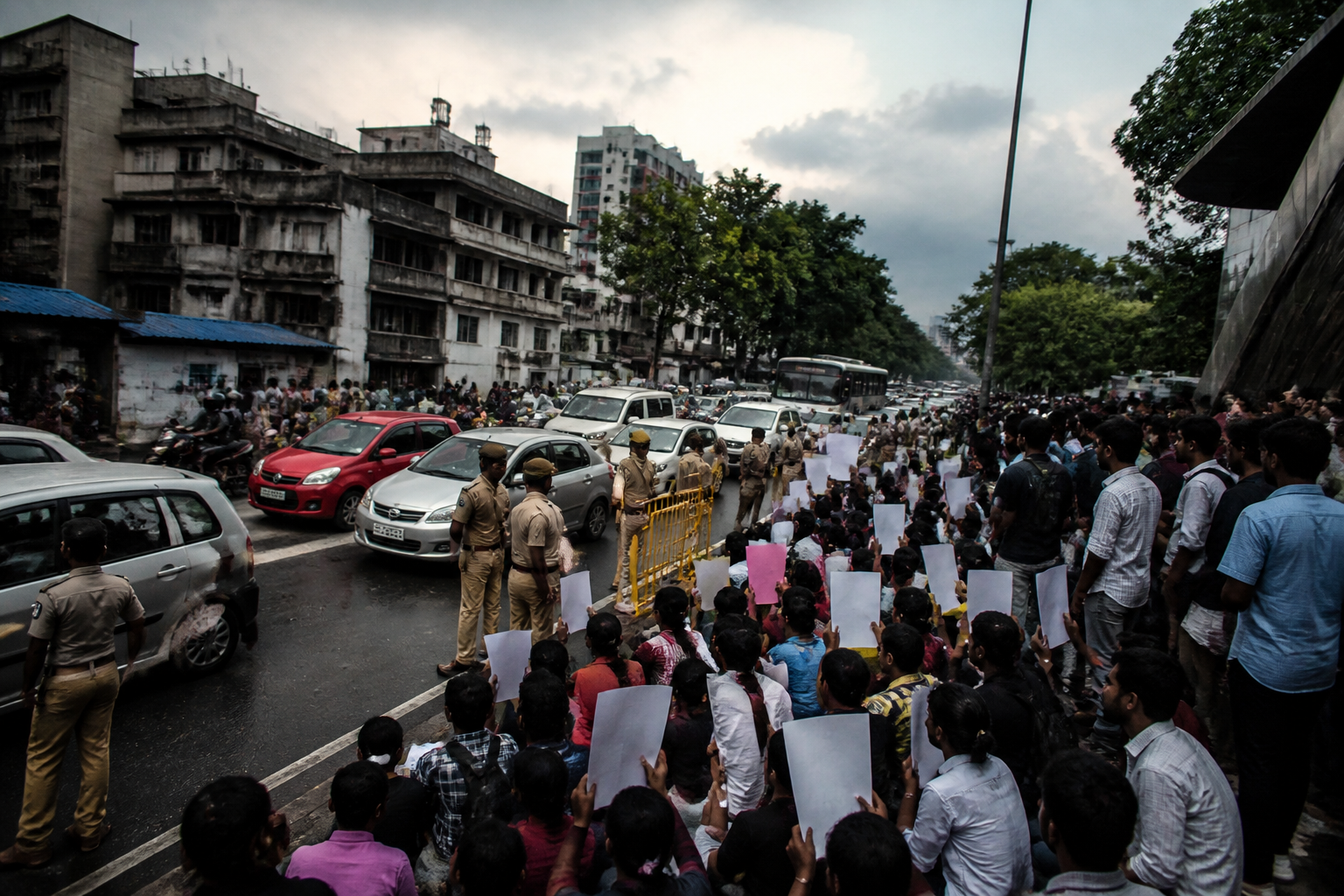
According to a report by Sakal – Pune, Vishrambaug police registered a case against 15 protesters over an agitation held on Shastri Road in Navi Peth. The police complaint alleges that the protesters violated a prohibitory order issued by the police commissioner, delivered provocative speeches, obstructed vehicles and disrupted traffic. It also alleges that the gathering affected public peace, law and order.
The case relates specifically to the protest held on Shastri Road on 1 October, and not to the demonstration at the S.M. Joshi Bridge. That distinction is important because the original permission sought by MPSC student representatives covered several locations and the later police action concerns a particular site and date.
The sequence described by police began on 25 September, when student representatives submitted a request to hold a protest on 2 October. The proposed locations included Lokmanya Tilak Chowk near Alka Talkies, Ahilya Study Centre on Shastri Road and the S.M. Joshi Bridge area near Ganjwe Chowk in Navi Peth. Following discussions, permission was granted for the S.M. Joshi Bridge area, subject to conditions.
The permission was subsequently withdrawn after a meeting between the Chief Minister and student representatives on 30 September. The students informed the police that the protest planned for 2 October had been postponed, while the police also informed them that the permission granted for the gathering had been cancelled.
The police complaint, as reported by Sakal, states that student representatives nevertheless gathered in large numbers near Indulal Complex on Shastri Road at around 4 pm on 1 October and began an agitation without permission. Vehicles were stopped, leading to traffic congestion and disruption to daily life, according to the complaint.
The 15 people named in the case are Pramod Patil, Akshay Kamble, Aniket Deshmane, Pravin Patil, Rishikesh Gangurde, Priyanka Chaudhary, Nitin Gite, Somnath Chavan, Omkar Patil, Gajanan Shelke, Ajit Kakade, Siddharth Panchange, Sanket Kanase, Siddharth Jambhulkar and Sahebrao Kshirsagar. Police head constable Sameer Pawar filed the complaint. Further investigation is being conducted by police inspector Vikas Bhingardive.
The immediate legal question is whether the alleged conduct breached provisions of the Bharatiya Nyaya Sanhita and the Maharashtra Police Act. The larger urban question is how public authorities manage demonstrations in streets that are simultaneously used as transport corridors, commercial routes and civic gathering spaces. The available report records the police version and the charges, but does not provide the students’ response or the precise sections applied. Those details matter when assessing the eventual legal position of the accused.
The location also helps explain why the matter became a traffic issue. Shastri Road in Navi Peth is not an isolated open ground. The police account places the gathering near Indulal Complex and states that vehicles were stopped. Once a protest occupies a road rather than an approved holding area, the effects can extend beyond the participants: traffic queues can spread into adjoining streets, buses and emergency vehicles can face delays, and residents and businesses can lose predictable access to the corridor.
At the same time, the case illustrates why protest-permission systems require clarity before an event begins. The representatives first sought permission for multiple locations. Permission was then reportedly granted for one area with conditions, followed by its cancellation after the postponement of the planned protest. The police say the students were informed of the cancellation. The later gathering, according to the complaint, occurred at a different location and on a different date from the permitted event.
This chain creates several administrative points at which confusion can arise: which location is authorised, whether a permission remains valid after a postponement, how cancellation is communicated, and what happens when organisers assemble outside the approved site. The supplied report does not establish whether the students disputed receiving the cancellation notice or how the communication was documented. It also does not record whether alternative arrangements were offered for a lawful demonstration.
For city administration, the distinction between a protest venue and a traffic corridor is central. A designated public space can allow authorities to plan crowd control, access routes and emergency movement. A road-based protest requires a different operational plan, including diversions, barricading, public notices and coordination with transport agencies. The police account indicates that the Shastri Road gathering did not have permission, but the report does not state whether a diversion plan was prepared or whether any traffic management measures were attempted before vehicles were stopped.
The case therefore reveals a governance system that becomes visible mainly after disruption occurs. The formal process begins with an application and ends, in this instance, with criminal charges. What remains less visible is the coordination between organisers and authorities between those two points. A permission letter, a cancellation message and a police complaint each record a different stage, but effective street management depends on those stages being understood consistently by everyone involved.
There is also a difference between the administrative description of an event and its legal conclusion. The police complaint alleges violation of orders, provocative speeches, obstruction and disruption of public peace. These are allegations forming the basis of investigation, not findings of guilt. The registration of a case establishes that police have begun proceedings; it does not by itself settle whether every allegation will be sustained.
That distinction is especially relevant in protests involving students, where the public issue may attract participants beyond the named organisers. The report identifies 15 accused individuals but does not specify the size of the gathering, the duration of the road blockage, the volume of traffic affected or whether anyone was injured. Without those details, the scale of the disruption cannot be independently assessed from the supplied material. What can be established is that police treated the gathering as unauthorised and linked it to traffic and public-order concerns.
The timeline also demonstrates how quickly the status of a public event can change. On 25 September, the representatives sought permission. After discussions, permission was reportedly granted for the S.M. Joshi Bridge area subject to conditions. On 30 September, following the Chief Minister’s meeting with representatives, the planned 2 October protest was said to have been postponed and the permission cancelled. On 1 October, the police say a gathering took place on Shastri Road without permission. The case was registered on Friday, according to the report.
For residents, the practical impact of such disputes is experienced through road access rather than administrative paperwork. A blocked street can alter school, work, delivery and emergency journeys even when the protest itself lasts for a limited period. Conversely, restrictions on protest locations affect how citizens can assemble and communicate grievances. The city’s challenge is therefore not simply to prevent disruption, but to administer public space in a way that makes lawful civic expression possible without transferring the cost to unprepared road users.
The available evidence does not show whether Pune has a publicly designated, consistently used system of protest venues, nor does it establish how applications are evaluated across different roads. It also does not provide the written permission, cancellation communication, police order or sections of law invoked in the case. Those documents would be necessary to examine whether the process was clear, whether conditions were objectively communicated and how the alleged violations are framed.
What the case does establish is a sharp conflict between an announced protest plan, a later cancellation and a gathering that police say occurred at an unauthorised location. The legal process will determine the allegations against the 15 named individuals. The administrative lesson is broader: when public demonstrations intersect with roads, permission procedures must be specific about location, date, conditions and cancellation, while traffic management must be planned before a crowd reaches the carriageway.
The next formal step is the police investigation being conducted by Vishrambaug police under the Bharatiya Nyaya Sanhita and relevant provisions of the Maharashtra Police Act. The supplied report does not state whether arrests were made, whether the accused were summoned or what response the student representatives have offered. Those developments, along with the written case sections and any court proceedings, will determine how the dispute moves from a police account to a legally tested record.
