


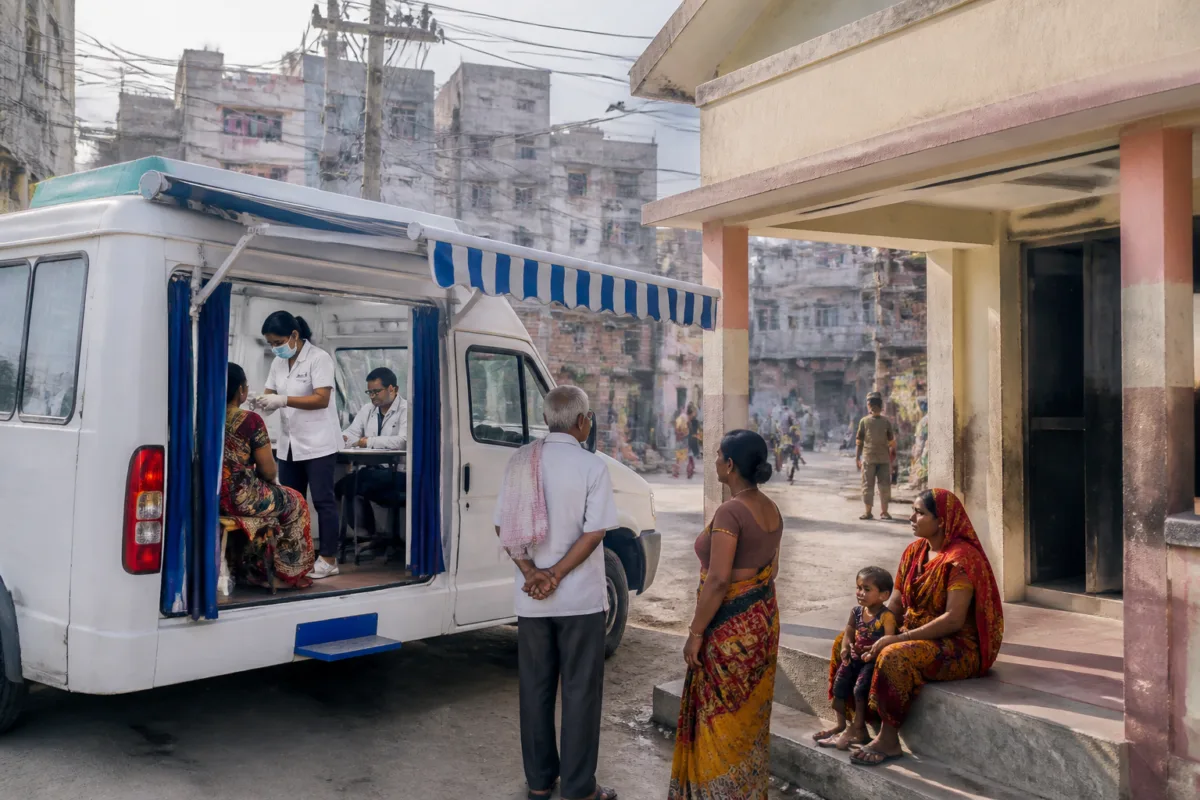
Mobile OPDs operating in Pune’s slum settlements are doing more than taking doctors to neighbourhoods that lack convenient access to public hospitals. They are revealing a central weakness in urban healthcare: a facility may exist on paper, but remain difficult to use when reaching it involves a long commute, restricted operating hours or the loss of a day’s wages.
In Laxminagar in Yerawada, residents receive consultations, basic tests, medicines and referrals from vans operated by non-governmental organisations. The mobile clinics return to identified locations on a fixed schedule, allowing patients to seek care close to home rather than travelling to a hospital for every consultation. For residents managing chronic diseases, seeking antenatal care or requiring early screening, that regularity is as important as the consultation itself.
The model is significant because access to healthcare in a city is not determined only by the number of hospitals. It also depends on distance, timing, cost and the ability of residents to leave work. The Times of India report describes Rajiv Gandhi Maternity Hospital as the nearest public facility for Laxminagar residents, but says that reaching it can require a 30-minute commute and that its outpatient department functions during fixed, restricted hours. For a daily-wage worker or someone working a shift-based job, these conditions can turn a nominally free service into an unaffordable one.
That gap is illustrated by the experience of residents using the vans. Asma Shaikh first visited a Smile Foundation mobile OPD during her pregnancy in 2024. She told the newspaper that the doctor provided supplements and that a nurse counselled her on maternal and infant vaccinations. Kausar Dalmia Shaikh, who works as a watchman, uses the service to manage diabetes and hypertension. He said the van’s presence throughout the day allows him to visit after his shift and that he receives a 15-day supply of medicines at no cost.
These accounts point to a practical distinction between healthcare availability and healthcare usability. A hospital may provide a wider range of services, but it may not be accessible at the time or price that low-income residents require. The mobile OPD does not eliminate the need for hospitals; instead, it reduces the number of journeys needed for primary consultations and routine medicine collection. It also creates a first point of contact for patients who might otherwise delay treatment.
The operating figures supplied by Smile Foundation indicate the scale of this neighbourhood-based approach. Satnam Singh, the foundation’s general manager of programmes for health initiatives and disaster response, said that three vans operate in Pune every day and screen an average of 90 patients daily. The organisation estimates that its vans screen about 4,500 patients a month in Pune. The report also says the foundation has a wider network covering most districts across Maharashtra.
The numbers require careful interpretation. The reported daily average and monthly estimate describe the reach of one NGO’s programme, not the total demand for primary healthcare in Pune’s informal settlements. They also do not establish how many patients are referred onwards, how many complete treatment, or whether the same residents return for follow-up care. Even so, they show how a relatively small mobile network can generate a recurring contact point between the public-health system and communities that are not consistently captured through facility-based services.
This is where the mobile clinic becomes more than a transportable dispensary. Singh said the vans offer consultations, basic blood tests, eye screenings and hospital referrals, while screening for vector-borne and water-borne infections and providing antenatal care. The organisation does not conduct specialised testing, according to the report, and refers patients requiring further treatment to government or charitable hospitals.
That division of responsibility is important. A mobile OPD can extend the reach of preventive and primary care, but it cannot replace a functioning referral network. The van can identify a health concern, provide an initial clinical assessment or supply medicines for a chronic condition. The patient may still need a public hospital, a charitable facility or a specialist service. The effectiveness of the model therefore depends partly on what happens after the mobile consultation: whether referrals are affordable, whether facilities have capacity and whether patients can complete the next stage of care.
The programme also exposes a data problem in urban health administration. Singh said community screening generates a database that can provide real-time inputs to government healthcare authorities. Facility-based records tend to reflect people who reach a hospital or clinic. Residents who delay treatment because of travel costs, work obligations or limited information may not appear in those records until their condition becomes more serious. By visiting communities repeatedly, mobile teams can identify patterns that fixed facilities may miss.
The potential value of this information lies in its local detail. Screening in a settlement can indicate the prevalence of chronic conditions, identify recurring infections or show where antenatal care is being accessed. The report does not provide a detailed breakdown of the data collected, nor does it establish how government agencies use the information. That limitation matters. Data becomes useful for public administration only when it is standardised, shared responsibly and connected to decisions on staffing, medicines, testing, sanitation and referrals.
The same caution applies to the description of mobile OPDs as a parallel healthcare system. The vans are clearly providing a recurring service and reducing some direct costs for patients, according to the report. They are also helping residents manage chronic conditions and access maternal care. But the available material does not establish whether the programme has reduced attendance at public hospitals, improved long-term health outcomes or lowered the overall burden on Pune’s municipal health system. Those are questions that would require programme-level records and follow-up evidence.
What the report does establish is the nature of the access barrier. For the residents quoted, the most important intervention is not only the free consultation or medicine. It is the relocation of the first point of care into the settlement and the predictability of the van’s return. A service that appears twice a month at the same place allows residents to plan around work, recognise the provider and continue treatment for chronic conditions. This is particularly relevant in neighbourhoods where employment is informal and income is closely tied to daily attendance.
The arrangement also raises an institutional question for Pune’s urban governance. NGOs can respond quickly in places where municipal services are stretched, but their coverage, funding and continuity may vary. Public hospitals remain essential for maternity care, specialised treatment, emergency services and referrals. Municipal authorities, meanwhile, are responsible for planning and coordinating public health provision within the city. The report does not detail the contractual, funding or data-sharing arrangements between the NGO vans and the Pune Municipal Corporation. Without that information, it is not possible to assess how the service fits into the city’s formal health infrastructure.
There is a broader planning lesson in the distinction between a city’s mapped facilities and its lived geography. A 30-minute journey may appear manageable in transport terms, but its real cost changes when it includes lost wages, childcare, uncertainty over queues and limited clinic hours. Healthcare planning that counts facilities without measuring these barriers can overstate effective access. Mobile OPDs respond to that gap by bringing a modest level of service to the places where the barriers are highest.
The model’s reach also has limits. The vans described by the report provide basic consultations, selected tests, medicines and referrals. They do not offer specialised testing, and the article does not indicate their capacity for emergencies, complex diagnoses or extended treatment. Their role is therefore strongest at the primary-care and prevention end of the system. Their value depends on being connected to hospitals and public-health programmes rather than operating as an isolated substitute.
For Pune, the immediate evidence is that three Smile Foundation vans are screening an estimated 4,500 patients each month, with services ranging from clinical consultations and medicines to antenatal care and infection screening. The report also documents how fixed locations and repeated visits help residents overcome travel and wage barriers. What remains unclear is how widely the model covers the city’s underserved communities, how referrals are tracked and whether the information collected changes municipal health planning.
Those unanswered questions define the next stage of scrutiny. The success of mobile OPDs should not be measured only by the number of consultations delivered. It should also be assessed through continuity of care, referral completion, medicine availability, screening outcomes, patient costs and the use of community-level data by public authorities. The experience in Yerawada suggests that last-mile healthcare is not simply a medical challenge. It is a question of urban distance, working conditions, administrative coordination and whether public services are designed around the ways residents actually live.

