


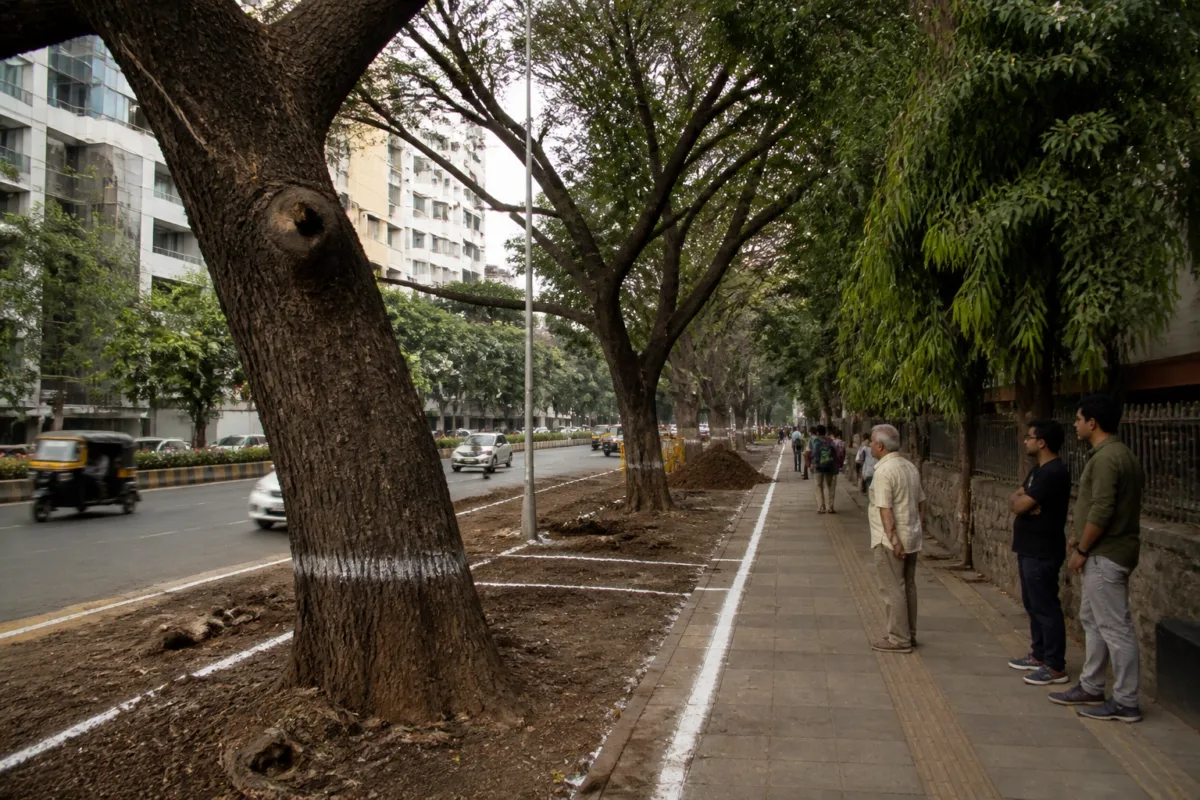
The Pune Municipal Corporation’s proposed High-Capacity Mass Transit Route (HCMTR) along Senapati Bapat Road has triggered concern among residents over the possible impact on mature trees, footpaths, green spaces and the neighbourhood’s existing streetscape. The PMC has maintained that no building will be affected under the current plan.
The concerns emerged after officials began marking locations along the stretch from University Chowk, where project-related structures, including ramps and exit points, may be constructed. Residents who inspected the marked areas said the apparent work zones overlapped with existing pedestrian spaces, green areas and parts of nearby properties.
The markings have prompted residents to seek greater clarity on the project’s design and its likely effect on the area. Their concerns centre on whether construction would require changes to footpaths, the removal of greenery or the use of open spaces that currently form part of the neighbourhood’s public realm.
Several trees located near the marked areas, including tamarind, bakul and ashoka trees, are estimated by residents to be between 40 and 50 years old. The trees are among the most visible elements of the existing streetscape, and their possible removal has become a central point of concern as residents assess the locations identified for project structures.
The HCMTR proposal is being examined against a built environment that includes established pedestrian routes, mature vegetation and properties along Senapati Bapat Road. Residents have questioned whether the current plan sufficiently accounts for the long-term needs of the neighbourhood, particularly the relationship between transport infrastructure and the spaces used by pedestrians and local communities.
The PMC’s position that no building will face demolition under the current design addresses one aspect of the local concern, but residents are seeking information on the project’s impact beyond building acquisition. They want clarity on how ramps and exit points would be placed, whether footpaths would be altered, and what would happen to trees and green spaces within the marked locations.
The issue highlights the practical effects that large urban transport projects can have even when the current design does not require the demolition of buildings. Changes to roadside space, vegetation and pedestrian infrastructure can alter how residents access properties and move through the neighbourhood, although the supplied report does not establish the final extent of such changes.
For now, the marked locations indicate areas where project-related structures may come up, while the PMC’s assurance applies to the current plan. Further clarity on the final design and the treatment of trees, footpaths and open spaces is awaited as the proposal moves ahead.

