


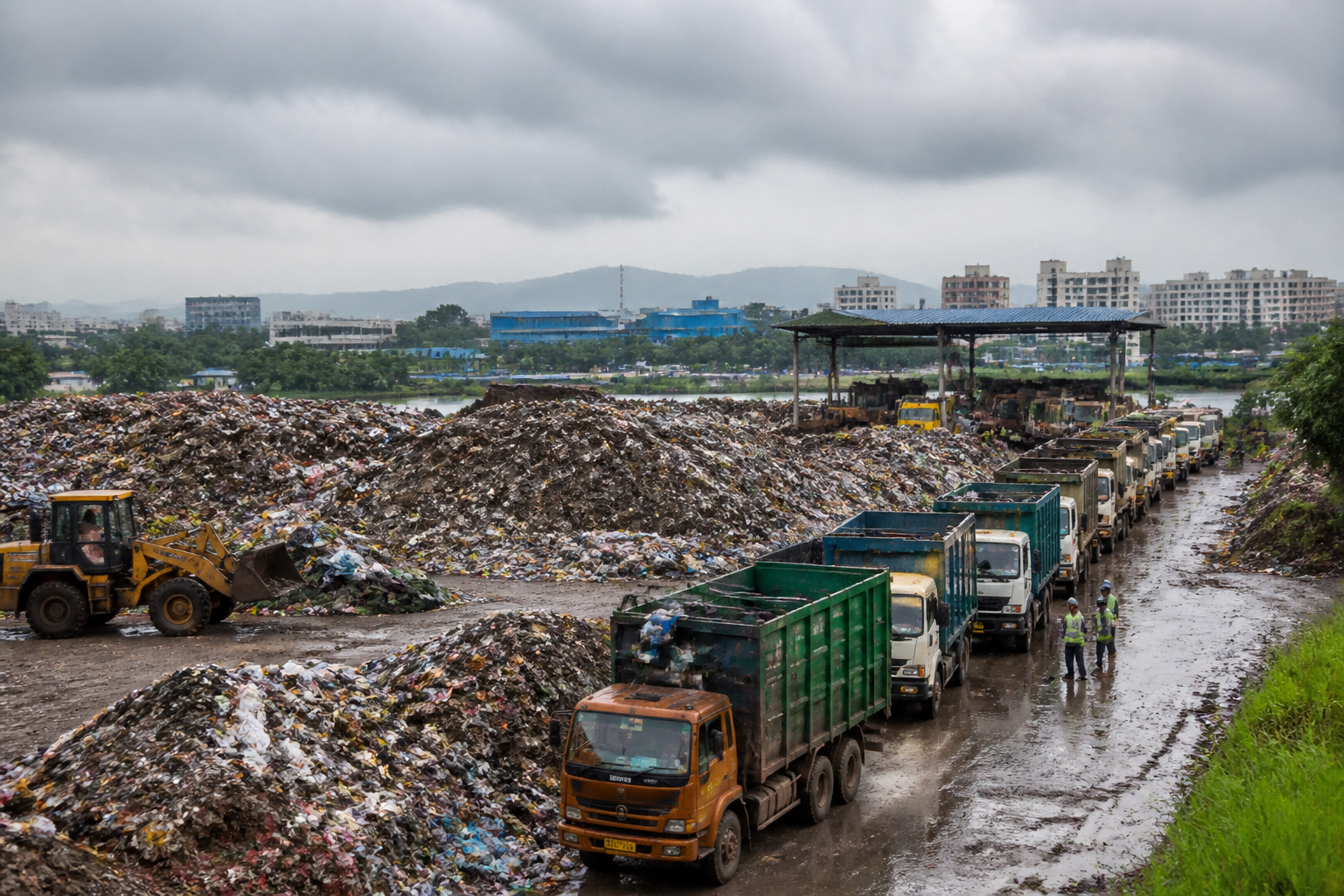
The proposed inclusion of Hinjawadi and six neighbouring villages in the Pimpri-Chinchwad Municipal Corporation has brought an existing Pune garbage crisis into sharper focus. While the administrative process is still at an early stage, the question of where waste from the seven villages would be processed has already triggered opposition in Moshi, where the corporation’s disposal site is operating under severe capacity pressure.
The seven villages identified in the report are Hinjawadi, Maan, Marunji, Nere, Jambhe, Sangawade and Gahunje. Chief Minister Devendra Fadnavis has recently indicated that steps could begin towards their inclusion in the civic corporation. Against that background, Pune district authorities asked the municipal administration to review waste management and infrastructure arrangements in the villages, in coordination with their village-level representatives and administrators.
That review matters because the villages are not being considered as undeveloped settlements entering a blank administrative space. Hinjawadi is a major employment and development zone, while the surrounding villages have experienced sustained urbanisation. The report does not establish the precise population, daily waste generation or infrastructure deficit across the seven villages, but it makes clear that any merger would bring additional service obligations for the municipal corporation.
The immediate obstacle is Moshi’s waste system. The corporation’s 81-acre Moshi depot has received the city’s waste for about 40 years. According to the report, the site’s capacity has been exhausted, yet waste continues to be transported there. The resulting accumulation has created large waste mounds and reduced the space available for routine disposal operations.
The pressure became more severe after a waste mound at the Moshi depot collapsed onto an administrative building connected with a waste-to-energy project. The incident killed nine workers and injured 12 others. Two months after the accident, the city’s waste problem remains unresolved, with waste accumulating at several locations and delays affecting door-to-door collection.
The municipal health department has attributed collection delays to the operational difficulty of creating space at the depot before incoming waste can be unloaded. This detail links the disposal-site problem directly to the everyday functioning of the city’s waste system. When waste vehicles spend longer at the depot, collection rounds can be delayed, affecting households and public spaces across the corporation.
The proposed merger therefore raises two separate but connected questions. The first is administrative: whether the seven villages will eventually become part of Pimpri-Chinchwad and under what process. The second is operational: whether the corporation currently has the disposal capacity, processing arrangements and institutional systems required to absorb waste from the additional settlements.
The report records opposition from local corporators and residents in the Moshi area to bringing the seven villages’ waste to the depot. Their objection is taking shape before any final decision on the merger or waste-routing arrangement has been reported. That timing reflects the extent to which the existing depot has become a local risk and governance issue rather than merely a municipal utility.
Moshi’s history is central to this conflict. For four decades, the site has functioned as the destination for the city’s waste, and the report says its available capacity has now ended. Continued dependence on the same location has produced a physical accumulation problem, while the accident has added a worker-safety dimension. The city is consequently confronting both the visible consequences of waste storage and the institutional consequences of relying on a site beyond its stated capacity.
The proposed merger exposes the difference between drawing a new municipal boundary and delivering municipal services within it. A merger can transfer responsibility for roads, sanitation, waste collection and other civic functions to the larger corporation. It does not automatically create disposal capacity, processing infrastructure, collection fleets, transfer arrangements or safe operating conditions. Those systems have to be assessed before new obligations are added.
The district administration’s proposed meeting with village sarpanches and administrators was intended to begin that assessment. The meeting scheduled at the municipal corporation was postponed and is expected to take place the following week, according to the report. No final decision on the villages’ inclusion or on a waste-disposal arrangement for them is reported in the supplied material.
This makes the next meeting an important administrative checkpoint. It could clarify how the seven villages currently handle their waste, what infrastructure they possess, and how their systems would be integrated if the merger proceeds. It could also determine whether the municipal corporation views the villages as an immediate service obligation or whether a phased transition will be considered. The supplied report does not provide those details.
The larger governance issue is the sequencing of urban expansion. When settlements urbanise faster than civic systems are upgraded, a municipal merger can formalise responsibility without resolving the underlying capacity gap. In this case, the proposed expansion is being discussed while Pimpri-Chinchwad is still struggling with the consequences of an overburdened disposal site, including the impact on collection schedules and worker safety.
The evidence available in the report confirms three facts. First, the inclusion of the seven villages has entered the public and administrative discussion but is not presented as a completed decision. Second, Moshi’s 81-acre depot has been used for roughly 40 years and is described as having exhausted its capacity. Third, the waste crisis has continued after a fatal accident and is affecting daily collection operations.
What remains unresolved is equally important: the future of the Moshi depot, the status of alternative processing or disposal capacity, the waste arrangements in the seven villages, and the institutional plan for integrating their services. Until those questions are addressed, the merger debate will remain inseparable from the city’s waste-capacity problem. The next meeting between the municipal administration and the village representatives is expected to provide the next official indication of how that problem will be handled.

