


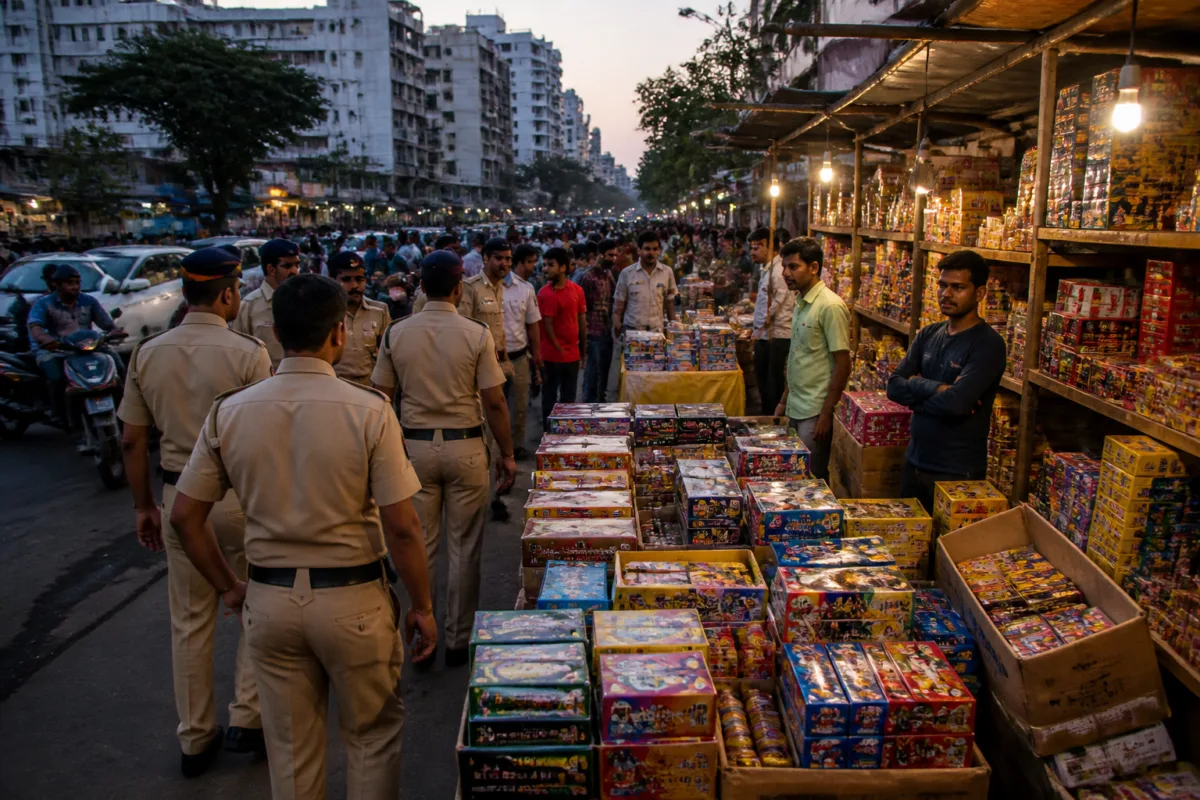
Pune’s firecracker safety concerns have intensified during the Diwali sales season, with unauthorised roadside stalls reportedly selling substandard and non-compliant products while enforcement responsibilities remain divided among the police, Pune Municipal Corporation and other agencies. The issue has raised questions about how consumers can identify authorised firecrackers and who is responsible for checking products sold outside licensed outlets.
The Maharashtra Pollution Control Board (MPCB) conducts annual testing of firecrackers produced by authorised manufacturers to assess compliance with prescribed noise limits. An MPCB official, speaking to Civic Mirror on condition of anonymity, said 16 types of firecrackers made by four companies had been tested this year and were found to be within the prescribed decibel limits. The companies named were Anil Fireworks Factory, Mayna, Dinesh Fireworks and Devasenadhipati Fireworks.
The official said the samples were selected randomly and that the tested products complied with the applicable noise standards. The sound intensity is also mentioned on the boxes of the relevant firecrackers, according to the report. However, the MPCB clarified that its testing was limited to products manufactured by authorised companies. This leaves the quality and safety of firecrackers sold by unauthorised vendors outside the regular testing process described in the report.
The Pune Firecracker Traders’ Association said only around 50 to 60 traders in the city held official licences to sell firecrackers. Association member Sitaram Khade said there were only two authorised firecracker sellers in Kothrud, even though an estimated 70 to 100 stalls had appeared in the area. He alleged that unauthorised stalls were selling products that did not meet prescribed standards and called for strict action by the municipal corporation and police.
The report also highlights the difficulty of enforcing rules when firecracker regulation involves multiple agencies. The police, municipal administration and other concerned departments are responsible for preventing the sale of illegal or dangerous explosive products, but traders and residents have alleged that action against unauthorised stalls has not been adequate. The report does not identify a single agency with complete responsibility for monitoring the quality of every firecracker sold in the city.
Pune police have separately imposed restrictions on the sale, storage and use of traditional connected firecracker chains, commonly called ladi or lari, and firecrackers wound around a rope and sold under the name ‘Atom Bomb’. An order issued on October 23 by Additional Commissioner of Police (Administration) Sanjay Patil also prohibits the use of sound-producing firecrackers between 10 pm and 6 am. During those hours, only firecrackers producing light are permitted, while bursting firecrackers on public roads is prohibited.
The report cites the Noise Pollution (Regulation and Control) Rules, 2000 and Central Pollution Control Board standards, under which the maximum limit for the sound of a single firecracker at a distance of four metres is 125 dB (AI) Leq. For connected firecracker garlands, the limit is 110 dB (AI) Leq. Environmental experts cited in the report warned that densely populated areas can experience a greater combined impact when several firecrackers are burst at the same time, even if individual products fall within prescribed limits.
Residents have sought a clearer system for identifying authorised products. Kothrud resident Rajendra Gokhale said the administration should publish a list of authorised firecrackers and display it where consumers can easily access it. Another resident, Rakesh Kadam, called for a ban on substandard firecrackers, saying ordinary buyers often cannot identify them. The immediate enforcement challenge is therefore not limited to testing authorised products; it also involves identifying, inspecting and regulating the large number of temporary stalls operating in Pune’s markets.

