


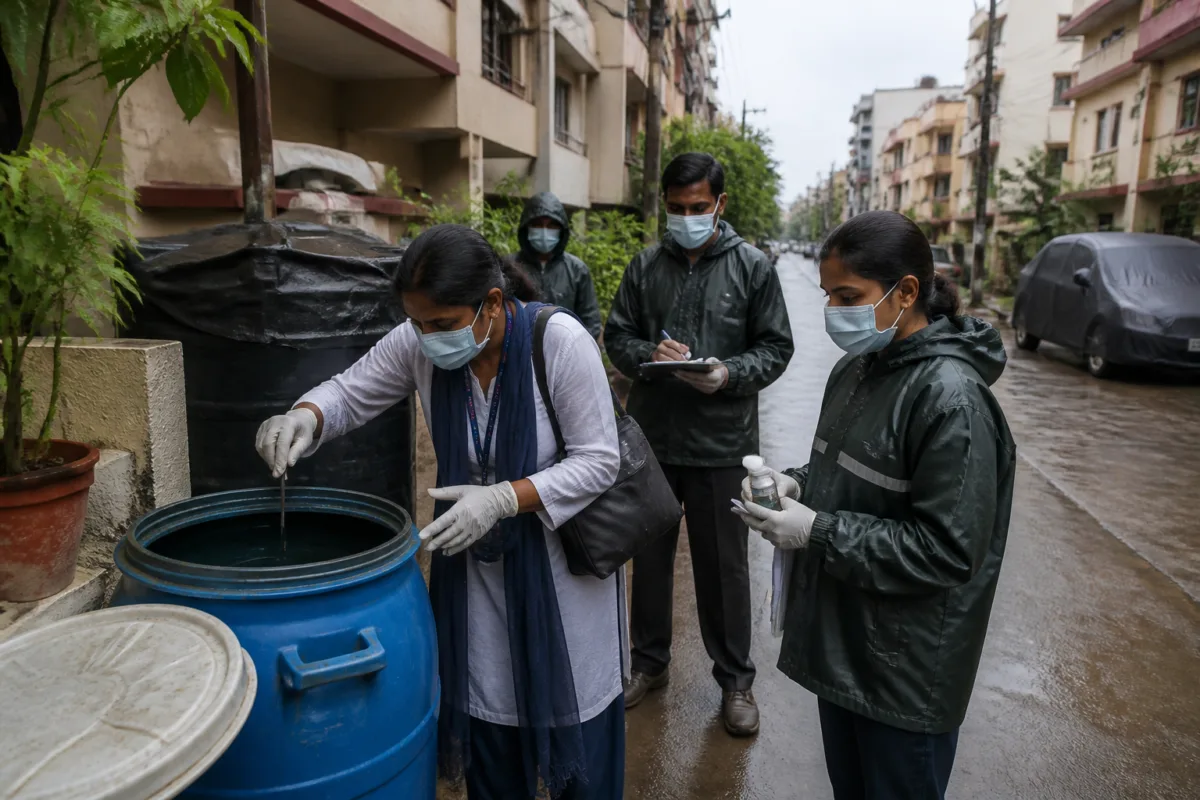
Pune’s dengue cases have risen alongside a widening municipal response, but the suspected death of an eight-year-old girl in Lohegaon has exposed a central weakness in the city’s approach: detecting mosquito breeding is not the same as preventing it. The Pune Municipal Corporation says it has inspected around 14 lakh houses, checked 28.31 lakh water-storage containers and made free testing available. Yet the political criticism following the child’s death centres on whether these measures are reaching vulnerable neighbourhoods quickly enough.
The girl died at Ruby Hall Clinic after four to five days of fever and abdominal pain, according to a hospital press release cited in the report. Tests confirmed dengue, the release said. She was shifted to the hospital in critical condition and developed severe shock, liver injury, kidney failure and multi-organ dysfunction. The case has therefore become more than an individual medical tragedy. It has brought municipal surveillance, field operations, public communication and access to treatment into the same public debate.
The available figures show that dengue is not a marginal or isolated problem in Pune this year. The city recorded 2,413 cases between January 1 and October 20, 2026. Monthly figures reported by the civic body were 568 cases in August, 726 in September and 553 in October. The numbers indicate a substantial concentration during the late monsoon and post-monsoon period, when standing water and mosquito breeding can remain a persistent urban-management concern. The supplied report does not establish whether the figures represent confirmed cases alone or the civic body’s broader reporting category, but it does show the scale at which the health system is operating.
That concentration matters because dengue control depends on repeated, localised action rather than a single city-wide intervention. Aedes mosquitoes can breed in small quantities of water stored in containers around homes and other properties. PMC’s inspection data provides a picture of the operational challenge: larvae were detected in 18,885 containers across 13,000 houses. The civic body issued notices to 2,664 properties and collected Rs 6.3 lakh in fines for mosquito-breeding violations during the year so far.
These figures reveal both reach and limitation. Inspecting 14 lakh houses and more than 28 lakh containers represents a large municipal field operation. At the same time, the detection of breeding sites across 13,000 houses shows that inspection alone does not eliminate the risk. Notices and fines create an enforcement trail, but the report does not say how quickly the affected containers were cleared, whether repeat violations were recorded, or how field teams followed up after action was taken. Those missing links are important because the effectiveness of surveillance depends on what happens after a breeding site is found.
The dispute over fogging adds an institutional dimension. PMC standing committee member Suhas Tingre accused the administration of failing to do enough to control mosquito breeding and questioned its ability to undertake fogging and related measures after the expiry of a contractor’s tenure. He told the Times of India that the civic body must find alternatives during serious health situations. The report does not provide the contract document, the contractor’s scope of work or the precise duration of any operational gap. It does, however, identify a familiar municipal risk: essential public-health functions may depend on procurement and contract continuity even when the disease threat does not follow administrative timelines.
PMC officials said preventive efforts had been stepped up and that teams had been instructed to prioritise insecticide spraying and other action in vulnerable areas. Assistant medical officer Rajesh Dighe said fogging was being conducted inside affected homes and adjoining enclosed spaces rather than indiscriminately in open areas. This distinction is significant for understanding how the civic body says it is deploying resources. The reported approach is targeted at locations connected to affected cases, instead of treating open-area fogging as a substitute for identifying and addressing breeding sites.
The contrast between the political criticism and the administrative response is not simply a disagreement about whether the PMC is active. Both sides point to different stages of the same system. The criticism focuses on prevention and operational readiness: whether teams can act before infections spread and whether services continue when a contractor’s tenure ends. The civic response focuses on surveillance, targeted spraying, testing and available hospital capacity. A city can perform strongly on the second set of measures while still facing questions about the first.
The treatment figures show that PMC is also preparing for pressure on hospitals. The civic body says Dr Naidu Hospital has reserved 50 beds for dengue patients, with 10 to 15 occupied on an average day, and that treatment there is free. It has also arranged confirmatory testing at Dr Naidu Hospital, Dr Kotnis Hospital and Kamala Nehru Hospital. Rapid diagnostic kits have been made available free of cost at all PMC dispensaries to support early detection.
According to PMC, private hospitals have 4,409 beds, including 670 intensive-care beds, for dengue treatment. Civic hospitals have 333 beds, including six ICU beds, and nearly half of those beds remain vacant, a senior official said. These numbers support the civic body’s appeal that residents should not insist on admission only at a few leading hospitals. They also show that the municipal response is treating dengue as a capacity-management problem as well as a vector-control problem.
However, hospital capacity cannot replace prevention. Dengue treatment becomes more difficult when patients arrive late or when early symptoms are not recognised. In the reported case, the child had fever and abdominal pain for four to five days before being shifted in critical condition. The account does not establish why the patient reached hospital in that condition, and no broader conclusion can be drawn from one case. It does underline why free rapid testing, confirmatory facilities and clear referral pathways are important parts of a city-wide response.
The policy landscape described in the report is distributed across several municipal functions. Health officials and dispensaries are responsible for testing and treatment access. Field teams undertake house inspections, identify larvae and conduct spraying. Enforcement mechanisms issue notices and impose fines. Contractors may support fogging or related services. Civic hospitals reserve beds, while private hospitals provide a much larger share of the stated treatment capacity. This division of responsibility creates the need for coordination across procurement, public health, ward-level operations and hospitals.
The contractor issue is therefore not a minor administrative detail. If a service depends on a contract that expires before an alternative arrangement is ready, a city may lose operational continuity during a period of rising cases. Tingre’s criticism points to that risk, while the PMC’s statements suggest that officials are attempting to redirect available teams and prioritise affected locations. The supplied material does not establish whether a replacement contract has been awarded or whether there was a measurable interruption in service. Those are the operational facts that would clarify the dispute.
Pune’s surveillance numbers also raise questions about how municipal performance should be measured. The headline figure is the number of dengue cases, but the civic body has also released activity indicators: houses inspected, containers checked, larvae detected, properties issued notices, fines collected, beds reserved and tests made available. These measures describe effort and capacity. They do not by themselves establish whether transmission has been reduced. For that, the city would need to connect field action with changes in cases across affected areas, information not included in the supplied report.
The same distinction applies to fogging. Counting fogging operations may demonstrate deployment, but the report’s description of targeted spraying suggests that location and timing are central. The civic body says it is focusing on affected homes and enclosed adjoining spaces. Whether that strategy is adequate cannot be determined from the supplied information alone. What is clear is that a visible operation such as fogging is only one component of dengue control; container management, surveillance, testing and rapid clinical care operate alongside it.
The larger urban question is whether Pune’s municipal system can convert extensive monitoring into timely neighbourhood-level action. The inspection figures show that the corporation has a substantial field presence. The case and the political criticism show that public confidence depends on more than the scale of the operation. Residents and elected representatives also want to know whether breeding sites are removed, whether vulnerable areas receive prompt intervention and whether contractor-dependent services continue without interruption.
The evidence currently confirms a high dengue burden, extensive municipal inspection and enforcement activity, expanded testing arrangements and significant reported treatment capacity. It also confirms a dispute over the adequacy and continuity of mosquito-control operations following a suspected dengue death. It does not establish that the civic body’s measures caused or failed to prevent the child’s death, nor does it provide independent evidence of the duration or effect of any contractor-related gap. The next meaningful developments will be the PMC’s continued action in vulnerable areas, the status of fogging and related contracts, and whether case numbers and breeding-site detections decline after the reported interventions.

