


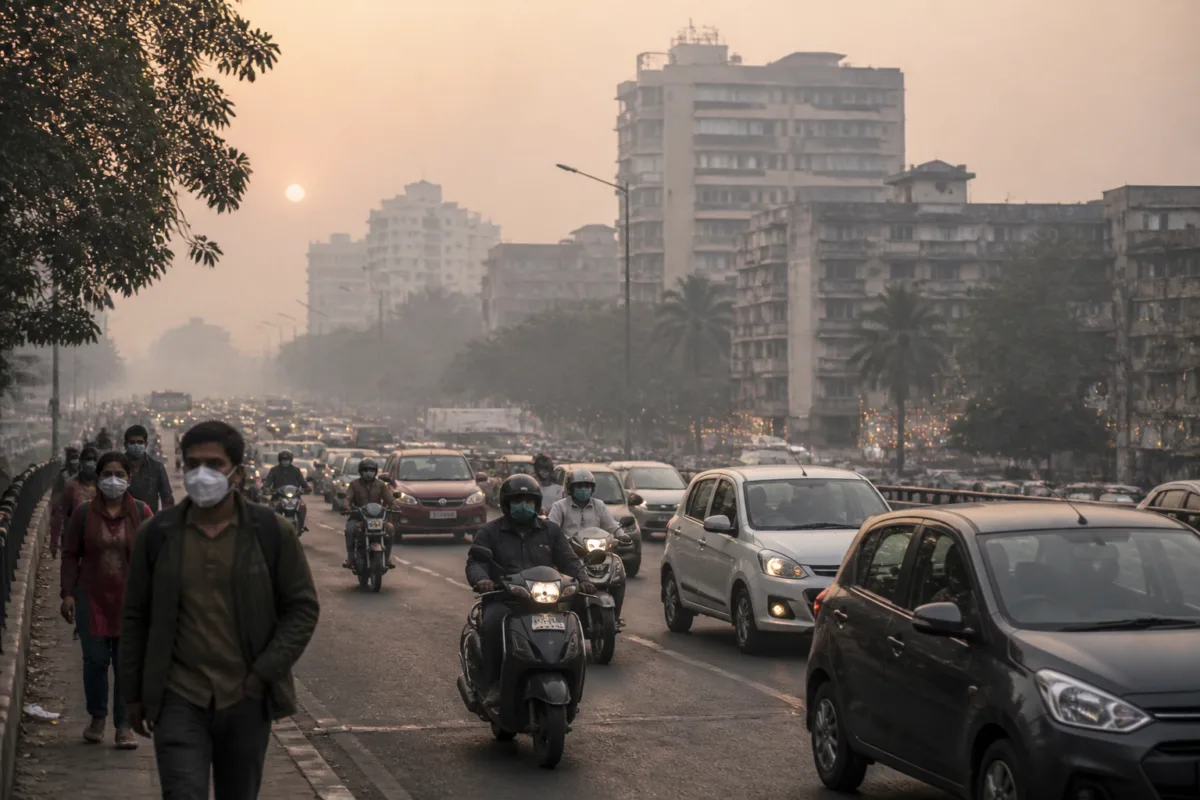
Pune’s air quality deteriorated sharply after Diwali fireworks, with the city’s average Air Quality Index rising from the 160s to between 292 and 321 after the main night of celebrations, according to a report by Lokmat citing Central Pollution Control Board data. The report says the 2026 Diwali period recorded the highest pollution levels in the city in the past five years.
Between 6 and 8 November, Pune’s average AQI remained between 155 and 168, a range classified as moderate under the CPCB scale. The levels reflected the combined effect of festival activity, vehicle emissions and changing weather conditions as winter began.
The sharpest increase was recorded on 9 November, after the fireworks associated with Lakshmi Puja. The city’s average AQI climbed to between 292 and 321, moving from the poor category towards very poor levels. Lokmat reported that the increase represented a rise of 129 AQI points within 24 hours. In some suburbs, readings during the early morning and night reportedly crossed 400 to 500.
The report attributed the deterioration to a combination of firecracker smoke, vehicle emissions, cooler weather and reduced wind speed. These conditions allowed smoke and fine particulate matter to remain trapped closer to the ground instead of dispersing quickly. Residents also reported respiratory discomfort as the pollution persisted, according to the report.
Air quality remained degraded after the initial spike. The AQI was reported to be between 175 and 281 on 10 November and stood at 229 on 11 November. These readings placed parts of the period in the poor category, indicating that pollution did not return immediately to the levels recorded before the main fireworks night.
The comparison with recent Diwali periods shows the scale of the increase reported this year. Pune’s AQI during Diwali in 2024 and 2025 was generally in the moderate range, between approximately 132 and 170. The report said the AQI on Diwali evening in 2025 was around 132 to 170, substantially below the post-fireworks levels recorded in 2026.
The figures also highlight the role of weather and dispersion conditions in determining how festival emissions affect a city. Firecracker smoke can create a short-term pollution spike, while low temperatures and weak winds can extend the period during which fine particles remain suspended in the urban atmosphere. The reported readings show that the pollution burden continued beyond the night of the celebrations.
The latest figures add to the challenge faced by Pune’s civic and environmental authorities in monitoring local air quality during periods of concentrated emissions. The reported AQI levels for 10 and 11 November indicate that the city’s air remained in the poor range after the peak recorded on 9 November.

