


Pune air pollution has exposed a difficult urban governance question: can spending on roads, cleaning equipment and related civic works improve air quality if the sources of dust remain active across the city? According to figures cited from the central government’s monitoring portal and claims by the Pune Air Action Hub, the city has spent ₹275.28 crore, or 66 per cent, of the ₹418.45 crore allocated over seven years under the National Clean Air Programme (NCAP) and the 15th Finance Commission. Yet particulate pollution, particularly PM10, has not been brought fully under control.
The figures do not establish that every rupee spent failed or that the funded works produced no benefit. They point instead to a more specific problem: expenditure is not the same as pollution reduction. Pune’s experience shows how clean-air funding can become distributed across road infrastructure, public transport, crematoriums and waste management, while the measurable link between each intervention and a reduction in particulate pollution remains difficult to see from the information available.
The reported allocation consists of two distinct funding streams. Pune received ₹9.45 crore under the National Clean Air Programme and ₹409 crore under the 15th Finance Commission, taking the total approved amount to ₹418.45 crore. Of this, ₹275.28 crore had been spent, according to the latest figures on the Portal for Regulation of Air Pollution in Non-Attainment Cities, developed by the Union government to monitor the implementation of the clean-air programme.
The spending rate is important, but it needs to be read alongside the purpose and design of the works. The Pune Air Action Hub says the funds were used for a range of activities, including road infrastructure, public transport, crematoriums and waste management. Such a spread reflects the fact that urban air pollution is not controlled by a single department. Roads, construction activity, traffic, waste handling and municipal maintenance can all shape the amount of dust and particulate matter entering the urban atmosphere.
At the same time, a broad project list can make accountability harder. If funding is allocated across several departments and asset categories, the city needs to demonstrate not only that the money was spent, but also which intervention addressed which pollution source. The supplied figures do not provide a project-wise assessment of air-quality improvement, nor do they show how PM10 concentrations changed after each intervention. That missing connection is central to evaluating whether clean-air expenditure is achieving its intended outcome.
### Pune’s dust problem is also an infrastructure problem
The reported works include strengthening 121.4 kilometres of roads and repairing 19 kilometres of footpaths. These activities can have an air-quality relevance when damaged road edges, exposed surfaces and broken pedestrian infrastructure create loose material that vehicles can resuspend. However, road strengthening and footpath repair are not automatically equivalent to dust control. Their impact depends on construction quality, the treatment of road shoulders, the management of excavated material and the maintenance of completed surfaces.
The Pune Air Action Hub has identified road dust as a contributor to pollution. That places routine municipal operations at the centre of the clean-air challenge. Roads are not only transport corridors; they are also large exposed surfaces that are repeatedly disturbed by traffic, utility works, construction and weather. A city may repair a road, but if adjoining shoulders remain unpaved, debris is left after civil works or vehicles move over dusty edges, the pollution source can persist.
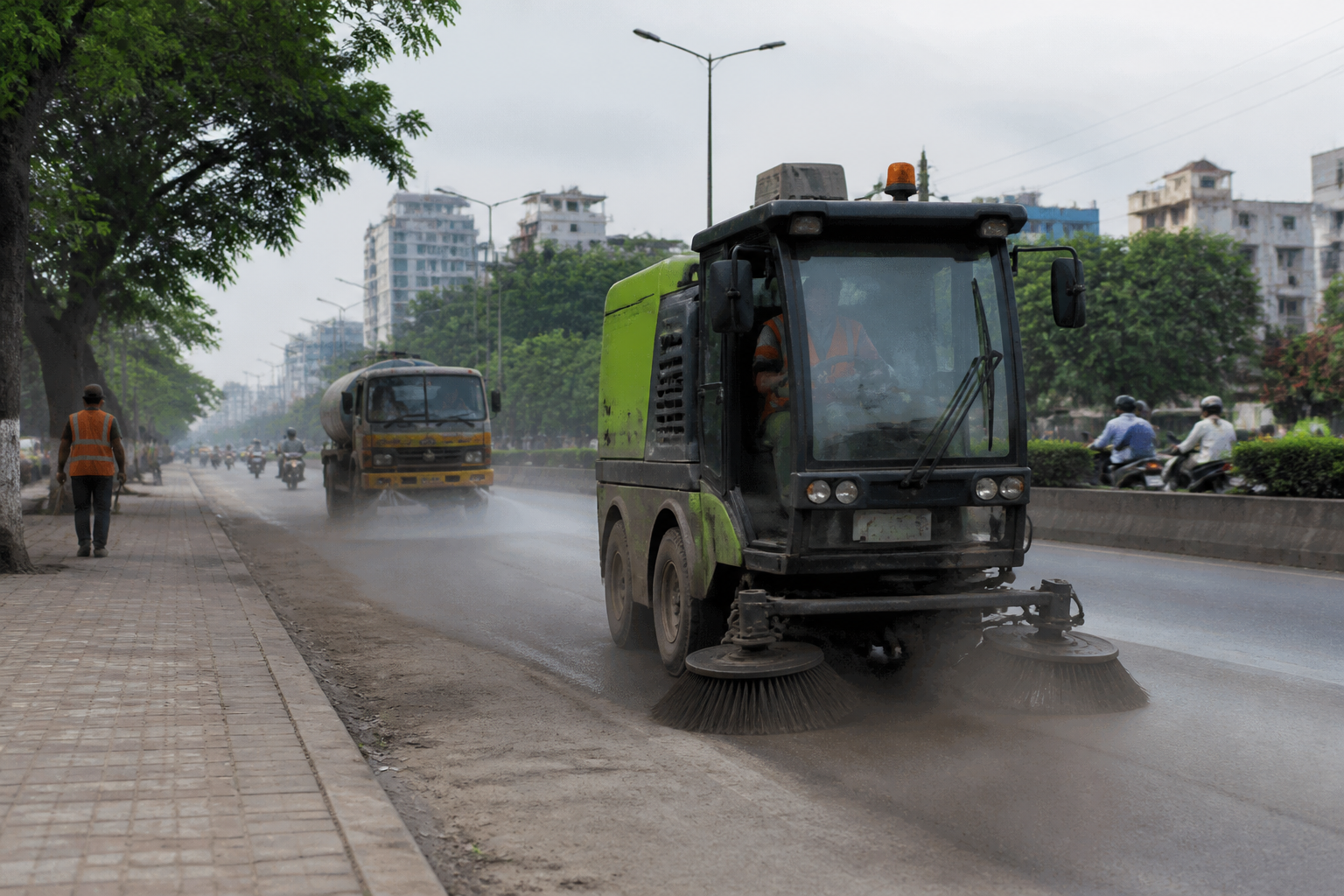
The city has also put two mechanical road-sweeping machines and 19 sprinklers into operation, according to the report. These assets indicate an attempt to address dust through regular cleaning and water application. But their effectiveness depends on where and how often they are deployed, whether they cover the highest-emission stretches, how much dust they remove rather than redistribute, and whether operations continue consistently. The supplied material does not include route schedules, coverage data, maintenance records or before-and-after pollution measurements.
This distinction matters because equipment procurement can be counted immediately, while environmental outcomes take sustained monitoring. Two sweepers and 19 sprinklers may be operational, but their presence alone cannot show whether the city’s most polluted roads are receiving adequate treatment. For residents, the relevant question is not simply whether a machine has been purchased or deployed. It is whether the road outside a home, school, workplace or market is becoming less dusty and whether measured PM10 levels are declining.
### The institutional challenge behind the expenditure
The funding structure also illustrates the administrative complexity of urban air pollution. The NCAP is a national programme, while the 15th Finance Commission funds form a separate, much larger source in the figures cited for Pune. The money reaches the city through a framework that requires local implementation, but the causes of pollution cut across municipal functions. Road maintenance, footpaths, public transport, waste management and crematorium operations do not normally sit within one narrowly defined workstream.
That fragmentation creates a risk of treating clean-air funds as a general pool for visible civic improvements. Roads and footpaths are important urban assets, and waste management is an essential municipal responsibility. But a clean-air expenditure framework requires an additional test: how directly does a particular work reduce emissions or exposure? Without that test, projects may be completed and funds may be marked as spent while the underlying pollution source remains insufficiently addressed.
The reported spending rate of 66 per cent should therefore be treated as an implementation indicator, not an outcome indicator. It tells readers how much of the approved money has been used. It does not, by itself, establish whether the city has achieved cleaner air, whether PM10 has fallen, or whether pollution has shifted from one locality to another. Those questions require linked data on project locations, operating performance and air-quality measurements.
The government monitoring portal is significant because it provides a formal mechanism for tracking funds under the clean-air framework. However, monitoring expenditure and monitoring environmental performance are different tasks. A portal can show allocations and spending, while a city’s air-quality system must additionally show pollutant levels, source patterns and changes over time. The information cited in the report gives a clear account of funding and selected works, but not the complete chain from expenditure to result.
### What the available numbers reveal—and what they do not
The headline numbers present a sharp contrast. Pune had ₹418.45 crore approved across the two funding streams and had spent ₹275.28 crore. That leaves ₹143.17 crore unspent, based on the figures reported. The larger share of the allocation—₹409 crore—came through the 15th Finance Commission, while the NCAP component was ₹9.45 crore. The scale and composition of the funding mean that implementation under the Finance Commission allocation is particularly important to understanding the overall result.
The physical output figures are also substantial: 121.4 kilometres of road strengthening, 19 kilometres of footpath repairs, two mechanical sweepers and 19 sprinklers. Yet these numbers describe inputs and outputs rather than outcomes. They do not show the condition of the repaired roads after completion, the proportion of the city’s road network covered by sweeping, the quantity of dust removed, the operational uptime of the equipment or the change in PM10 readings at the treated locations.
That does not invalidate the works. It clarifies the evidence boundary. The available material supports the conclusion that Pune has deployed a considerable clean-air fund across multiple urban works and that dust pollution remains a recognised concern. It does not support a conclusion that the expenditure was wholly ineffective, nor does it identify a single reason for the continuing pollution. A stronger assessment would require project-level performance data and pollutant measurements connected to the interventions.
The gap is particularly relevant for PM10 because the pollutant is closely associated with coarse particulate matter and resuspended dust. The report states that PM10 pollution has not been fully controlled, but it does not provide a time series, annual concentration values or location-wise readings. Without those numbers, it is not possible to determine from the supplied evidence whether pollution has improved gradually, remained stable or worsened in specific parts of Pune.
### The bigger urban question
Pune’s clean-air spending raises a wider question about how Indian cities measure environmental governance. Municipal systems are often judged by the completion of works: kilometres repaired, machines deployed, funds utilised and facilities upgraded. Air pollution requires a second layer of accountability. It asks whether those completed works changed the conditions experienced by residents and reduced the pollutants identified in the programme’s objectives.
For Pune, the immediate evidence points to a mismatch between financial progress and environmental resolution. The city has spent most of the funds reported as available, but the Pune Air Action Hub says dust pollution remains a problem. The next stage of scrutiny must therefore move from allocation and expenditure to performance: where the money was spent, which departments implemented the works, how frequently the equipment operated, and whether PM10 readings changed in the areas targeted.
The available figures confirm that Pune has treated clean air as an infrastructure and municipal-management issue rather than only a monitoring exercise. They also show that spending across several sectors has not, by itself, settled the city’s dust problem. Further evaluation will depend on the government portal’s project-level data, municipal operating records and consistent air-quality measurements that can connect public expenditure with actual pollution outcomes.

