


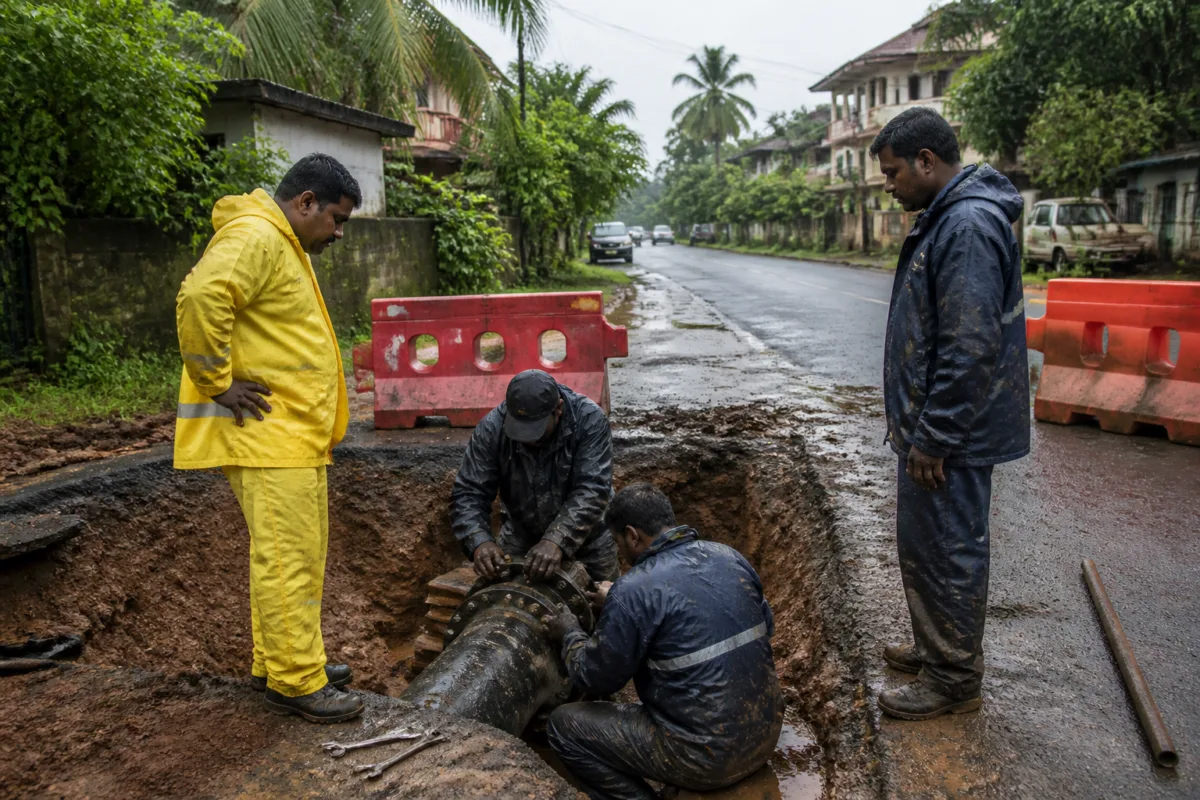
A pipeline joint leak at Paniwada-Borim left parts of Ponda and Marcaim without drinking water on Friday, but the immediate disruption is only the latest in a series of failures affecting the same water distribution network. The repeated interruptions show how a local fault on a relatively small pipeline can quickly become a wider service problem for several settlements and parts of a town.
The drinking water department repaired a loosened joint at Paniwada-Borim in Goa’s Shiroda constituency after leakage was reported from Friday morning. The repair work affected supply to Kapileshwari, Bandora, Talaulim, Durbhat, Agapur and parts of Ponda town. The report does not specify how long the latest interruption lasted or when normal supply was fully restored, but it records that the joint was fixed.
The affected areas are supplied through a network connected to the Opa water treatment plant. A 200mm ductile iron main distribution pipeline carries water from the main pipeline bringing treated potable water from Opa. The network therefore has a defined dependency: a failure on the distribution section can interrupt supply across areas that are geographically separated but connected to the same line.
That dependency is central to understanding the disruption. The latest failure was reported at Paniwada-Borim, while earlier incidents cited in the report occurred at Dhavali, on the outskirts of Ponda town, and near Khadapabandh ward. Although the locations differ, the incidents affected overlapping areas in the Marcaim constituency and parts of Ponda constituency. The service impact has consequently been broader than the physical size of each damaged section.
The recurrence is visible in the sequence recorded by the report. On July 12, water supply was affected for two days while department staff repaired a loosened pipeline joint at Dhavali. On March 9, a private road contractor carrying out asphalt work in the parking area of a private building near Khadapabandh ward ruptured the main water pipeline. On February 12, the same pipeline burst near a temple at Dhavali, affecting supply to the same areas.
These incidents point to two different sources of risk within the network. The February and July failures were described as pipeline bursts or loosened joints, while the March incident followed damage caused during private road works. The available report does not establish whether the failures share a single technical cause, whether the damaged sections were replaced or repaired, or whether the network has undergone a broader condition assessment. It does, however, establish that residents have faced repeated interruptions linked to the same supply system.
The distinction between a joint failure and third-party damage matters for administration. A loosened joint is a maintenance and asset-condition issue. A rupture during road work raises questions about the visibility of underground utilities, coordination between contractors and the drinking water department, and safeguards before excavation or road improvement. The report does not state whether responsibility or liability was assigned in the March case, so no conclusion can be drawn about the contractor’s compliance or the department’s oversight.
For residents, the operational effect is similar regardless of the immediate cause: taps go dry across multiple localities when a critical section is taken out of service. The areas named in the report include residential settlements, parts of Ponda town and locations spread across the Ponda and Marcaim constituencies. The report does not provide household numbers, alternative supply arrangements, tanker details or information on whether schools, hospitals, businesses or public institutions were affected. Those omissions limit the ability to measure the full social and economic cost of each outage.
The network’s structure also helps explain why a 200mm pipeline can have a disproportionate effect. The pipe is identified as a main distribution line receiving water from the Opa system and serving areas in and around Ponda and Marcaim. It is not described as an isolated local connection. When work is required on such a line, supply must be interrupted or affected while staff isolate, access and repair the damaged section. The latest incident demonstrates the vulnerability created when several communities depend on a shared distribution asset.
The report’s evidence is especially significant because it does not describe a single isolated emergency. It records at least four incidents: the February burst, the March rupture during private works, the July joint repair and the latest leakage at Paniwada-Borim. The exact dates of the latest Friday event and the intervals between repairs are not fully explained in the supplied material, but the sequence is sufficient to show recurring service disruption within the same broader network.
What remains unclear is whether the department treats these events as separate faults or as symptoms of a common infrastructure problem. The supplied report does not mention pipe age, pressure levels, soil conditions, previous replacement work, inspection schedules, repair costs or the length of the affected pipeline. It also does not state whether the 200mm DI pipeline was designed for current demand or whether demand growth has altered the network’s operating conditions.
Those details are important because repair frequency alone cannot establish the cause of failure. A repeated joint problem could reflect installation, movement, pressure or maintenance issues, but the available evidence does not identify any of them. Similarly, the March rupture confirms exposure to external construction activity, but it does not show whether the line was inadequately mapped, insufficiently protected or struck despite proper utility information. The correct institutional response depends on facts that have not been supplied.
The responsibility for restoring supply in the reported incidents lay with the drinking water department, whose staff carried out the repairs. The Opa water treatment plant is the source of potable water entering the main pipeline, while the 200mm DI line distributes water to the affected areas. The report does not identify the specific administrative division responsible for capital replacement, contractor coordination or network planning, nor does it state whether any long-term upgrade has been announced.
This separation between treatment and distribution is an important governance issue. A treatment plant can produce water, but reliable access also depends on the condition, layout and protection of the network that carries it to consumers. The latest event was not presented as a shortage at Opa or a failure of water treatment. It was a distribution failure that interrupted the final movement of potable water to several localities.
The incidents also show why road and building works require coordination with underground utility networks. In March, the report says a private road contractor entrusted to asphalt a parking area ruptured the main water pipeline. Such damage can convert a private construction activity into a public service disruption. Without information on utility mapping, permissions or enforcement, the report cannot determine whether the incident resulted from an avoidable procedural failure. It does establish that infrastructure outside the water department’s direct operations can affect water continuity.
The available data is limited but clear in one respect: the same areas have repeatedly experienced disruption. The February burst near a temple at Dhavali, the July repair at Dhavali and the March rupture near Khadapabandh all affected supply to parts of Marcaim and Ponda. The latest leakage at Paniwada-Borim again affected Kapileshwari, Bandora, Talaulim, Durbhat, Agapur and parts of Ponda town. The repeated geography indicates that network dependence, rather than only the location of an individual fault, determines the scale of impact.
There is no evidence in the report to quantify total outage hours across the incidents, compare performance with other Goa networks or establish whether the frequency is increasing. There is also no information on planned redundancy, alternate routing or pressure management. Those gaps should not be filled with assumptions. They identify the questions that future official updates would need to answer if residents and public authorities are to assess whether the system is being repaired temporarily or made more resilient.
The larger urban question is whether a water network can remain dependable when its most consequential sections are repeatedly repaired without a publicly stated assessment of their condition. A leak may be a routine maintenance event, but repeated failures on a shared distribution line turn routine maintenance into a governance and service-continuity issue. The burden is felt locally, while the cause may involve treatment infrastructure, distribution design, road works, contractor coordination and asset management.
The latest repair restored the immediate function of the affected joint, according to the report. What it does not establish is whether the department has scheduled a broader inspection of the 200mm DI pipeline, reviewed the earlier failures or introduced measures to prevent damage during private works. Those are the developments that will determine whether the episode remains another short-term interruption or becomes the trigger for a more systematic response to Ponda and Marcaim’s recurring water-supply vulnerability.

