


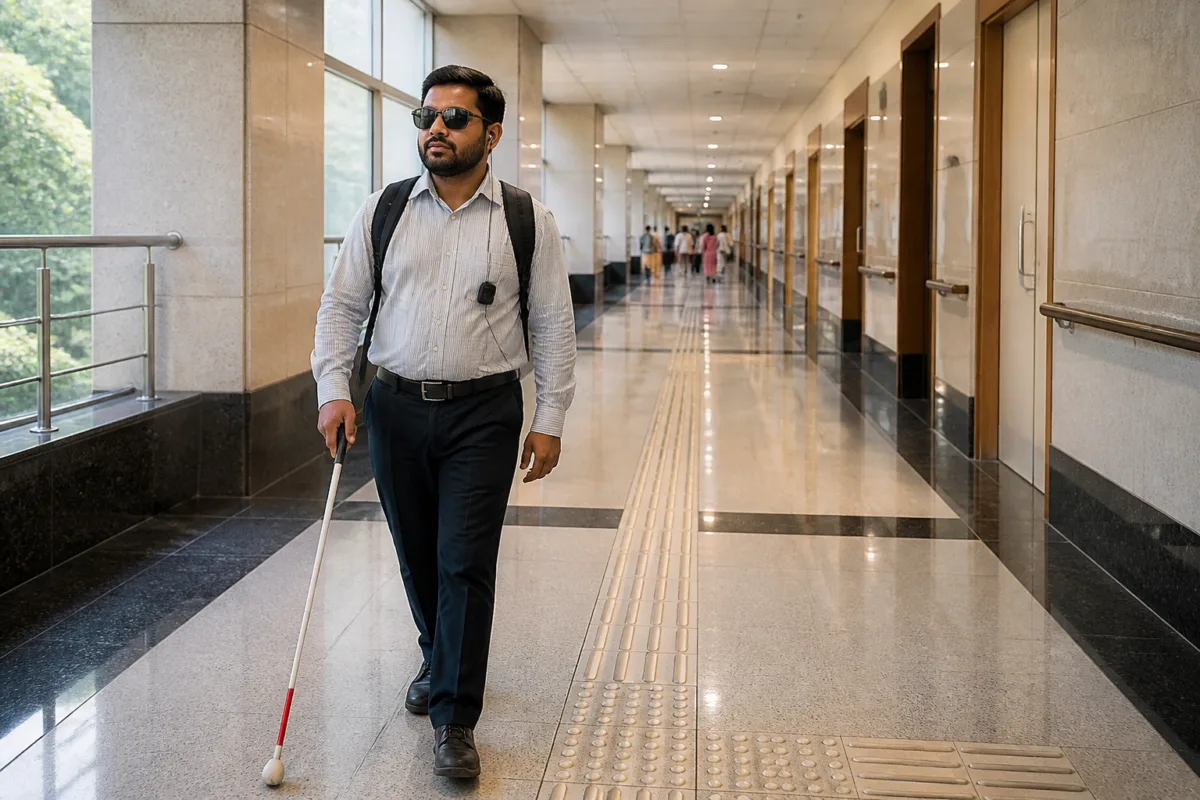
IIIT Delhi is developing PathSense technology to help blind and low-vision users navigate large buildings independently, using audio augmented reality to communicate the structure of indoor spaces through sound. The three-year research project is intended for locations such as hospitals, government buildings and other public places where finding corridors, rooms and destinations can be difficult without assistance.
The project has received a grant of approximately Rs 62 lakh under the Qualcomm XR University Research Grant-2026. Dr Richa Gupta will serve as the principal investigator, while Dr Anmol Srivastava will be the co-investigator. The research will be conducted by Indraprastha Institute of Information Technology, Delhi.
PathSense is designed to go beyond voice-based turn-by-turn directions. According to the report, the project will examine how blind and low-vision people understand their surroundings without sight and how audio and other non-visual cues can communicate information about a place. The proposed system will focus on helping users understand buildings, corridors, routes and the spatial arrangement of locations.
Indoor navigation presents a distinct accessibility challenge because large public buildings often contain complex layouts, multiple entrances, long corridors and several levels or destinations. The source report identifies hospitals, government offices and public spaces as settings where visually impaired people may have to depend on others to reach their intended destination.
Dr Richa Gupta said that finding routes inside large buildings is challenging for visually impaired people. Dr Anmol Srivastava said the purpose of the research was not only to provide directions, but also to enable users to understand the complete structure of a location. The project will therefore study both navigation and the communication of spatial information through sound.
The use of audio augmented reality places the research at the intersection of accessibility, built-environment design and emerging extended-reality technology. Rather than relying on visual maps or signs alone, the proposed approach would investigate how digital audio can help users interpret the physical characteristics of indoor spaces. The supplied report does not specify the final device, software interface, buildings to be used for testing or the deployment timeline beyond the three-year research period.
The project’s immediate milestone is the research programme funded through the Qualcomm grant. Further details about its prototype, testing locations, user trials and eventual public deployment are expected to emerge as the three-year study progresses.

