


Panaji’s Rs 1,100 crore Smart City Mission was presented as a route to modern infrastructure, better drainage, upgraded sewerage and digitally managed urban services. The condition of several projects described in a Times of India report suggests a more difficult outcome: the city has built assets whose ownership, operation, maintenance and measurable public benefits remain contested.
That distinction is central to understanding Panaji’s experience. A smart city is not defined only by roads being reconstructed, cameras being installed or utility lines being placed underground. Its success depends on whether those assets work together, whether residents can use them reliably, whether the municipal system can maintain them and whether public agencies can account for the money spent. In Panaji, the available record points to a widening gap between project completion on paper and urban service delivery on the ground.
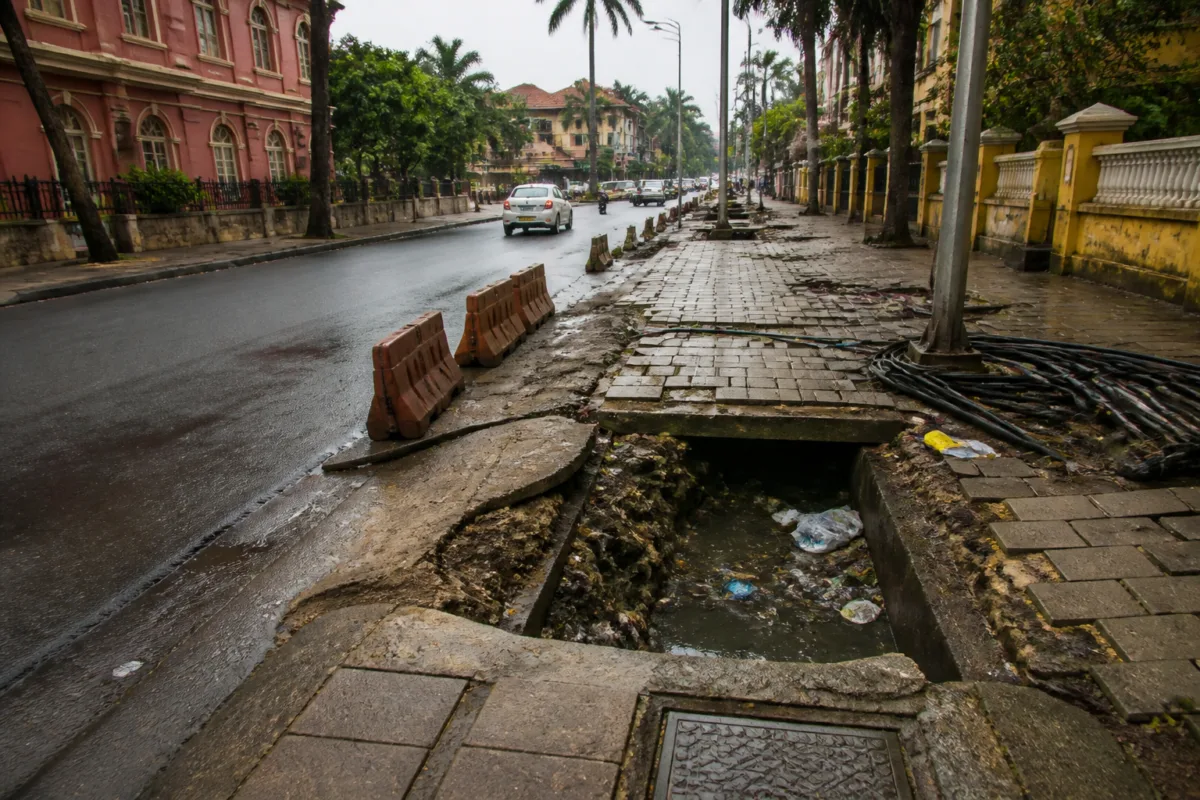
The mission began in 2015 with an ambitious mandate. According to the report, almost two years of trenches, barricades and dust accompanied works intended to transform the city. Yet infrastructure completed barely two years ago has reportedly deteriorated. Pavements and stairs in Altinho are described as cracked or overgrown with weeds, while the promised smart roads remain incomplete in their intended form. The account also says underground utility ducts are limited and that sewerage systems continue to face overflows during the monsoon.
These failures are not merely defects in individual construction packages. They indicate how urban infrastructure can lose value when planning, execution and operations are treated as separate stages. A road may be technically completed but still fail as a public asset if adjoining drainage does not work, utility ducts are not integrated, pavements are not maintained or traffic management remains unchanged. Similarly, a sewerage pipeline has limited public value if the network is incomplete or if chambers are poorly designed in relation to surrounding colonies.
Former Panaji mayor Surendra Furtado told the Times of India that pavers had begun coming out and that some sewerage lines were not working. He also said that in certain colonies, sewerage chambers were higher than the colonies, causing sewage to flow into residential areas. These comments, as reported, connect visible defects to a deeper design and implementation problem: infrastructure has been inserted into the city without consistently resolving how systems interact with existing neighbourhoods.
The Ribandar sewerage project illustrates the difference between laying infrastructure and delivering a functioning network. The report says a pipeline was laid there, but the network remains incomplete and unused. For residents, an unutilised pipeline does not provide the public health or environmental benefit associated with sewerage investment. For the administration, it creates an asset that may require additional spending before it becomes operational.
Drainage presents a similar test. The St Inez nallah is described as a crucial natural storm-water channel, with Rs 41 crore allocated for its rejuvenation. The report says the channel remains clogged with silt, plastic waste and stagnant water. It also raises concerns about duplicated works and unverified billings. Those concerns are allegations reported by the source, not established findings in the supplied material, but they point to the importance of outcome-based auditing. A drainage project should be assessed not only by the amount sanctioned or the work recorded, but by whether water moves safely through the system during the conditions for which it was intended.
The expenditure figures cited in the report show the breadth of the mission. About Rs 123 crore was spent under the combined heads of smart roads, electricity and sewage. A further Rs 16 crore was divided between smart water pipelines and smart meters. Despite these investments, residents reportedly continue to experience dry taps and low water pressure rather than uninterrupted 24-hour clean water supply. This gap between capital spending and daily service reliability is one of the clearest measures of the mission’s unresolved problems.
It also complicates the meaning of the word “smart”. Digital monitoring, meters and surveillance cameras may improve information flows, but they cannot substitute for basic network capacity, regular maintenance or accountable service management. The report says a smart CCTV network did little to resolve congestion and haphazard parking on arterial roads. That does not necessarily mean the cameras have no operational value; it does show that surveillance technology alone cannot solve a street-management problem when enforcement, parking supply and road use remain unresolved.
The Miramar beachfront development adds a second dimension: the relationship between urban improvement and environmental protection. The project, undertaken by the Imagine Panaji Smart City Development Ltd (IPSCDL), is reported to have cost Rs 12.8 crore. Panaji Corporation councillor Jack Sukhija questioned its purpose and said future interventions along Goa’s beaches should prioritise environmental protection over extensive concretisation. The report describes the project as an example of alleged wasteful expenditure, while IPSCDL officials did not respond to the concerns raised.
The reported condition of the Rs 2.5 crore mangrove boardwalk behind the central library raises the same question from a maintenance perspective. The boardwalk is said to have fallen into disrepair before it was handed over to the Corporation of the City of Panaji. When an asset deteriorates before transfer, responsibility can become blurred: the implementing agency may consider construction complete, while the receiving authority may argue that it cannot accept or maintain defective infrastructure.
This is where the institutional design of the mission becomes important. The special purpose vehicle was created to build projects, but, according to the report, it was not intended to operate them. The city and state are now described as being in a tussle over who should inherit and maintain the assets. Furtado questioned whether the Corporation has the funds and technical capacity to maintain the projects, and whether a dedicated technical team should have been created within the civic body.
The problem is common to capital-led urban programmes: the agency that has access to project funding and technical consultants may not be the agency responsible for routine operations. Construction can therefore move faster than institutional preparation. Roads, sewerage networks, water systems, public spaces and digital equipment each require different maintenance contracts, staff skills, budgets and performance standards. If these arrangements are not established before handover, the city inherits liabilities rather than durable services.
The financial and documentary record described in the report makes that accountability problem more serious. RTI records covered expenditure of only about Rs 500 crore on projects, while audit reports were available only up to 2019 for a mission that began in 2015. More than Rs 4.3 crore was reportedly spent on consultancy fees, but the physical results associated with that advice remain unclear in the account. The report also says Rs 23.5 lakh booked under the Atal Mission for Rejuvenation and Urban Transformation, or AMRUT, could not be traced to clear outcomes.
The absence of a complete, current and publicly intelligible project ledger makes it difficult to answer basic questions. Which works were sanctioned, completed, commissioned and transferred? Which assets are operational? What defects remain pending? Who is contractually responsible for repairs? What is the annual maintenance cost, and which agency has budgeted for it? Without such information, public debate is forced to rely on deteriorating assets, individual complaints and partial records rather than a verified assessment of performance.
That does not mean every reported failure can be attributed to the Smart City Mission alone. Panaji’s traffic, water pressure, drainage and parking problems may involve agencies and systems beyond a single programme. But the mission’s stated purpose makes its outcomes assessable against everyday urban conditions. If residents continue to face sewage overflows, low water pressure, congested roads and neglected public spaces, the programme must explain how its investments changed those conditions.
The evidence supplied in the report therefore points to three linked failures of urban delivery. First, project execution appears to have been uneven, with incomplete networks and deteriorating works. Second, the conversion of construction into operating services remains unresolved. Third, the public record of spending and outcomes is incomplete enough to weaken accountability. These are not separate administrative details. Together, they determine whether public infrastructure becomes a functioning city system or a collection of isolated projects.
Panaji’s experience also shows why maintenance cannot be treated as a postscript to urban development. A pavement, sewer, drainage channel, boardwalk or water pipeline generates public value over years, not on the date of inauguration. That value depends on inspections, cleaning, repairs, replacement cycles, operational staffing and predictable funding. If those costs are not built into the programme from the beginning, deterioration is not an unexpected event; it is an institutional risk embedded in the project model.
The supplied account does not establish the final legal or financial responsibility for each disputed work, nor does it provide a complete audit of the Rs 1,100 crore mission. IPSCDL officials did not respond to the reported queries, and the concerns about duplicated works, unverified billings and wasteful expenditure remain allegations in the source material. What is established is the broader public-interest question: Panaji received substantial smart-city investment, but the city’s residents and institutions are still struggling to identify reliable services, complete records and a clear maintenance owner.
The developments that deserve monitoring are the completion and utilisation of the Ribandar sewerage network, the condition and functioning of the St Inez drainage channel, the transfer of Smart City assets to the civic body, the availability of maintenance funding and technical staff, and the publication of updated expenditure and audit records. Until those links are clarified, Panaji’s Smart City Mission will remain less a story of completed transformation than a warning about the costs of building urban infrastructure without securing its long-term operations.

