


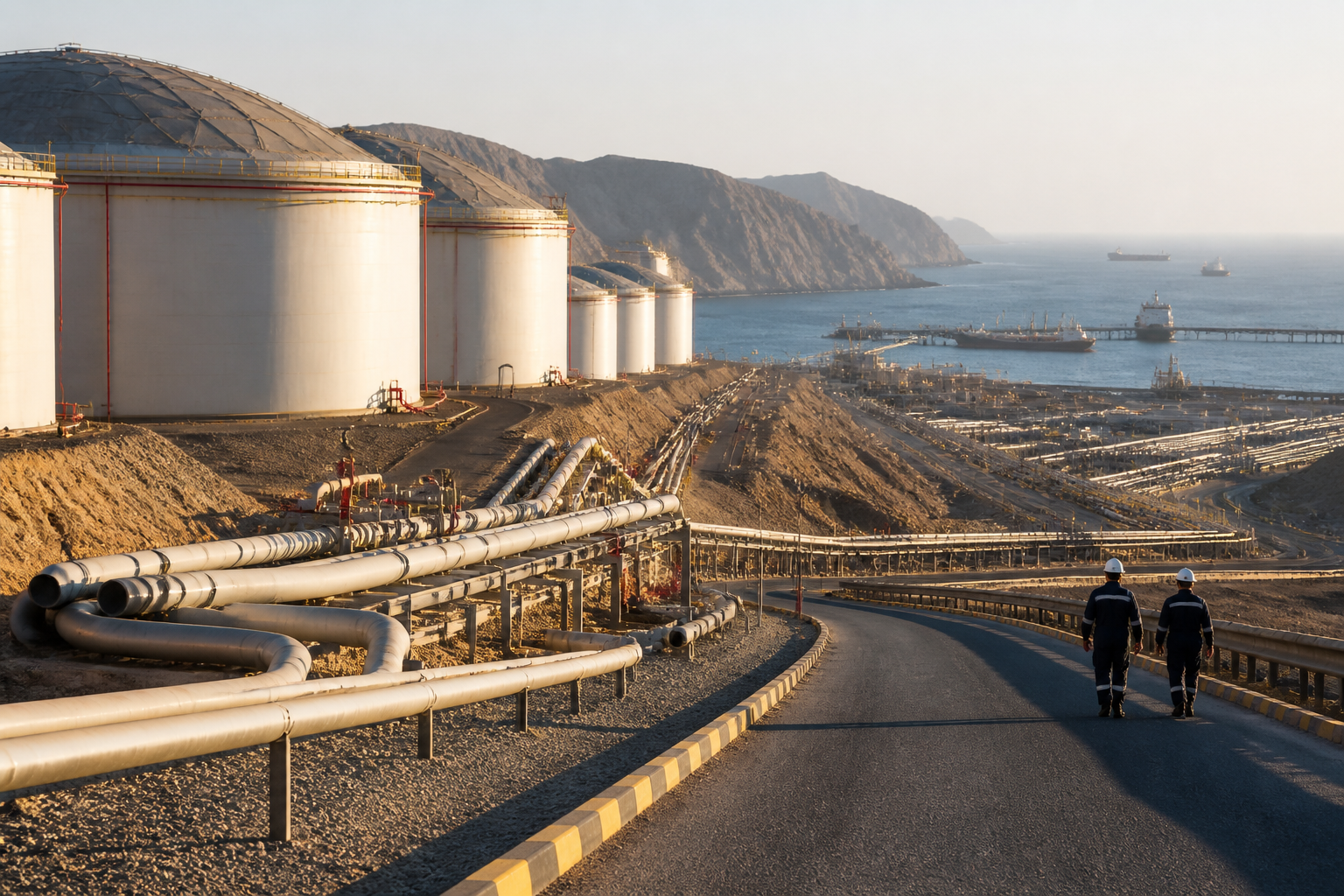
Oil infrastructure projects are moving up the Gulf’s strategic agenda as Saudi Arabia and the United Arab Emirates examine pipelines, storage facilities and terminals designed to reduce their dependence on the Strait of Hormuz. For India’s state-run Engineers India Ltd (EIL), the shift creates a difficult balance: conflict has slowed current orders, but the same disruption could generate a larger market for infrastructure that makes energy exports less vulnerable to interruptions.
EIL chairman and managing director Atul Gupta said the company is in early-stage discussions with Saudi Arabia and the UAE for consultancy and engineering work linked to these projects. The investments under consideration are estimated at about $1 billion. EIL is seeking mandates for project consultancy and feasibility studies, with the Gulf producers still at the planning stage, according to Gupta’s comments to reporters after the company’s annual general meeting.
The significance of the discussions lies in the type of infrastructure being considered. The Strait of Hormuz is the principal maritime route connecting the Persian Gulf with international markets. When shipping through the chokepoint is disrupted, producers cannot solve the problem simply by increasing output. They also need alternative systems for moving, storing and exporting crude and petroleum products. That makes pipelines, inland storage, export terminals and associated facilities part of the region’s energy-security response.
The conflict involving Iran and the United States has exposed the operational dependence built into the Gulf’s energy geography. Producers have been compelled to focus on securing and restoring existing installations, while new orders have slowed. Gupta said the slowdown was visible in order inflows from the region, even as he expected activity to improve in the third and fourth quarters. For EIL, the immediate commercial effect is therefore negative: projects are being delayed while energy companies prioritise existing assets and operational security.
The longer-term opportunity is different. If Gulf producers move from planning to execution, they could commission a range of assignments in which EIL already operates. These could include engineering design, feasibility studies, project management and construction-management services. Gupta also pointed to additional underground oil-storage facilities being planned by the UAE at Fujairah, an important energy and shipping location on the Gulf of Oman.
This is not simply a story about one engineering company pursuing overseas work. It shows how geopolitical risk can reshape the physical infrastructure of energy markets. A disruption at a maritime chokepoint can lead to investment in fixed assets elsewhere: storage capacity, alternative pipelines, terminals and systems that allow producers to redirect supplies. Such assets take time to plan and build, but their purpose is to reduce exposure to a single route whose disruption can affect shipping, energy security and the cost and availability of crude and petroleum products.
The financial figures explain why the Gulf matters so much to EIL’s growth strategy. Overseas projects account for 43 per cent of the company’s order book. International consultancy generated about ₹4,929 crore, or nearly 62 per cent of the fresh business secured during 2025-26. EIL won fresh business worth ₹7,978 crore in the year ended March 2026, lifting its order book to a record ₹15,109 crore as of March 31. Gupta said the order book had since reached around ₹17,000 crore.
The company has secured ₹510 crore of orders from the Gulf region since the Iran conflict began. That figure indicates that the disruption has not stopped commercial activity altogether, but it also needs to be viewed against the wider slowdown described by the company. Gulf governments and energy companies are currently directing attention towards protecting and restoring existing installations. New resilience-oriented investments may emerge later, once immediate operational pressures ease.
EIL’s existing regional presence gives it a base from which to pursue the potential work. The company has projects and engagements across Saudi Arabia, the UAE, Bahrain and Kuwait. It has opened an office in Saudi Arabia and holds a long-term in-Kingdom services agreement with Saudi Aramco. These arrangements do not guarantee new mandates, but they give EIL local institutional and commercial access as Gulf producers assess alternative export infrastructure.
The institutional structure of such projects is also important. A pipeline or storage terminal is not a single procurement item. It normally requires feasibility studies, route and capacity decisions, engineering design, approvals, project management and construction supervision before operations begin. The early-stage discussions described by EIL are therefore significant as an indication of possible project preparation, not as confirmation that construction contracts have been awarded.
That distinction matters for assessing the opportunity. The proposed $1 billion investment is still at the planning stage, and EIL is seeking consultancy and feasibility-study mandates rather than reporting a confirmed award for the entire programme. The company’s order outlook will depend on whether the Gulf producers approve the projects, decide their scale and move them into procurement. It will also depend on whether the slowdown in existing work eases.
The Gulf’s infrastructure response could eventually extend beyond crude export routes. Storage facilities can provide operational flexibility when vessels are delayed or routes become unavailable. Terminals can support different loading and distribution arrangements. Pipelines can reduce the need to move every barrel through the same maritime passage. Together, these assets can create redundancy in a system whose efficiency has historically depended on established routes and concentrated energy infrastructure.
For EIL, the possible Gulf work forms part of a broader attempt to expand beyond traditional hydrocarbons and build a larger international business. The company continues to work in Saudi Arabia, the UAE, Bahrain, Kuwait, Algeria, Guyana and Mongolia, and is expanding in Africa. In Nigeria, it has secured an engineering, procurement and construction-management mandate for the expansion of the Dangote refinery, valued at about $360 million, along with a separate assignment for a four-train fertiliser project.
EIL is also pursuing infrastructure, renewables, green hydrogen, biofuels, nuclear energy and defence. This diversification suggests that the company is trying to reduce its dependence on conventional hydrocarbon projects even while using its hydrocarbon engineering capabilities to capture new demand. The Gulf discussions illustrate that transition clearly: the immediate opportunity remains connected to oil and gas, but the underlying demand is for resilience, redundancy and more secure infrastructure.
The data supplied by the company presents a mixed business picture. International work is already a major part of EIL’s order book and fresh business, making regional disruptions commercially important. At the same time, the conflict has opened discussions around a new category of projects whose rationale is precisely the reduction of geopolitical exposure. The company therefore faces a timing problem: the strategic opportunity may be expanding while the near-term market is contracting.
For Gulf producers, the infrastructure question is whether alternative routes and additional storage can justify their cost relative to the risks of continued dependence on Hormuz. The supplied report does not establish the final design, capacity, financing structure or implementation schedule of the proposed investments. It does establish that Saudi Arabia and the UAE are examining such infrastructure and that EIL is attempting to participate at the planning stage.
For India, the development highlights the international role of its engineering and project-management firms in a changing energy system. EIL’s ability to convert the current discussions into orders will depend on the movement from feasibility work to approved projects, and from approved projects to tenders and construction. Until those milestones occur, the Gulf programme remains a potential pipeline rather than a secured order book.
The central evidence is therefore clear but limited. The conflict has disrupted existing order flows from the Gulf, while also encouraging producers to consider pipelines, storage and terminals that could reduce their reliance on the Strait of Hormuz. EIL has a regional presence, relevant capabilities and early-stage discussions, but the scale and timing of any resulting contracts remain unresolved. The next meaningful indicators will be the award of consultancy or feasibility mandates, formal investment decisions and the easing of delays affecting existing installations.

