


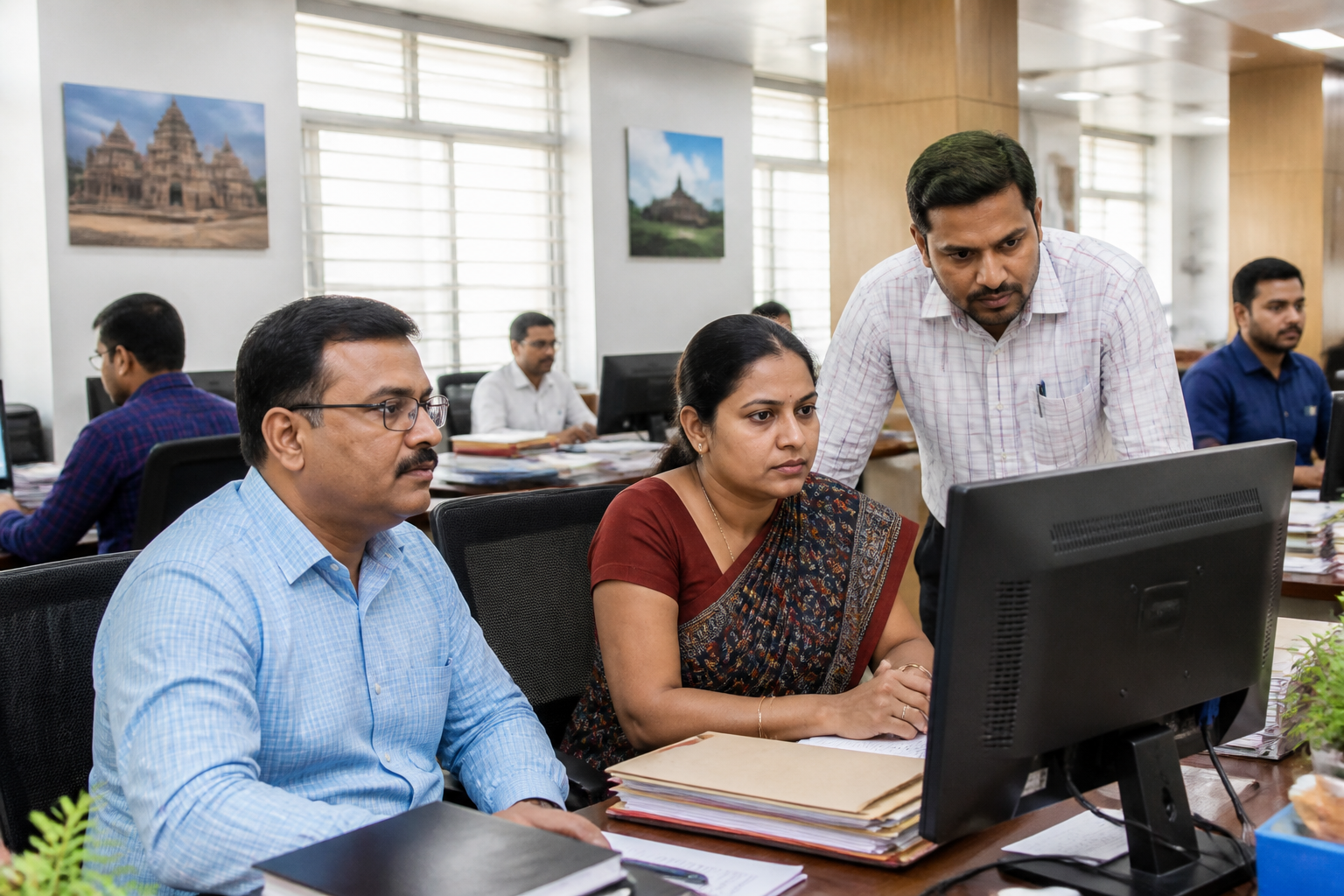
Odisha’s decision to extend its digital governance platform through a ₹122.6-crore contract with Tata Consultancy Services is more than a technology procurement announcement. It marks the next stage in a state administration that has been shifting official work from paper files and manual follow-ups to a common digital workflow for 4,600 government offices and nearly 50,000 users.
TCS has won the bid to implement OSWAS 3.0, the latest phase of the Odisha State Workflow Automation System. The company said the project will extend its partnership with the Government of Odisha by around six years. The upgraded platform will combine workflow automation, system integration, analytics, security and artificial intelligence-enabled capabilities on a common digital foundation.
The immediate event is straightforward: a state government is commissioning an expanded version of a digital system that supports the movement of files, electronic approvals, real-time tracking and access to official records. The larger issue is how such systems change the internal machinery of government, particularly when a platform moves beyond a secretariat and becomes part of administration across directorates, districts and corporations.
Odisha’s digital administration did not begin with OSWAS 3.0. According to the information supplied by TCS, the state’s paperless administration programme began in 2009, when OSWAS 1.0 was introduced to digitise file processing and official correspondence within the Odisha Secretariat. In 2018, OSWAS 2.0 brought a technology refresh, stronger infrastructure and a wider rollout across the state administration.
That sequence matters because it places the latest contract in the context of institutional continuity rather than a standalone technology launch. The system has been developed through successive phases: first digitising files and correspondence, then widening the administrative footprint, and now adding a more modern platform architecture and new user-facing capabilities.
The Government of Odisha describes OSWAS as the digital backbone of its administration. Vishal Kumar Dev, Additional Chief Secretary to the Government in the Electronics and Information Technology Department and chairman of the Odisha Computer Application Centre, said the system had enabled “seamless, transparent, and paperless governance across the state”. He said OSWAS 3.0 would build on that foundation by simplifying routine administration and enabling faster, informed decision-making from anywhere.
Those claims identify the intended administrative gains. Digital file movement can reduce dependence on physical circulation. Electronic approvals can make the status of a file easier to identify than a paper-based process. Real-time tracking can provide visibility into where a matter is within an administrative chain, while electronic records can make documents easier to access than files held in separate offices.
The supplied material does not provide independent performance measurements showing how much processing time has been reduced, how many files are handled digitally, or whether approval delays have fallen since the earlier phases. It therefore establishes the scale and stated purpose of OSWAS, but not a quantified assessment of its outcomes. That distinction is important when evaluating a public-sector technology platform: the existence of digital infrastructure is not, by itself, evidence of improved administrative performance.
The next phase will be built on microservices architecture and is described as secure, scalable and mobile-first. It will also include artificial intelligence-enabled capabilities, Odia language support and integration with government systems. These features suggest that OSWAS 3.0 is intended to move beyond document digitisation and become a more connected operating layer for government work.
The shift from digitised files to an integrated platform changes the nature of the administrative challenge. A basic workflow system can record the movement of a file. A broader platform must also allow different systems, offices and users to work together without losing the integrity or accessibility of official records. The source material identifies integration and security as core components of OSWAS 3.0, but it does not specify which government systems will be connected, how data will be governed or what technical standards will apply.
The same uncertainty applies to the artificial intelligence component. The announcement says the upgraded platform will include AI-enabled capabilities, but it does not detail the tasks that AI will perform, the decisions that will remain with officials or the safeguards that will govern its use. Without those details, the significance of the AI component is best understood as a planned capability rather than a demonstrated administrative outcome.
The public-sector value of a system such as OSWAS depends partly on what happens inside government offices and partly on whether the resulting administration becomes more accessible to citizens. The supplied information focuses on official workflows, approvals, tracking and records. It does not claim that OSWAS 3.0 is a public-facing service portal, nor does it provide evidence about citizen usage or changes in the delivery of specific services.
That boundary is significant. A paperless internal process can improve administrative visibility without automatically improving the citizen’s experience. For residents, the practical effect would depend on how internal digitisation connects to applications, decisions, certificates, payments, grievance systems and other public interfaces. The current announcement establishes the internal governance platform’s intended capabilities, but does not describe those downstream connections in detail.
The institutional structure is clearer. The Odisha Computer Application Centre is collaborating with TCS on the programme, while the state’s Electronics and Information Technology Department is represented in the announcement by its additional chief secretary. TCS is responsible for implementing OSWAS 3.0 under the ₹122.6-crore bid. The contract is expected to extend the company’s partnership with the state by around six years.
This arrangement also illustrates the importance of continuity in government technology. OSWAS has been associated with TCS since its first phase in 2009, according to the supplied material. A long-running relationship can support institutional knowledge and reduce disruption when a platform is upgraded. At the same time, the success of a new phase depends on how clearly responsibilities are defined for implementation, security, maintenance, system integration and user support. The announcement does not provide those contractual details.
The available numbers show the scale of the platform more clearly than its performance. OSWAS supports more than 4,600 government offices and nearly 50,000 users across the state. The system’s history spans at least three identifiable phases: the 2009 introduction of OSWAS 1.0, the 2018 expansion through OSWAS 2.0, and the current OSWAS 3.0 implementation. The ₹122.6-crore bid provides the stated financial value of the latest phase, while the announcement gives no itemised breakdown of costs or implementation milestones.
That combination of duration and reach is what makes the development relevant to the built environment and urban governance agenda. Cities and towns do not function through physical infrastructure alone. Roads, housing, utilities and public facilities are administered through decisions, permissions, records and coordination among public institutions. A digital workflow platform does not replace that physical infrastructure, but it shapes how quickly and transparently the state can manage the administrative systems connected to it.
The Odisha case also demonstrates that digital governance is an incremental institutional process. The state’s programme began with the digitisation of secretariat files, expanded across the wider administration and is now being redesigned around integration, mobility, language access and AI-enabled tools. Each stage addresses a different constraint: paper dependence, limited administrative reach and the need for a more connected platform.
What the supplied evidence confirms is the scale and continuity of Odisha’s digital administration programme, as well as the state’s intention to build a more secure, mobile-first and integrated platform. What remains unestablished is whether OSWAS 3.0 will deliver measurable reductions in processing time, improve citizen-facing services or produce better decisions through its analytics and AI capabilities. Those outcomes will depend on implementation details that have not been disclosed in the announcement.
The next phase of Odisha’s digital governance will therefore be judged not only by whether the new platform is deployed, but by whether its stated capabilities translate into more visible, accountable and accessible administration across the offices it serves.

