


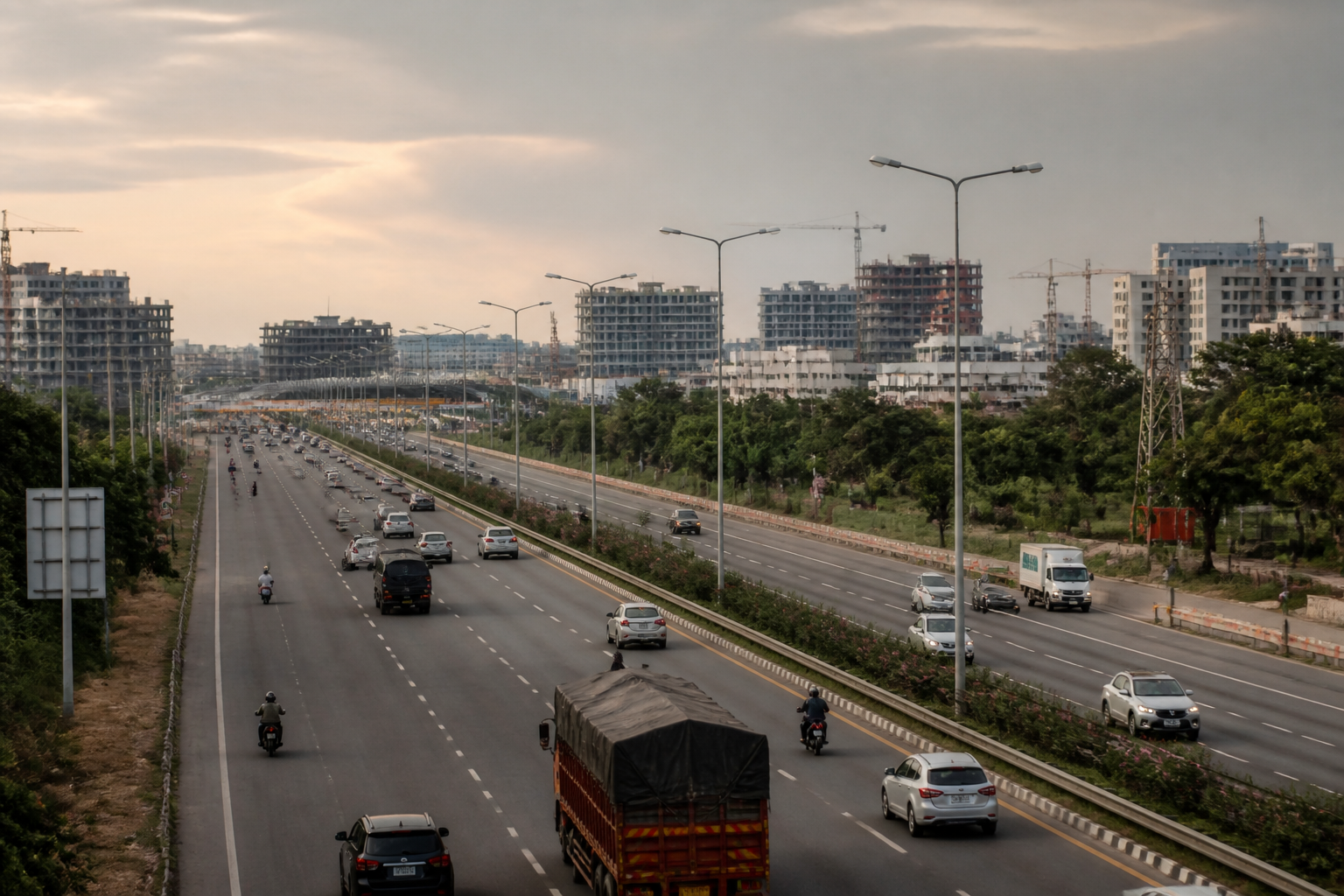
The latest dispute over the NICE project has moved beyond a political allegation about toll collections. It now places three unresolved questions about Bengaluru’s infrastructure system in the foreground: whether the project delivered the assets required under its original agreement, whether land granted for the corridor was used within approved limits, and how the state should respond when a privately operated road remains embedded in the city’s transport network for years.
Union Minister H.D. Kumaraswamy alleged at a press conference that the Bengaluru–Mysuru Infrastructure Corridor, commonly known as the NICE project, had an original cost of ₹1,583 crore but had generated ₹5,586.48 crore through tolls, land sales, joint development advances and convention-centre revenues. He demanded that the Karnataka government take over the project and stop toll collection immediately. The figures and documents cited in the report were presented by Kumaraswamy; the supplied report does not include a response from the NICE company or an independent government audit of the claims.
That qualification is important because the central issue is not simply how much money the project has generated. Infrastructure concessions are structured around a chain of obligations: land is made available, assets are constructed, operations and maintenance are carried out, and the concessionaire recovers its investment through approved revenue streams. The public-interest question is whether those obligations were fulfilled in the sequence and manner specified in the agreement.
According to Kumaraswamy, the original arrangement required the construction of a four-lane concrete road, service roads and lay-bys before the company could collect user fees. He alleged that an incomplete road was opened for use in 2008 and that toll collection began without complying with the relevant conditions. He said the project collected ₹5.59 crore in tolls during 2008 and that annual user-fee revenue had risen to ₹734.92 crore by 2024-25. The total toll collection cited by him was ₹4,756.48 crore.
These figures, if established through the project agreement, audited accounts and official records, would show the scale of the corridor’s financial life. They would not, by themselves, establish that the collections were illegal. That determination would depend on the contractual terms, approvals, construction milestones, tolling permissions, expenditure records and applicable court directions. The report says Kumaraswamy released the project agreement, contracts, company accounts and court orders, but it does not reproduce the documents in full or set out the findings of a fresh official review.
The broader revenue claim includes more than road tolls. Kumaraswamy attributed ₹384 crore to land sales, ₹108 crore to advances from joint development of land and construction projects, and ₹338 crore to convention centres. Together with the toll collections, these figures form the reported total of ₹5,586.48 crore. The breakdown raises a structural issue in public infrastructure concessions: land is not merely a construction input. When public or concession-linked land is used for commercial development, the terms governing that use become as important as the road itself.
Kumaraswamy alleged that land given to the NICE company had been used for purposes other than those permitted under the rules. He also referred to changes in the project alignment made on 12 February 2004 without approval from the state cabinet. According to his account, the land requirement for the peripheral road increased from 2,193 acres to 2,747 acres, while the land requirement for the expressway increased from 6,999 acres to 9,468 acres.
He said the Karnataka High Court, in a judgment delivered on 29 July, had described this change as unlawful. The supplied report does not provide the case number, the exact text of the judgment or the court’s complete reasoning. It therefore establishes that Kumaraswamy made this representation about the judgment, not the full legal position arising from the order. Any decision by the state to resume the project, recover land or alter toll operations would have to account for the operative parts of the court’s ruling and any connected proceedings.
The land question is central because the NICE corridor was planned as more than a standalone road. Its viability depended on a combination of transport infrastructure and land arrangements. That model can reduce the immediate burden on public budgets, but it also creates long-term administrative responsibilities. Government agencies must track whether land is being used for the approved purpose, whether development rights have been transferred or monetised, and whether the public receives the infrastructure and access conditions promised in return.
The dispute also involves environmental and compliance claims. Kumaraswamy said the company had told the Supreme Court during proceedings initiated by Somasekhar Reddy that it would not use lakes under the project. He further claimed that an engineer’s report recorded the destruction of several lakes for road construction. The report does not identify the lakes, reproduce the engineer’s findings or state whether a competent authority has acted on them. These claims therefore require examination against the Supreme Court record, environmental permissions, land-use maps and engineering documentation.
A second strand of the controversy concerns the state’s own earlier reviews. Kumaraswamy referred to a 2016 legislative committee led by T.B. Jayachandra, which he said recommended taking over the NICE project and recovering additional land given to the company. He also said Jayachandra wrote to the state government in August 2023 that the NICE road was no longer necessary because an expressway had already been constructed.
If those recommendations and communications exist in the form described, they point to a problem that extends beyond the company’s conduct: the absence of a clearly communicated state position on an infrastructure asset whose strategic role may have changed. A corridor can remain financially active for its operator while becoming less central to the wider transport network after a parallel expressway opens. That does not automatically end contractual rights or tolling authority, but it does require the government to explain how overlapping roads are being evaluated and how users are affected.
For Bengaluru residents, the immediate issue is the toll paid to use the road. The larger issue is whether the city’s transport system is being governed through transparent, enforceable and periodically reviewed agreements. The NICE project connects road access, land conversion, real-estate development and public authority in one long-running arrangement. Any dispute over one component can affect the others. A decision to stop tolling, for example, could have operational, legal and financial consequences that are not addressed by a political demand alone.
The institutional responsibility is divided. The state government must interpret and enforce the concession and land terms. Transport and infrastructure agencies must verify construction and maintenance obligations. Revenue and land authorities must examine transactions involving granted land. Courts determine the legal validity of contested actions, while legislative committees can review public administration and recommend corrective steps. A credible resolution would therefore require more than a fresh exchange between political leaders: it would need a document-based account of obligations, approvals, collections, land use and compliance.
The numbers cited in the latest report show why the dispute has returned to public attention. The reported annual toll revenue rose from ₹5.59 crore in 2008 to ₹734.92 crore in 2024-25, while cumulative toll collection was placed at ₹4,756.48 crore. But revenue is not the same as profit, and neither is enough to settle whether the project met its contractual obligations. The relevant comparison would include verified construction costs, maintenance expenditure, debt or financing arrangements, approved commercial revenues, the value of land transferred and the duration of the concession.
The evidence currently available establishes that Kumaraswamy has made detailed allegations and presented documents that he says support them. It does not establish, from the supplied material alone, that every collection was unlawful, that all land use breached the agreement or that the state has accepted the demand for takeover. It also does not include the NICE company’s response, a detailed government rebuttal or the complete court and committee records.
The NICE project dispute therefore remains both a legal question and a governance test. The next meaningful development will be whether the Karnataka government orders a formal review, releases the underlying agreements and accounts, responds to the High Court-related claims, and clarifies the status of toll collection and land use. Until then, the competing figures and allegations remain part of an unresolved public infrastructure controversy rather than a settled finding.
